
The Journalist's Dilemma: Navigating the Networked Society Without Losing the Soul of News
Looking for a Place in Social Media Without Getting Trapped in Networks
The paper investigates how traditional and digital media in Spain adapt to the "Networked Society" by establishing a presence on social platforms. It explores strategies used by 30 major media outlets to maintain journalistic relevance while avoiding total dependence on tech giants like Facebook and Google.
TL;DR
As the "Information and Knowledge Society" matures, journalism is undergoing a radical reconfiguration. This study analyzes the digital presence of 30 leading Spanish media outlets, revealing that while being "social" is no longer optional, the strategy varies wildly between press, radio, and TV. The core challenge: reaching the 82% of web users on social media without becoming a mere captive of Silicon Valley's infrastructure.
Background Positioning
This paper serves as a critical snapshot of a transitional era (circa 2015) when initiatives like Facebook Instant Articles and Google AMP were first merging traditional reporting with high-speed social distribution. It frames journalism not just as a content industry, but as a "social communication technique" fighting for space in an ecosystem dominated by algorithms.
The Problem: The Trap of the Platform
The digital scenario is a paradox. On one hand, platforms like Twitter and Facebook have surpassed printed press as the primary news source for users under 44. On the other hand, media houses fear being "trapped" within these networks.
The authors identify a clear tension:
- Obsolescence: Staying outside social networks leads to invisibility.
- Homogenization: Entering them risks losing the "essential elements of journalism" to clickbait and algorithmic whims.
Methodology: Mapping the Spanish Media Landscape
To understand how professionals are responding, the researchers monitored:
- Press: Top 10 newspapers (e.g., El País, Marca).
- Radio: Top 10 broadcasters (e.g., Cadena Ser, RNE).
- Television: Top 10 channels (e.g., Telecinco, Antena3).
They tracked followers, account diversification (using secondary accounts for specific programs), and the adoption of visual-centric "emergent" networks like Instagram and YouTube.
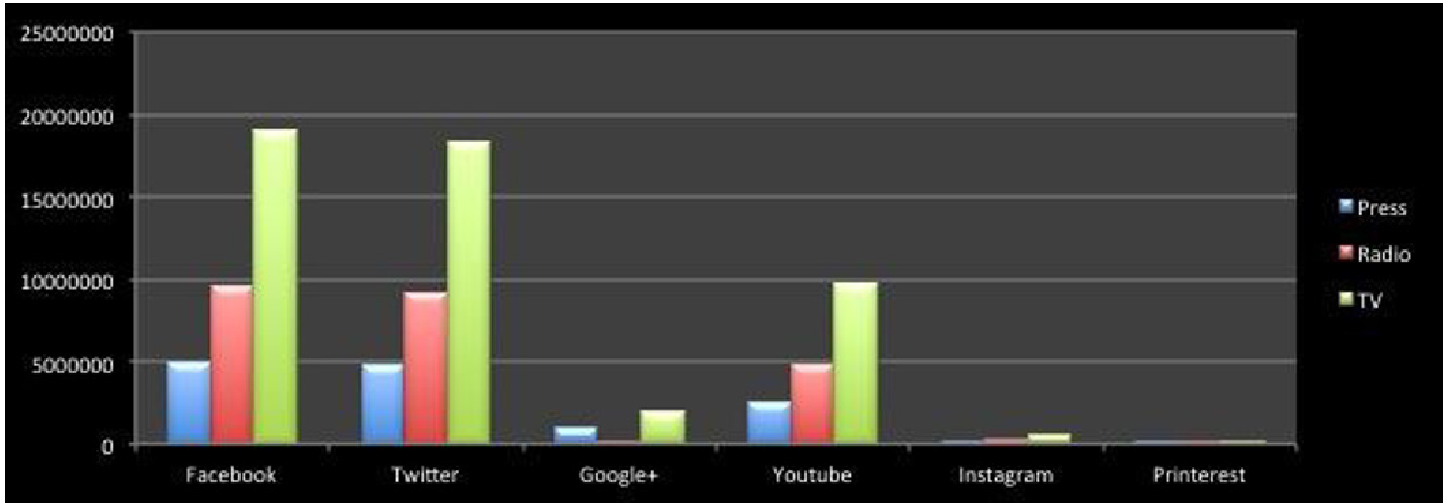 Fig 1: Total volume of followers across the three media types (Press, Radio, TV).
Key Findings: The Visual Gap
The data reveals a significant divergence in how different media utilize the "Social Space":
- Facebook is the Mass Ruler: With over 33 million engagements across the sample, it is the primary engine for audience flow for Press and TV.
- The Radio/Twitter Alliance: Unlike other media, Radio found its home on Twitter. The real-time nature of microblogging aligns with the "live" essence of radio. However, Radio units were found to be "resistant" to visual trends, largely ignoring Instagram and YouTube.
- Strategy Diversity: Larger brands like El País or Cadena Ser use a "diversification" strategy, spawning over 50-100 secondary Twitter accounts to target niche interests, whereas smaller brands opt for "concentration" around a single flagship profile.
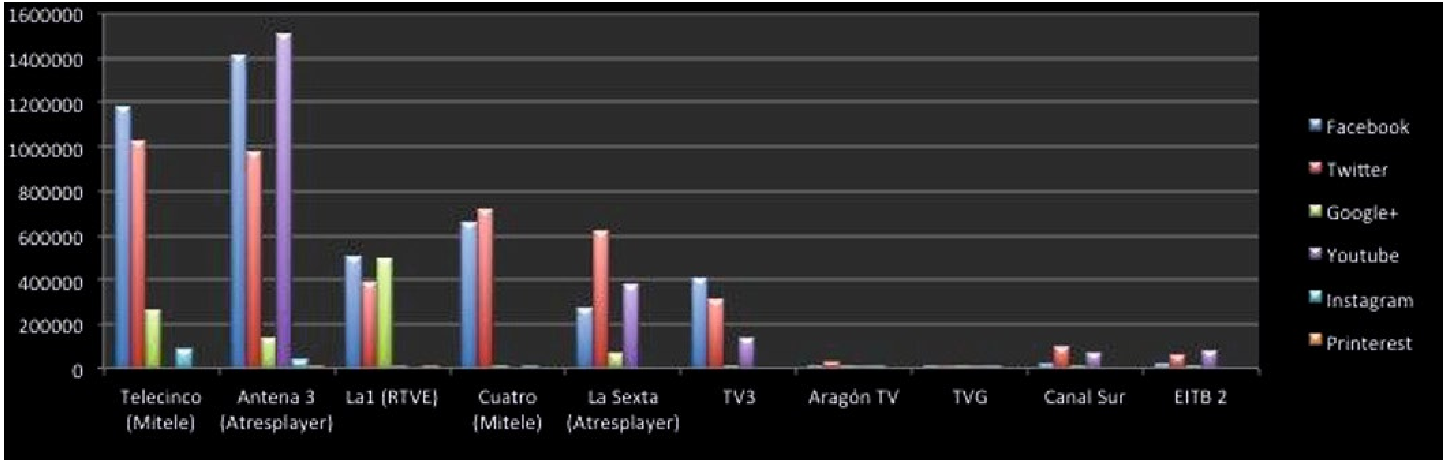 Table 3: TV channels show the highest engagement levels, leveraging video-friendly environments.
Methodology Insights: From Live Feeds to "Slow Journalism"
The paper suggests that the path forward isn't just about speed. While media must provide "live news" to survive the feed, there is an equal and opposite movement toward Slow Journalism.
The authors argue that the future depends on:
- Multimedia Integration: Using every technical dimension (interactivity, documentation, mobility).
- High-Quality Non-Fiction: Telling "good stories" remains the core value proposition that distinguishes professional journalism from amateur social media posts.
Critical Analysis & Future Outlook
The study highlights that while the Spanish media was quick to adopt Facebook and Twitter, it was slow to master the visual "grammar" of networks like Instagram (which only had ~976k followers across the sample at the time).
Limitations: The paper focuses on quantity (follower counts) rather than the qualitative impact of engagement or the conversion of social followers into paid subscribers—the "Holy Grail" of modern digital journalism.
Takeaway for 2026: Looking back, the "shy partnership agreements" mentioned by the authors became the dominant (and often predatory) relationship between platforms and publishers. The survival of journalism now depends on its ability to use these "windows" in social media to pull users back into independent, owned ecosystems.