
Digital Duel: How Trump and Biden Built Parallel Realities on Twitter in 2020
Social Media in Politic: Political Campaign on United States Election 2020 Between Donald Trump and Joe Biden
This research provides a comparative analysis of Twitter campaign strategies used by Donald Trump and Joe Biden during the 2020 US Presidential Election. Utilizing Qualitative Data Software Analysis (QDSA) with NVivo 12 Plus, the study identifies distinct thematic disparities and sentiment patterns, highlighting Biden's focus on social/health issues versus Trump's focus on electoral processes.
TL;DR
In the shadow of a global pandemic, the 2020 US Election became the most "online" political event in history. This research analyzes how Joe Biden and Donald Trump utilized Twitter as their primary battlefield. By processing thousands of tweets through NVivo analysis, the study reveals two fundamentally different strategies: Biden’s broad, issue-based inclusivity versus Trump’s focused, high-intensity rhetoric on electoral processes.
Background Positioning
While social media has been a factor since Obama's 2008 run, the 2020 election represents a critical shift where digital platforms moved from supplementary tools to the primary arena for political deliberation due to COVID-19 lockdowns. This paper serves as a post-election autopsy, utilizing Qualitative Data Software Analysis (QDSA) to map the thematic DNA of both campaigns.
Problem & Motivation: The Pandemic Pivot
The core challenge for the 2020 candidates was maintaining "social presence" without physical proximity. Traditional methods like rallies were high-risk, forcing a total reliance on Web 2.0 technologies. The researchers aimed to understand if Twitter was merely a megaphone or a nuanced tool for addressing specific societal pain points, such as racial justice and public health.
Methodology: Decoding the Feed
The authors utilized NVivo 12 Plus, a sophisticated tool for qualitative content analysis. By pulling data via NCapture, they processed a significant dataset:
- Donald Trump (@realDonaldTrump): 1,992 tweets and 1,225 retweets.
- Joe Biden (@JoeBiden): 3,008 tweets and 209 retweets.
The "Instructional" core of their method involved automatic coding, where the software identifies recurring clusters of words to define "Themes."

Experiments & Results: A War of Themes
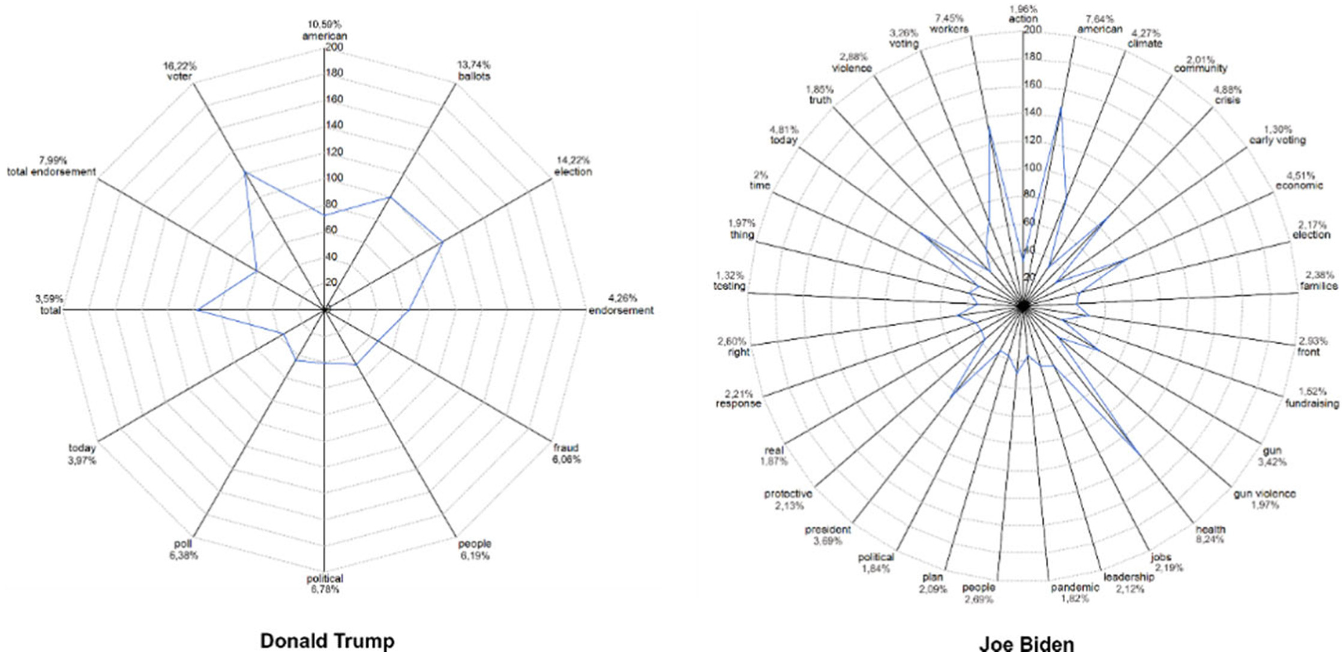
The findings highlight a stark contrast in "Thematic Breadth." Joe Biden’s account generated 33 unique themes, suggesting a diverse policy-oriented approach. In contrast, Donald Trump’s account focused on only 12 themes, indicating a highly targeted message.
1. Thematic Focus
- Trump's Top Themes: Voters (16.22%), Election (14.22%), and Ballots (13.74%). His strategy was centered on the process and mechanics of the election.
- Biden's Top Themes: Health (8.24%), American (7.64%), and Workers (7.45%). His strategy focused on societal impact and the pandemic.
2. The Racial Divide
The study found a complete absence of "Race Issues" in Trump’s hashtag usage. Biden, however, integrated racial discourse via hashtags such as #NationalBlackVoterDay and #BlackHistoryMonth.
3. Sentiment Polarity
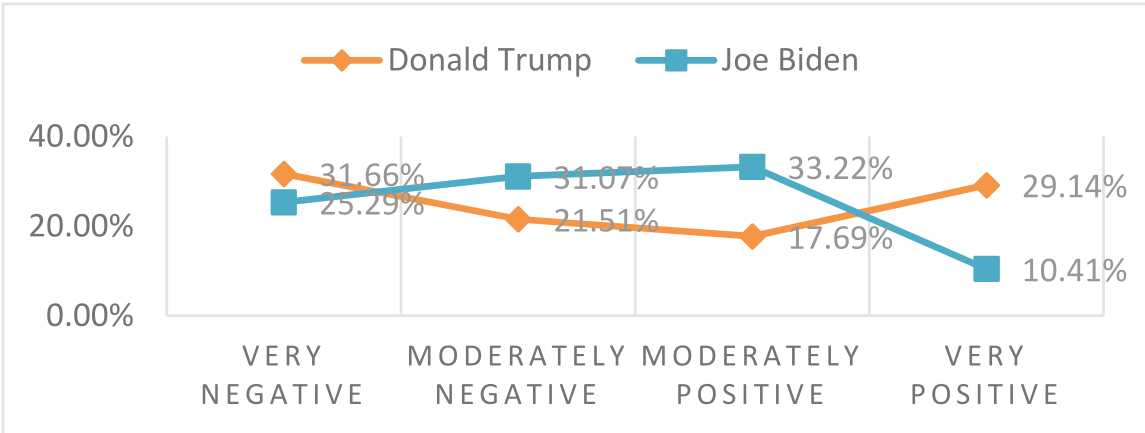
The sentiment analysis (Fig. 3) reveals a psychological contrast:
- Trump: Oscillated between "Very Negative" (31.66%) and "Very Positive" (29.14%). This "all-or-nothing" sentiment is characteristic of populist "de-professionalized" campaigning.
- Biden: Favored "Quite Positive" (33.22%) and "Quite Negative" (31.07%) tones, indicating a more measured, traditional political persona.
Critical Analysis & Conclusion
Takeaway
The research confirms that Twitter is not just a tool for information dissemination but a medium for Identity Construction. Trump used it to challenge the electoral system, while Biden used it to build a coalition around policy and racial inclusivity.
Limitations
A notable limitation of the study is its reliance on Automatic Coding. While efficient for large datasets, automated sentiment analysis can sometimes miss the nuance of political sarcasm or cultural subtext that a human coder might catch. Furthermore, the data was collected shortly after the election; an analysis of the "long-tail" effect of these tweets on public perception would be valuable.
Future Outlook
As we move toward 2026 and beyond, the "Trump Model" of high-polarity sentiment and "Biden Model" of broad thematic inclusivity will likely evolve. The integration of AI-generated content in social media campaigns will be the next frontier for researchers using QDSA methods.