
Leveraging Social Media to Warm Up the Recommendation Cold Start
Using Social Media Presence for Alleviating Cold Start Problems in Privacy Protection
This paper proposes a social-media-driven recommendation approach to alleviate the "Cold Start" problem in e-commerce. By leveraging public Twitter data, the method extracts user interests using a Bag-of-Words (BoW) strategy and TF-IDF similarity to generate Top-N movie recommendations without requiring prior interaction history.
TL;DR
The "Cold Start" problem is the Achilles' heel of modern recommender systems. This paper introduces a framework that bypasses the need for initial user-item interactions by mining public Twitter data. By analyzing the semantic similarity between a user's tweets and movie plotlines, the system can predict preferences with high accuracy—achieving over 75% accuracy for nearly three-quarters of the tested user base.
Problem & Motivation: The Data Sparsity Wall
Recommender systems generally rely on Collaborative Filtering (CF), which finds "similar users" to make suggestions. However, for a new user, the system is a blank slate (the Cold Start).
Current workarounds often fail because:
- User Friction: Explicitly asking users to rank preferences is cumbersome and leads to drop-offs.
- Privacy Guarding: Users are increasingly hesitant to provide detailed personal information to new e-commerce platforms.
- Data Lag: Interests change faster than interaction logs can capture.
The authors' insight is grounded in a social reality: users are far more willing to share their opinions and interests spontaneously on social media (like Twitter) than to fill out a static form on a shopping site.
Methodology: Mapping Tweets to Genres
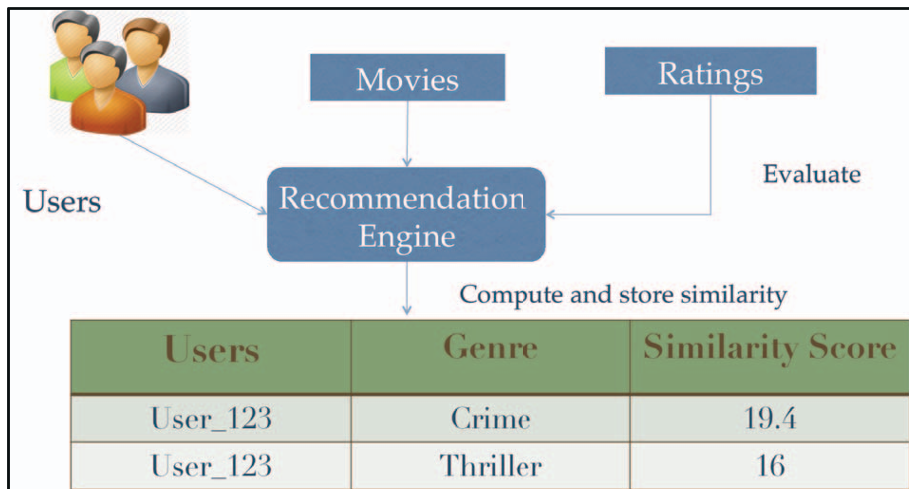
The core of the proposed solution is a semantic bridge between social media activity and product metadata.
1. The Bag-of-Words (BoW) Strategy
The system represents both Twitter posts () and movie plots () as vectors of word frequencies. It uses TF-IDF (Term Frequency-Inverse Document Frequency) to determine the importance of specific words, ensuring that "gibberish" or common stopwords don't skew the results.
2. Similarity Computation
To find the link between a user and a movie genre, the system calculates the Cosine Similarity between tweet vectors and movie synopsis vectors:
If the similarity score exceeds a threshold (0.5), the genres associated with that movie are added to the user’s "Preferred List."
Experiments & Results: High Precision for New Users
The researchers tested their approach using the MovieTweetings dataset—a real-world corpus of movie ratings shared via Twitter.
Key Findings:
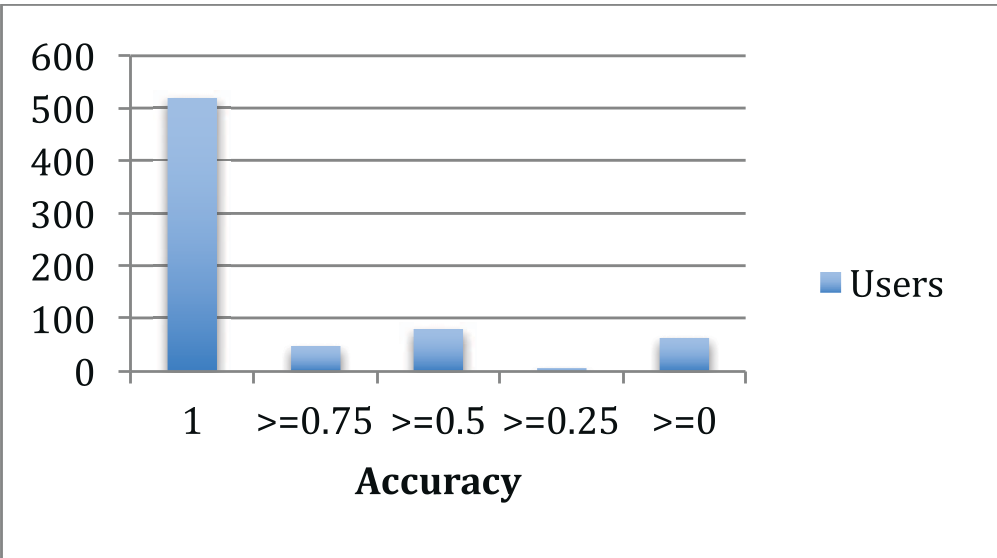
- Accuracy Peaks: In a cohort of 771 users, a staggering 72.67% received 100% accurate recommendations (where "accuracy" is defined by matching high ratings with high-interest genres).
- Scalability: When expanded to over 3,500 users and 50,000 movies, the system maintained high performance, with 72% of users seeing at least 75% accuracy.
- Precision: The overall precision of the algorithm was calculated at 0.86, indicating highly relevant suggestions even with zero traditional "warming" of the account.
Critical Analysis & Conclusion
Takeaway
The paper successfully demonstrates that personal interests are "leaked" through public social discourse in a way that is structured enough for machine learning to ingest. This effectively bridges the gap from a Cold Start to a Warm Start without requiring user-provided labels.
Limitations
- Text Quality: The system relies heavily on the quality of movie synopses. If a plotline is poorly written, the TF-IDF matching will fail.
- Twitter Dependence: The method assumes a user has a public social presence that is active enough to generate a representative vector.
- Feature Depth: While BoW/TF-IDF is efficient, it misses the nuanced "sentiment" and "context" that modern Large Language Models (LLMs) could provide.
Future Work
The authors suggest that this engine could be generalized beyond movies to any e-commerce category (books, electronics, fashion) as long as product descriptions are available to be mapped against the user's "social concept" profile.