
Social Media as the New Social Capital: Architecting Informal Knowledge Sharing
Social Media, Social Capital, and Knowledge Sharing in Enterprise
This study investigates the impact of social media on informal knowledge sharing (KS) within enterprises through the lens of social capital. By analyzing data from 58 consultants across 17 firms, it identifies how platforms like LinkedIn, Twitter, and internal SNS transform tie strength and bridge structural holes to enhance organizational intelligence.
TL;DR
In the modern enterprise, 90% of knowledge sharing happens in the "white space" between formal processes. This paper explores how social media (Facebook, Twitter, LinkedIn, and internal SNS) acts as a digital catalyst for Social Capital, allowing workers to bridge organizational silos, locate experts instantly, and transform casual connections into high-trust professional relationships.
Problem & Motivation: The Failure of "Formal" Knowledge
For decades, corporations invested in heavy-duty Knowledge Management (KM) systems—databases meant to store "what the company knows." However, these systems often became "knowledge graveyards."
The author argues that true knowledge is tacit and context-specific. Traditional systems fail because:
- Decontextualization: They strip away the "story" behind the data.
- Structural Holes: Knowledge is trapped in silos (functional units or geographical locations).
- The "Invisible" Work: Most learning is informal. As Lew Platt (former CEO of HP) famously said, "If only HP knew what HP knows, we’d be three times more productive."
Methodology: The Social Capital Lens
The study interviewed 58 consultants from 17 management consulting firms—environments where knowledge is the primary product. The researcher used the Social Capital Perspective to evaluate how digital tools affect our professional networks.
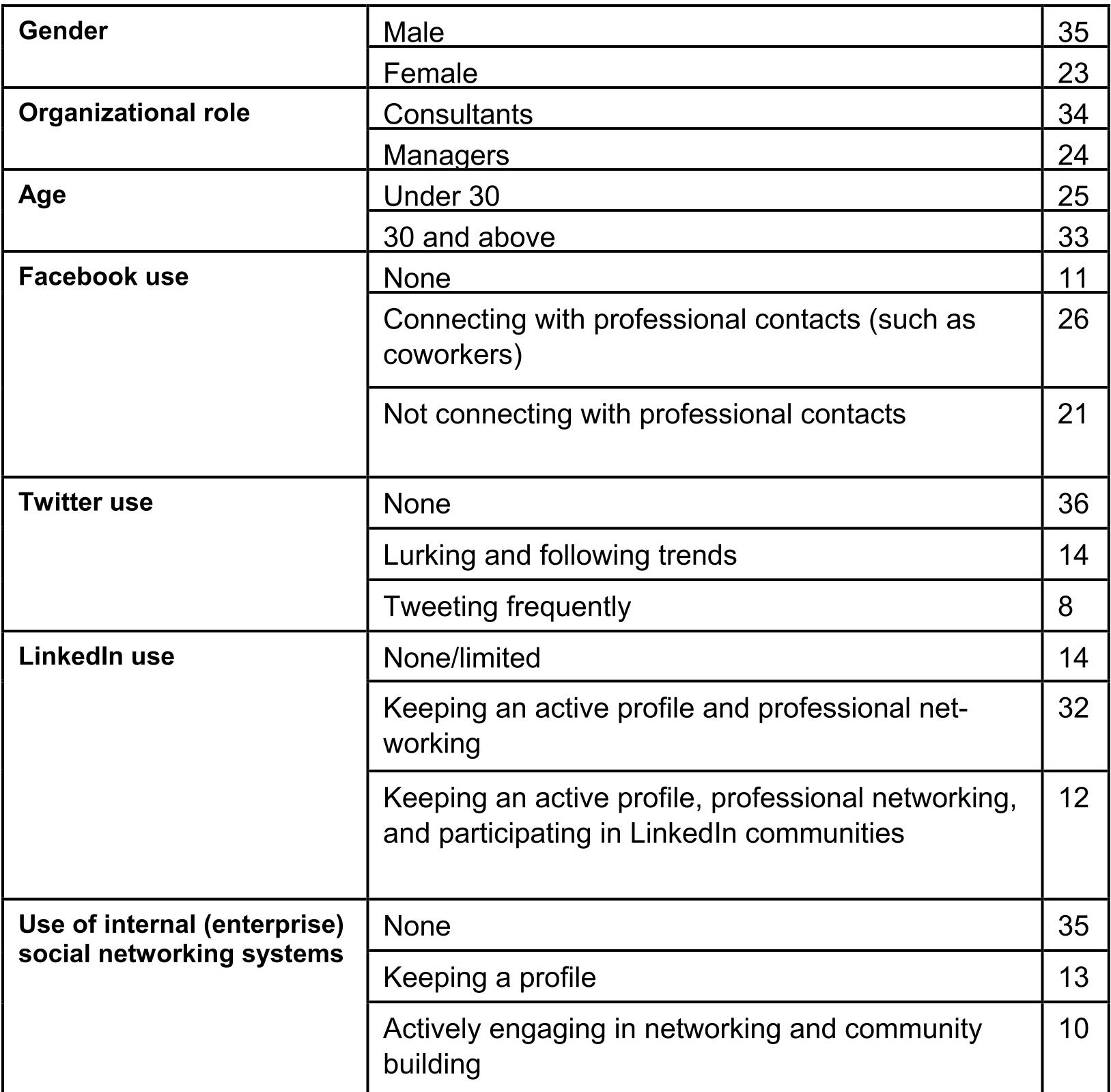
1. Strengthening the "Strong Ties" (Bonding Capital)
Strong ties are close-knit relationships (coworkers, mentors). Social media, particularly Facebook and Internal SNS, allows for "social awareness." Use cases include:
- Maintaining rapport after a project ends.
- "Friending" coworkers to share personal updates (e.g., family photos), which facilitates smoother "casual connections" in high-stress work environments.
2. Leveraging "Weak Ties" (Bridging Capital)
Weak ties are acquaintances or "friends of friends." They are crucial for Expert Locating.
- Twitter: Used by "digital natives" to broadcast problems to a wide audience. A simple tweet like "Has anyone implemented Hadoop? I'm stuck" can trigger a solution from someone outside the immediate team.
- LinkedIn: Acts as a living CV. Consulting firms now send LinkedIn profiles to customers instead of Word docs, creating immediate transparency and trust.
Key Results: Tools and Their Utility
The research synthesized the utility of various tools into a framework for digital transformation.
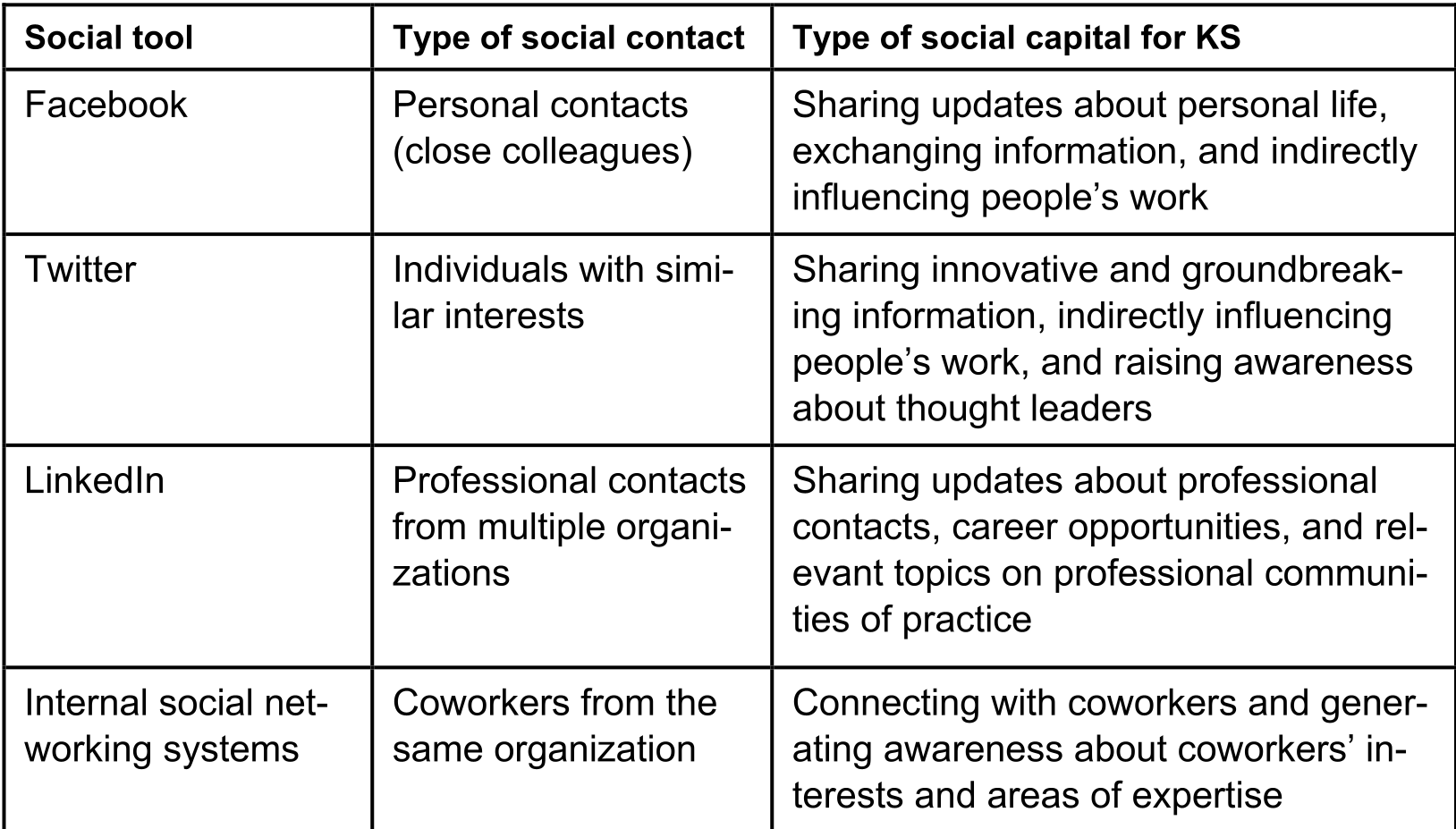
Key Findings:
- Boundary Spanning: Social media users act as "boundary spanners," filling structural holes by linking unconnected groups.
- Innovation: Users with diverse Twitter networks were found to generate more innovative ideas for the enterprise.
- The Generational Shift: "Digital natives" view social media as a primary work tool, often finding public tools more effective than internal corporate alternatives.
Critical Insight: The Digital Transformation of the Workplace
The most profound takeaway is that Digital Transformation is not just about installing software; it’s about a sociotechnical shift.
- Individual vs. Organization: Social capital initially accrues to the individual, but when that individual uses their network to solve a corporate problem, it becomes organizational capital.
- Privacy Paradigms: The study found that consultants in sensitive areas (Mergers & Acquisitions) must navigate geotagging risks, showing that social media use is governed by professional norms, not just technical features.
- The New "Expertise": Expertise is no longer just what you know, but how effectively you can navigate your social network to find the person who knows.
Conclusion
This study serves as a wake-up call for organizational leaders. To foster a truly "knowledge-sharing" culture, companies must stop viewing social media as a distraction and start seeing it as the infrastructure of modern social capital. The goal is no longer to "capture" knowledge in a database, but to facilitate the social ties that allow knowledge to flow freely.