
Social Media Steganography: The Invisible Arms Race in Plain Sight
Social Media and Steganography: Use, Risks and Current Status
This paper provides a comprehensive review of digital steganography applied within Online Social Networks (OSNs) like Facebook, Twitter, and WhatsApp. It evaluates various data-hiding techniques, performance metrics such as Shannon Entropy and PSNR, and discusses the dual-natured impact of these technologies on global communication security.
Executive Summary
TL;DR: This research explores how Online Social Networks (OSNs) have evolved into the ultimate "Covert Channels" for data hiding. By analyzing Facebook, Twitter, and WhatsApp, the authors demonstrate that while steganography protects privacy, it is increasingly exploited by cyber-criminals and terrorists. The paper shifts focus from simple "what is steganography" to a deeper analysis of "how it survives" the hostile processing environments of modern social platforms.
Background: Positioned as a comprehensive survey and methodological roadmap, this work bridges the gap between classical information hiding and the modern era of high-volume social data.
Problem & Motivation: Why Social Media?
The digital era has created a paradox: we produce so much data that we've become blind to it. Attackers exploit this unattended data volume. Traditionally, steganography used TCP/IP headers or local file systems. Today, the motivation is Undetectability through Ubiquity.
However, social media platforms are not "passive" carriers. They actively manipulate data:
- Facebook re-samples photos, killing simple LSB (Least Significant Bit) hidden data.
- Twitter enforces strict character limits, requiring sophisticated linguistic transformations.
- WhatsApp provides end-to-end encryption but remains vulnerable to steganographic payloads hiding within innocent-looking media.
Methodology: The Core of Data Hiding
The authors detail several platform-specific approaches:
1. Facebook: Word Shift & Extended Lines
For text-based communication, the "Extended Line" method inserts extra white spaces or alters line lengths based on a binary stream. For example, if a bit is '1', an additional space is added between words.
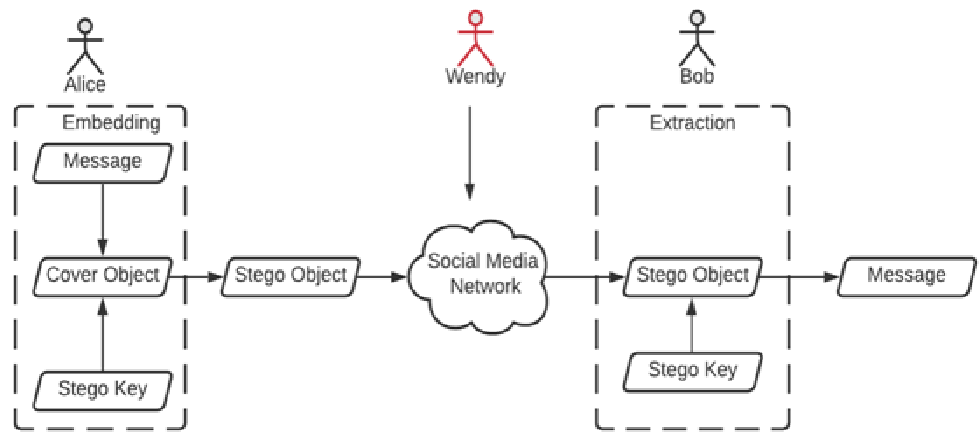 Figure 1: The standard workflow of embedding secrets into OSN carrier files.
2. Twitter: Linguistic Paraphrasing
Twitter requires "Cover Tweets." Using a Paraphrase Database (PPDB) containing millions of lexical transformations, researchers can tokenize a tweet and replace words with synonyms that correspond to specific bit codes. This makes the message look like a natural, human-written tweet.
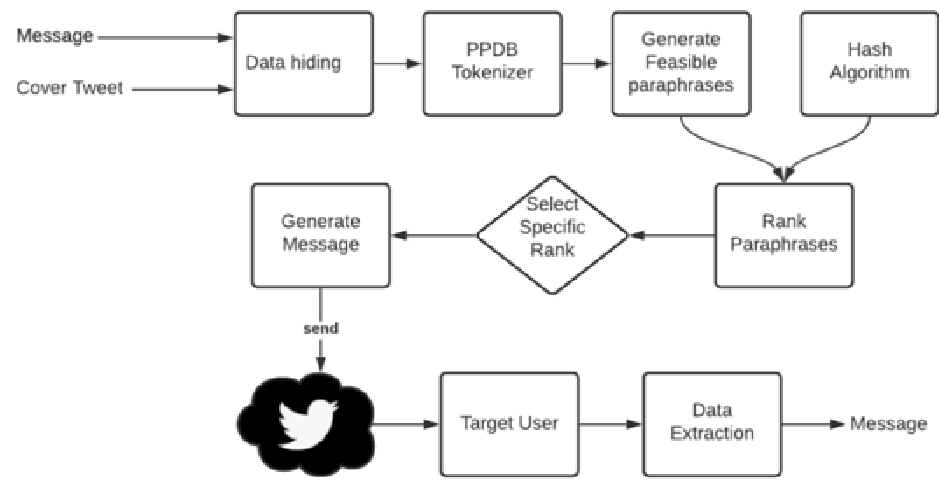 Figure 2: The pipeline for generating steganographic tweets using NLP tools.
3. Mathematical Evaluation: Shannon Entropy
How do we detect these "invisible" messages? The authors propose Shannon Entropy (). High entropy indicates high randomness (noise), which often signals that a file has been tampered with. By comparing the entropy of a standard sentence (4.02) vs. a stego-text (4.09), analysts can mathematically flag suspicious content even if it "looks" normal to the human eye.
Experiments & Results
The paper highlights a critical "Stego-Friendly" hierarchy:
- Google+ & Twitter: Top tier. They preserve image dignity, allowing methods like LSB to work effectively.
- Facebook & Flickr: Hostile environments. Standard LSB tools often fail because these sites manipulate DCT (Discrete Cosine Transform) coefficients or pixels during upload.
- Tool Performance: YASS (Yet Another Steganographic Scheme) was found to be more resilient on Facebook compared to mainstream tools like GhostHost or F5.
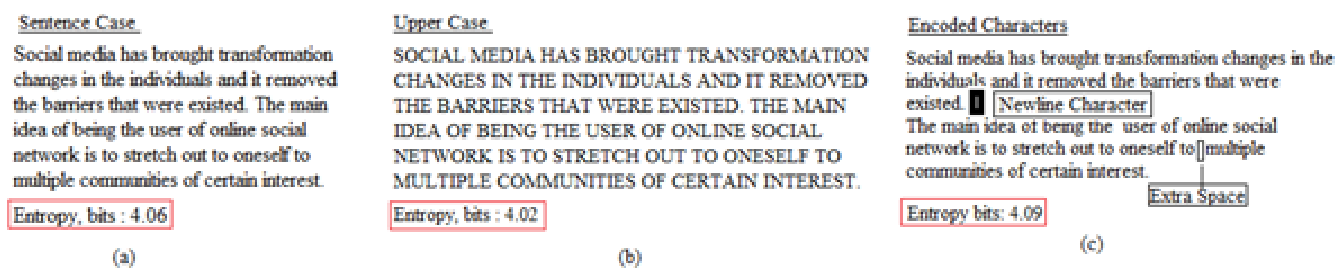 Figure 3: Comparison of entropy values across different text formatting and embedding algorithms.
Critical Analysis & Conclusion
The Dark Side
The paper warns of "StegBots"—malicious social bots that communicate stolen passwords and C2 commands through profile pictures or innocuous status updates. This is no longer a human-to-human threat but an automated software-driven arms race.
Limitations & Future Work
The primary weakness of current methods (Word Shift/Line Shift) is their sensitivity to OCR (Optical Character Recognition) and automated scanners. If a social platform normalizes text spacing, the secret is lost.
The Takeaway: The industry is moving toward Generative Neural Networks. Instead of "hiding" a message in an existing image, future AI will generate a completely new, unique image where the message is woven into the very logic of the pixel distribution. As we head toward Web 3.0, the battle for information privacy vs. radical transparency via steganalysis will only intensify.