
Invisible Threads: Decoding the Role of Steganography in Modern Social Media
Social Media and Steganography: Use, Risks and Current Status
This paper provides a comprehensive review of digital steganography applied to Online Social Networks (OSNs) like Facebook, Twitter, and WhatsApp. It analyzes methodologies for embedding data in social media traffic and explores the dual-use nature of these techniques for both privacy protection and illicit activities.
TL;DR
Steganography—the ancient art of hiding messages in plain sight—has found a fertile new breeding ground: Online Social Networks (OSNs). This paper surveys how platforms like Facebook, Twitter, and WhatsApp are exploited as covert channels. By leveraging massive data flows and varied embedding techniques (from word-shifting to DCT manipulation), users can hide sensitive or illicit data within seemingly innocent posts.
The Motivation: Why Social Media?
The digital era has transitioned from TCP/IP covert channels to the vast, noisy landscape of social media. The authors point out a critical psychological vulnerability: Inattentional Blindness. Most users ignore the sheer volume of "unimportant" data on their feeds, providing the perfect cover for hidden messages. However, this convenience comes with a cost—social media platforms often compress or "clean" uploaded files, which can inadvertently destroy hidden data.
Methodology: Hiding Data in the "Social" Noise
The paper breaks down steganography into two primary domains on OSNs: Textual and Visual.
1. Textual Steganography (Facebook & Twitter)
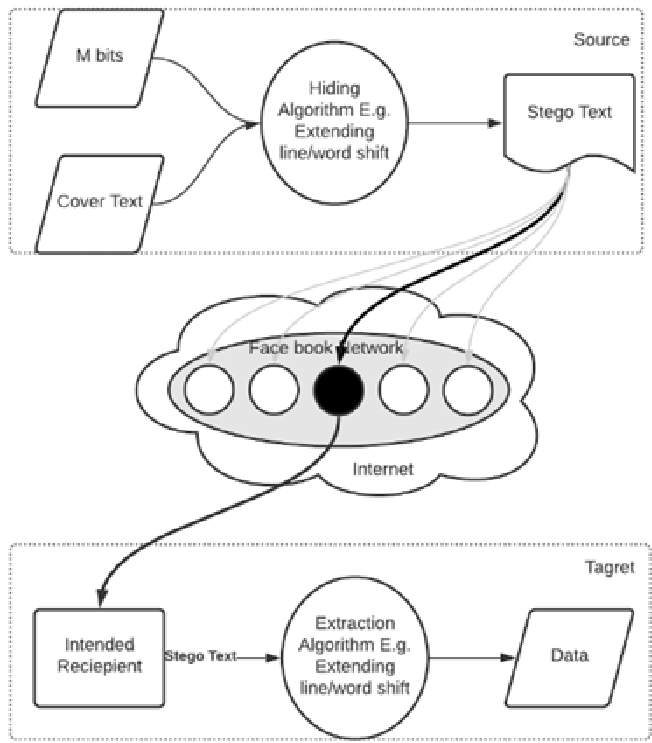
For platforms dominated by text, the authors showcase the Word Shift/Extended Line algorithm. By subtly altering the spacing between words or extending line lengths, binary bits (like "NTUEE") are encoded into a paragraph.
- The Insight: If the first bit is 1, an extra whitespace is added; if 0, nothing changes.
- The Flaw: These methods are vulnerable to OCR and simple text-formatting tools that strip extra spaces.
2. Visual Steganography (Instagram & WhatsApp)
Since imagery is the language of social media, hiding data in pixels is highly effective. However, the study finds a hierarchy of platform "friendliness":
- Stego-friendly: Google+ and Twitter (preserving more pixel data).
- Stego-hostile: Facebook and Flickr (due to aggressive resampling).
The Mathematical Filter: Shannon Entropy
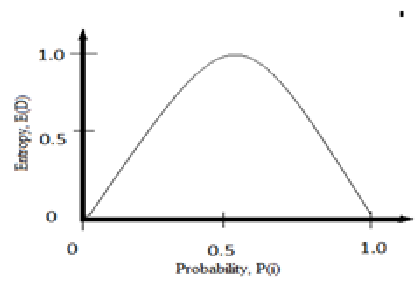
How do we detect these hidden messages? The authors advocate for the use of Shannon Entropy. Entropy measures the randomness of information. When a secret is embedded, the distribution of symbols (or colors) shifts. A "noisy" paragraph with hidden bits will show a higher entropy value (e.g., 4.09) compared to standard sentence-case text (4.06). This subtle delta is the "smoking gun" for steganalysts.
Evaluation: The Security Triad
A steganographic system is only as good as its balance of three features:
- Undetectability: Measured often by PSNR (Peak Signal to Noise Ratio). Higher PSNR means the "Stego-image" is indistinguishable from the original.
- Robustness: The ability of the secret to survive compression or resizing.
- Payload Capacity: How much data can you hide before the image starts looking "garbage-y"? (Inverse to PSNR).
The Dual-Use Dilemma
The paper concludes with a stark reminder of the "Dark Side." While steganography facilitates private communication in oppressive regimes, it is also documented in malicious activities:
- Vawtrak & zbot: Viruses that hide configuration URLs or stolen financial data inside JPEG files distributed via social networks.
- Terrorism: Instances where groups like Al-Qaeda allegedly used pornographic videos or online images to hide terror plans.
Future Outlook
The authors suggest that we are moving toward Generative Steganography—using neural networks to create innocent-looking content from scratch that inherently contains the message, rather than modifying existing files. This would bypass structural detection methods like OCR or entropy analysis. As we approach Web 3.0, the battle between "Hidden Writing" and "Steganalysis" will only intensify within the noise of our daily feeds.