
Beyond Surveys: Leveraging Social Metrics for E-Learning Evaluation
A Social Metric Approach to E-Learning Evaluation in Education
The paper introduces a novel approach for evaluating e-learning effectiveness by integrating social metrics with traditional assessment methods. It identifies specific Critical Success Factors (CSFs) and Key Performance Indicators (KPIs) and utilizes Sentiment Analysis on students' social media interactions to capture spontaneous feedback.
TL;DR
This paper addresses the limitations of traditional e-learning assessment by proposing a social metric approach. Instead of relying solely on questionnaires, the authors suggest mining students' spontaneous discussions on social platforms. By defining 16 KPIs and using Sentiment Analysis, they provide a framework to turn unstructured social "chatter" into professional quality assessments.
Background & Motivation: The "Spontaneity Gap"
Evaluating e-learning has historically been a clinical process. Universities use questionnaires or track "clicks" and "logins." However, the authors argue that these methods miss the "real perception" of students.
Why? Because students often find surveys time-consuming or succumb to "guessing" biases. In contrast, on blogs and internal social networks, students express opinions spontaneously. The core insight of this paper is that this "Social Metadata" is a goldmine for understanding if an e-learning system is actually successful.
Methodology: The CSF-KPI-Sentiment Framework
The researchers developed a four-step methodology to bridge the gap between social media posts and academic evaluation:
- CSF Identification: Grouping success factors into five pillars: IT, Human Factor, Instructional Design, Cost Effectiveness, and Course Evaluation.
- KPI Definition: Mapping these areas to specific indicators using the "Indicator Triangle" method (Service, Quality, Efficiency).
- Social Metric Selection: Filtering which KPIs can be measured via text (e.g., "User-friendliness") versus those requiring classic metrics (e.g., "Access time").
- Sentiment Mapping: Assigning keywords (Neutral, Positive, Negative) to each KPI to facilitate automated analysis.
The Technical Architecture
The system relies on an e-learning ontology—a knowledge map that allows the software to recognize that a student typing "the interface is intuitive" is actually providing a high quality score for KPI 2: Quality of service accessibility.
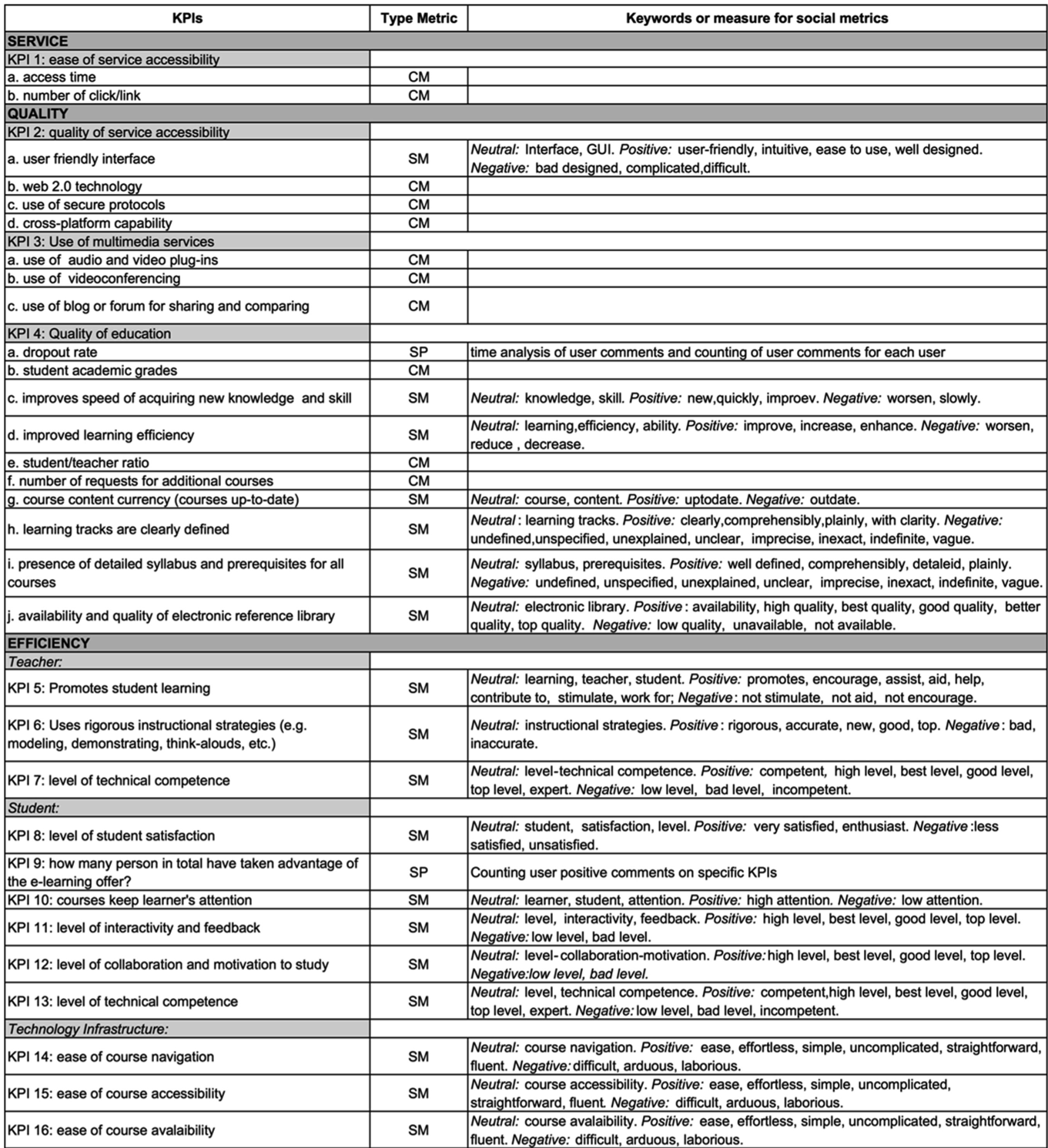 Table 1: The mapping of KPIs to Social Metrics and Sentiment Keywords.
The backend utilizes AlchemyAPI, which combines linguistic (grammatical) analysis with statistical (mathematical) analysis to ensure high accuracy even in informal, student-generated text.
Key Results and Insights
The paper categorizes metrics into three types:
- Classic Metrics (CM): Quantitative data (e.g., students/teacher ratio).
- Statistical Parameters (SP): Derived from frequency (e.g., dropout rates inferred from the disappearance of user comments).
- Social Metrics (SM): Qualitative sentiment (e.g., "level of technical competence").
By using a Tag Cloud visualization, the platform allows educators to see at a glance which aspects of the course are hitting the mark (green) and which are causing frustration (red). For example, if "Syllabus" appears large and red, it immediately identifies a specific failure in Instructional Design.
Critical Analysis & Conclusion
Takeaway
The integration of social software into e-learning transforms the evaluation process from a "delayed reporting" model to a "real-time monitoring" model. It acknowledges that in the Web 2.0 era, the most honest feedback happens outside the formal survey.
Limitations
- Language Barrier: The authors admit Sentiment Analysis currently performs significantly better in English than in other languages.
- Privacy and Ethics: Using students' "spontaneous thoughts" for evaluation raises questions about data privacy and the potential for students to self-censor if they know they are being monitored.
Future Work
The team is moving toward a real-world validation involving 80 students in an "Information Systems" course. This will provide the necessary quantitative proof to see if social metrics truly correlate with academic performance and long-term learning outcomes.