
Social Mix: Bridging Social Trends and Seamless Audio Mixing
Social mix: automatic music recommendation and mixing scheme based on social network analysis
The paper introduces Social Mix, an automated system that leverages Social Network Analysis (SNA) from Twitter to provide real-time music recommendations. Key contributions include a dual-path recommendation engine and a signal-based automatic mixing module that generates seamless "DJ-style" mixtapes.
TL;DR
Social Mix is a comprehensive framework that transforms the chaotic stream of Twitter into a curated, professional-grade music experience. By analyzing real-time social data, it identifies what’s "trending" (Bursty) versus "classic" (Steady) in specific regions, recommends songs personalized to the user's social circle, and then uses audio signal processing to mix these tracks into a continuous, beat-matched mixtape.
Problem & Motivation: Beyond the Static Playlist
Most of us are familiar with the "random shuffle" or sequential playback of Spotify or Apple Music. However, these lists often feel disconnected from the "now." The authors identify two major gaps in the status quo:
- Context Blindness: Existing systems fail to capture geographical and temporal shifts—what is popular in Seoul at 9 PM on a Friday is very different from what is trending in London on a Tuesday morning.
- The "Gap" Problem: Traditional recommendation ends at the selection of songs. The experience of listening is still interrupted by silence between tracks, unlike the fluid transitions of a radio DJ or a nightclub set.
Methodology: The Core Engine
The "Social Mix" architecture is divided into two phases: Social Extraction and Audio Synthesis.
1. Real-time Social Filtering
The system monitors Twitter via Streaming and REST APIs. It filters for specific "clues" like #nowplaying or #np. To handle the noise (URLs, mentions, slang), it uses a multi-stage validation process:
- Pattern Matching: Identifying strings like "Song Title by Artist."
- Database Validation: Cross-referencing extracted strings against the Musicbrainz database to ensure they are valid musical entities.
2. The Relationship Graph
For personalized discovery, the system builds a graph where nodes are songs and edges are weights derived from user co-occurrence. If User A tweets about Song X and Song Y, a link is formed. By adjusting a Seed Probability (α), users can decide if they want "safe" recommendations (low α) or "diverse/exploratory" ones (high α).
3. Structural Audio Mixing
The most technical feat is the "DJ Logic." The system doesn't just cross-fade; it performs Music Structure Analysis:
- Self-Similarity Matrix: It identifies the "verse," "chorus," and "outro" by comparing segments of the audio signal.
- Ordering (The TSP Problem): Ordering songs for a mix is treated as a Traveling Salesman Problem, where the "distance" is determined by how well the end of Song A matches the beginning of Song B in terms of tempo and harmonic key (using the Camelot Wheel).
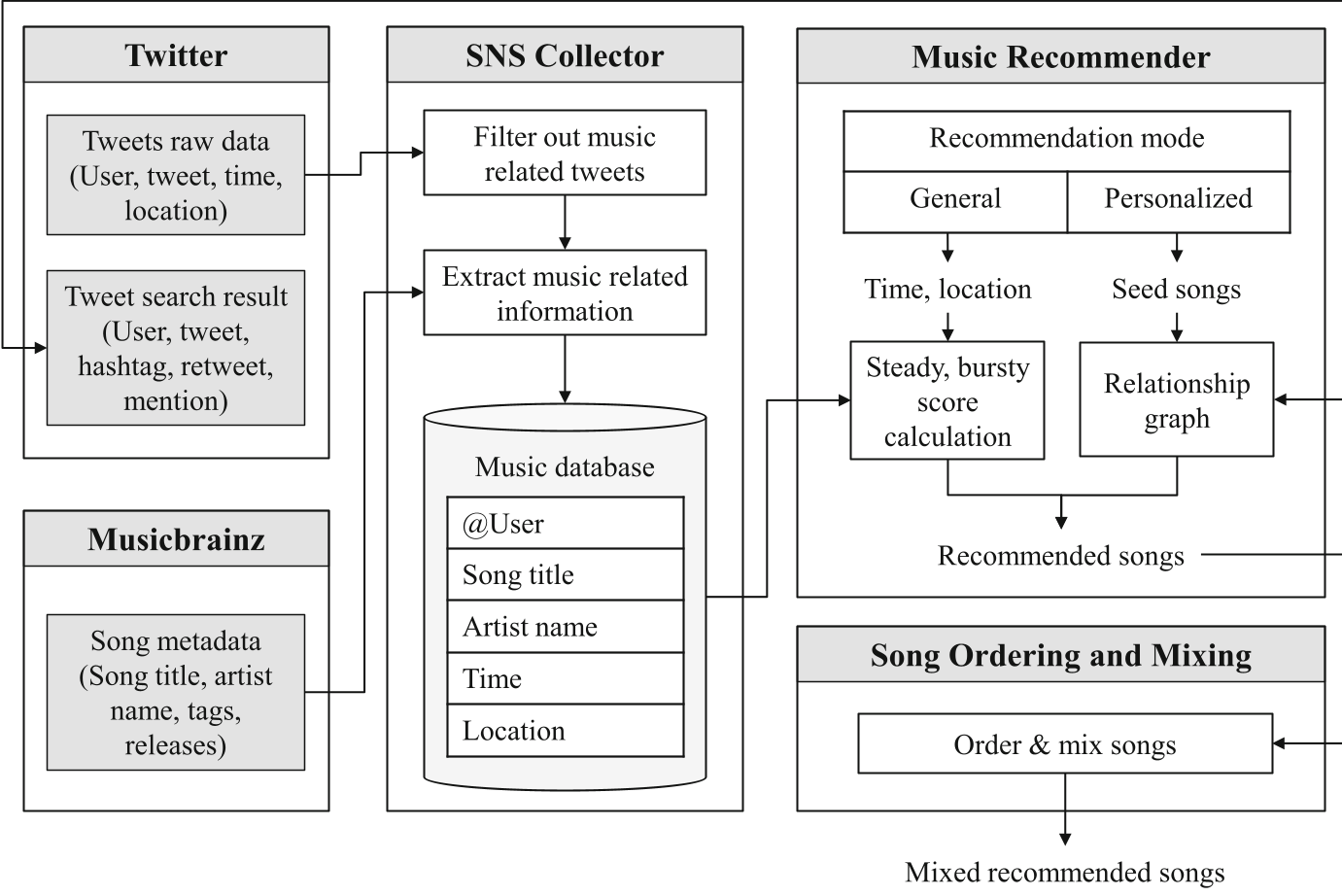 Figure 1: The dual-component architecture consisting of the SNS Collector and the Music Recommender.
Experiments & Results
The authors validated the system on several fronts:
- Accuracy: The combination of Regular Expressions and Musicbrainz validation yielded an impressive 96.8% accuracy in identifying song/artist pairs from messy tweets.
- Scalability: Utilizing Cloudera CDH and Impala, the system demonstrated sub-second recommendation times even when the database scaled to millions of entries.
- User Satisfaction: A blind test revealed that users found the "Social Mix" results significantly more satisfying than random shuffling and nearly as good as manual mixes created by amateur DJs.
 Table 1: High precision and recall rates for song identification and extraction.
Critical Analysis & Conclusion
Takeaway
Social Mix successfully proves that social media is a viable "real-time sensor" for cultural trends. By treating audio mixing as a structural matching problem rather than just a playback task, it elevates the user experience from a mere utility to a form of automated curation.
Limitations
While the system is robust, it relies heavily on Twitter's metadata. As social media landscapes shift (e.g., the transition from Twitter to X or the rise of TikTok), the "hashtag clues" used here might need to evolve into multi-modal analysis (analyzing short-form video audio). Furthermore, the 2014-era signal processing used here could be enhanced today with Neural Audio Embeddings.
Future Outlook
This research paves the way for "Ambient Intelligent" music services—imagine an office or gym where the music doesn't just follow a genre but adapts its energy level and transitions in real-time based on the local social "vibe" found online.