
SMIBLS: Bridging the Gap Between Traditional Classrooms and Social Mobile Learning
Towards Social Mobile Blended Learning
The paper introduces the Social Mobile Interactive Blended Learning System (SMIBLS), a framework that integrates traditional face-to-face education with mobile learning and social network platforms (Web 2.0). It focuses on a specialized adaptation mechanism that delivers personalized "Learning Objects" (LOs) tailored to a student's knowledge level, learning style, and environmental context.
TL;DR
The paper "Towards Social Mobile Blended Learning" proposes SMIBLS, a framework designed to merge physical classroom instruction with mobile accessibility and social media connectivity. By utilizing a sophisticated adaptation engine, it delivers personalized, micro-sized learning content that accounts for a student's cognitive style, device constraints, and even environmental factors like ambient noise.
Background & Motivation: The Fragmentation of Learning
Despite the explosion of Web 2.0 and mobile technology, education remains fragmented. Traditional classrooms are often static, while mobile learning is frequently disconnected from the social interactions that drive engagement. The authors identify a critical need for "Just-in-Time, Just-Enough" learning—an approach where educational content is not only portable but contextually aware.
The core challenge addressed is threefold:
- Learner Diversity: No two students have the same knowledge base or learning style (e.g., Visual vs. Verbal).
- Contextual Variability: Learning happens everywhere—from noisy buses to quiet libraries.
- Connectivity Disconnect: Bridging the gap between students physically present on campus and those learning remotely.
Methodology: The SMIBLS Architecture
The heartbeat of this paper is the Social Mobile Interactive Blended Learning System (SMIBLS). Unlike standard LMS (Learning Management Systems), SMIBLS introduces a dual-module adaptation strategy.
The Adaptation Mechanism
The system employs an Adaptation Engine that processes four distinct context vectors:
- Learner Context: Style (Sequential/Global), knowledge level (Beginner/Pro), and habits.
- Educational Context: Pedagogical theories and specific achievement goals.
- Infrastructure Context: Device capabilities (battery, screen size) and network bandwidth.
- Environmental Context: Physical location, local weather, and noise levels.
Content Strategy: Learning Objects (LOs)
To facilitate mobile consumption, the system breaks curriculum into Learning Objects (LOs). These are small, self-contained files (SWF, MP3, MP4) designed to be consumed during short windows of time, such as commuting.
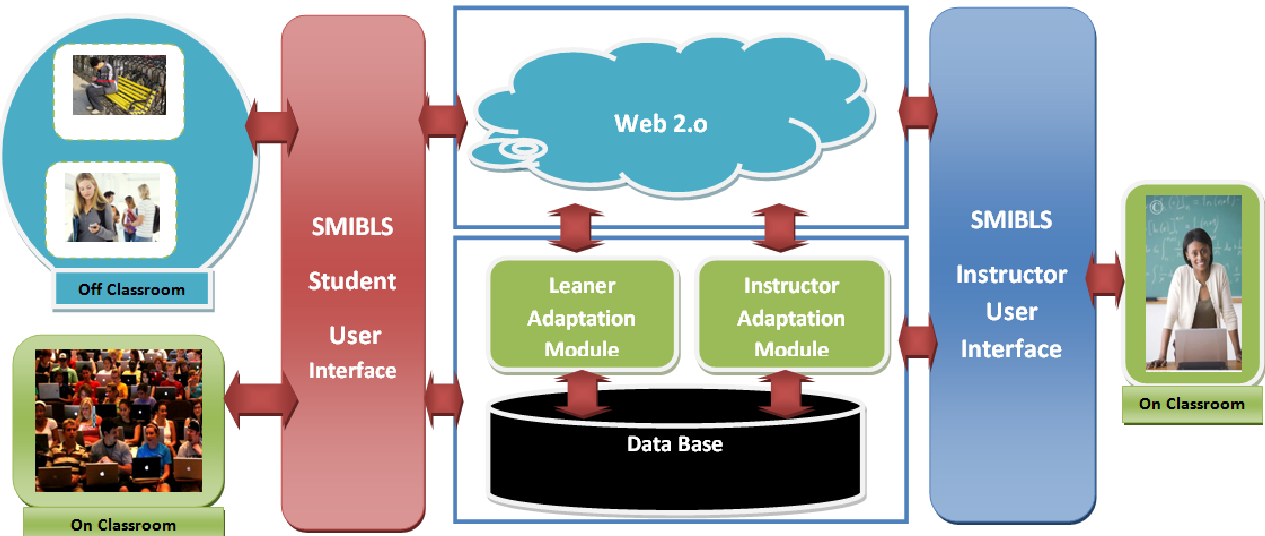 Figure 1: The architecture illustrates the flow between the Instructor and Learner modules via the Adaptation Engine.
Hybrid Communication: Bluetooth + Web 2.0
One of the paper's more unique technical insights is its hybrid communication layer:
- On-Campus: Uses Bluetooth to facilitate low-latency, localized interaction between instructors and students' mobile devices.
- Off-Campus: Leverages Web 2.0 tools (Facebook/Twitter) to maintain a social "alive communication" thread, ensuring remote students are not isolated from the classroom's social energy.
Critical Analysis & Future Outlook
The SMIBLS framework represents an early and ambitious attempt to codify Context-Aware Ubiquitous Learning. Its strength lies in its holistic view of the "learner"—treating their hardware and environment as being just as important as their test scores.
Limitations:
- The paper focuses heavily on the framework architecture; more empirical data on the "Adaptation Engine's" algorithmic efficiency would strengthen the technical depth.
- Reliance on Bluetooth for on-campus interaction may face scalability issues in high-density environments compared to modern Wi-Fi 6/7 standards.
Future Impact: This work pre-empts the current move toward "Micro-learning" and "Adaptive Learning Paths" now seen in platforms like Duolingo or Khan Academy. The integration of social networking as a primary educational conduit remains a highly relevant strategy for increasing student retention in hybrid models.
Conclusion
SMIBLS provides a roadmap for a more fluid educational experience. By treating the transition between the classroom and the mobile device as a continuous, adaptive journey, the authors offer a compelling vision for how technology can support, rather than distract from, the learning process.
Takeaway: Effective blended learning requires more than just making content digital; it requires making content malleable to the user's immediate environment and social context.