
Social Moms and Health: Deciphering the Digital Pulse of Maternal Communities
Social moms and health: A multi-platform analysis of mommy communities
This paper presents a multi-platform analysis of "mommy communities" on Twitter and the blogosphere, investigating how mothers discuss health and form social circles. Using a specialized local community discovery algorithm and Latent Dirichlet Allocation (LDA), the study analyzes 858 mothers to compare content patterns and structural links across micro-blogging and long-form platforms.
TL;DR
This research investigates the intersection of maternal influence and digital health discourse. By analyzing a cohort of 858 mothers active on both Twitter and the blogosphere, the researchers found that while health is a pervasive topic, the way it is shared changes drastically between platforms. Blogs are hubs for personal experience, while Twitter functions as an awareness-driven "push" mechanism. Crucially, the study identifies a massive "connection gap" where mothers with identical health interests remain disconnected in the social graph.
Problem & Motivation: The Gatekeepers of Family Health
In the hierarchy of social agents, mothers occupy a central role as primary health decision-makers. However, the explosion of social media has created fragmented communities. The researchers sought to understand a critical disconnect: Do mothers use different platforms for different health objectives? And more importantly, are the social networks we see (followers/mentions) actually reflective of shared health interests, or are thousands of mothers missing out on vital support networks?
Methodology: Mapping the Maternal Social Circle
To bridge the gap between platforms, the authors moved beyond simple keyword matching. They utilized two main technical pillars:
- Directed Social Circle Discovery: Starting from "seed" mothers, they used a greedy algorithm that balances "linked-to" and "linked-from" scores to grow a cohesive community in directed graphs.
- Implicit vs. Explicit Analysis: By using Latent Dirichlet Allocation (LDA), they represented each mother as a document vector. This allowed them to calculate Implicit Affinity (who should be friends based on topics) and compare it to Explicit Links (who actually follows whom).

Platform Usage: Authoring vs. Retweeting
The study highlights a fascinating behavioral split. On Twitter, health topics often surface via retweets—particularly for awareness-driven topics like Down Syndrome or Autism. Conversely, personal, high-investment topics like Pregnancy or Illness are more likely to be authored as original content, especially in the long-form blogosphere.
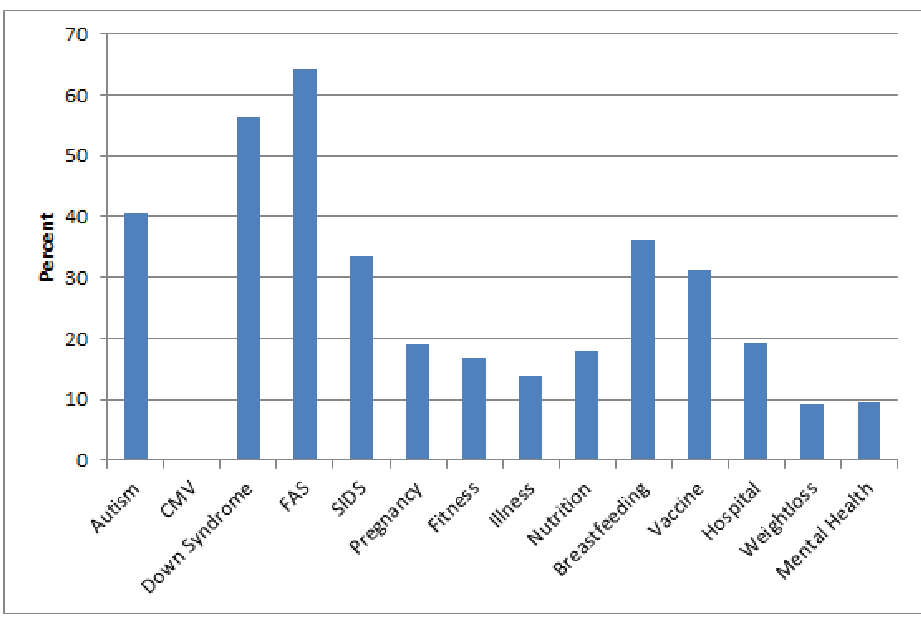 Fig 1: Notice how topics like Down Syndrome and FAS rely heavily on retweets for visibility, while items like Hospital visits are almost entirely original content.
The Connection Gap
One of the most striking findings is the visual representation of the internal "mommy-sphere." The researchers generated a network graph where nodes are connected only if their topical similarity (calculated via LDA) exceeds 0.8.
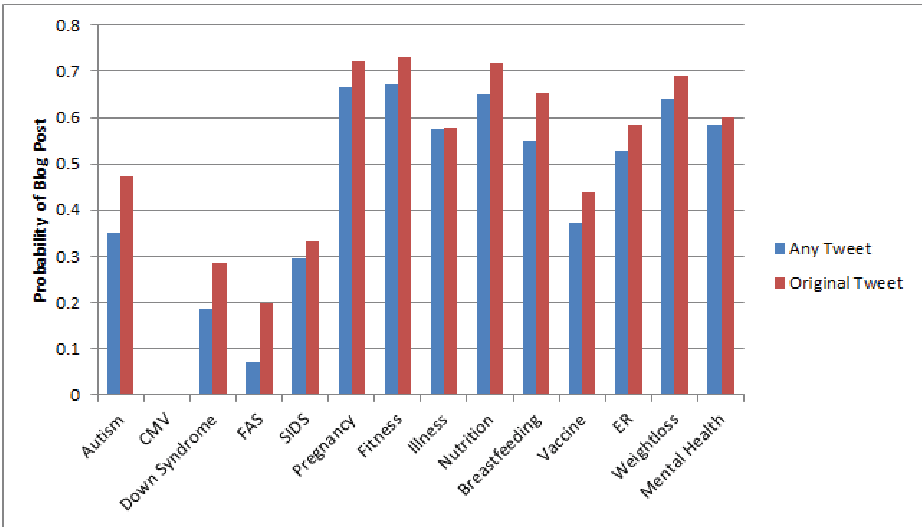 Fig 2: Clusters of mothers grouped by latent topics such as "Cloth Diapering," "Couponing," and "Fitness."
The data shows that less than half (45.4%) of these strongly related pairs have an explicit link. This suggests that the current social graph is "sparse" relative to common interests, representing a significant opportunity for recommendation engines to foster support for niche health behaviors (e.g., specific rare conditions or unconventional health practices).
Critical Analysis & Conclusion
Takeaway
The medium dictates the message. Health practitioners shouldn't treat Twitter and Blogs as a single "social media" bucket. Twitter is superior for spreading awareness (the "push"), while blogs are the primary site for building deep, experiential trust (the "pull").
Limitations
- Time Period: The study was conducted in 2013; platform dynamics (especially Twitter/X) have shifted significantly with the rise of algorithmic feeds.
- Selection Bias: Starting from "top-rated" mommy blogs might exclude lower-income or marginalized maternal communities.
Future Outlook
This methodology provides a blueprint for "community-aware" health interventions. By identifying mothers who discuss similar but underrepresented topics (like CMV) and have no explicit links, health organizations can facilitate "missing" connections to improve family health outcomes globally.