
COSMOS: Bridging the Gap Between Social Media and the Internet of Things
Social monitoring and social analysis in internet of things virtual networks
The paper introduces the COSMOS project's approach to the Social Internet of Things (SIoT), shifting IoT management from centralized systems to a decentralized, autonomous framework. It proposes two core components—Social Monitoring and Social Analysis—to enable Virtual Entities (VEs) to share knowledge and services through social-like interactions and relationship modeling.
Executive Summary
TL;DR: This paper presents the COSMOS framework, an architecture that transforms "Smart Things" into "Social Objects." By hijacking the logic of social networks—followers, trust scores, and influence—the authors provide a decentralized management system where Virtual Entities (VEs) autonomously discover, share, and recommend services and knowledge.
Placement in the Field: This work is a foundational architectural proposal in the Social Internet of Things (SIoT) sub-field. It moves beyond simple device-to-device communication toward a complex, self-organizing social ecosystem, refining the IoT-A reference model with advanced Social Network Analysis (SNA).
Problem & Motivation: Why do Things need a Social Life?
The authors identify a looming crisis: as we hit trillions of IoT devices, centralized management becomes a "mission impossible." Communication latency, administrative silos, and the lack of autonomous reasoning make current systems brittle.
Their Insight is deceptively simple: Humans solved the scale problem with social structures. We don't know everyone on Earth, but we navigate through friendship, trust, and influence. The COSMOS project applies this "Social Situational Awareness" to Virtual Entities (VEs). If a sensor "knows" who its reliable neighbors (friends) are, it doesn't need a central server to tell it who to trust or where to find data.
Methodology: The Socialized MAPE-K Loop
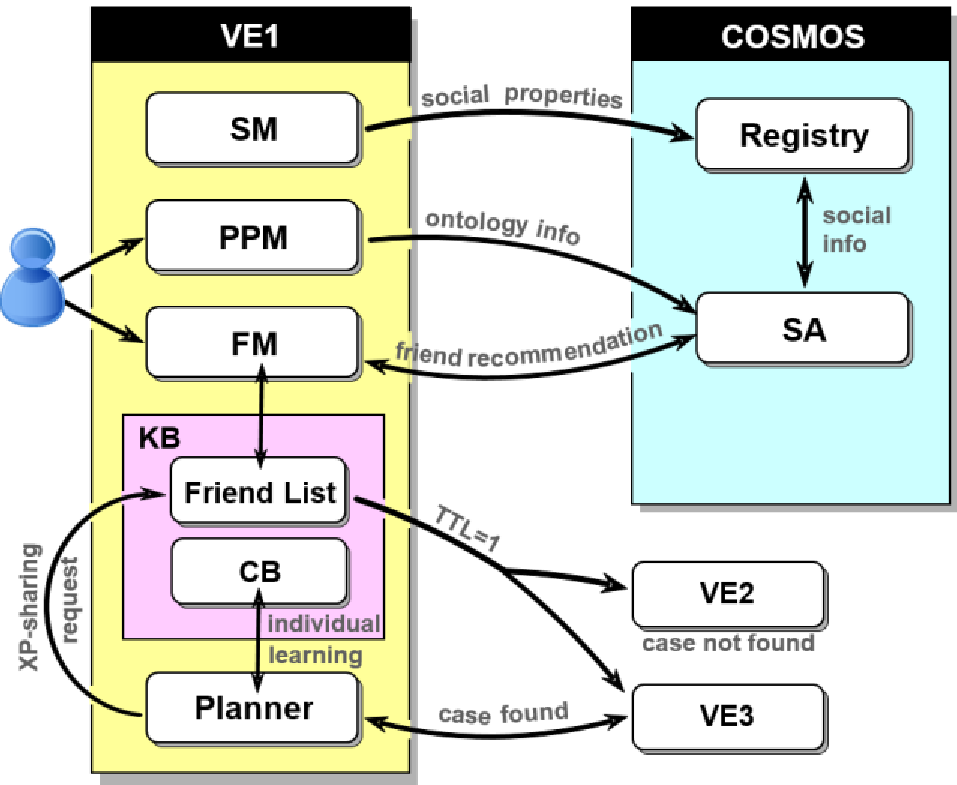
The authors leverage the classic MAPE-K (Monitor-Analyze-Plan-Execute-Knowledge) model but augment it with two critical layers:
1. Social Monitoring (SM)
Instead of just monitoring temperature or battery, SM tracks interaction metrics:
- Shares: Frequency of knowledge distribution.
- Assists: Acting as a broker between other VEs.
- Applauses: Feedback on how useful a shared resource was.
- Mentions: Citations of a service in other entities' case bases.
2. Social Analysis (SA)
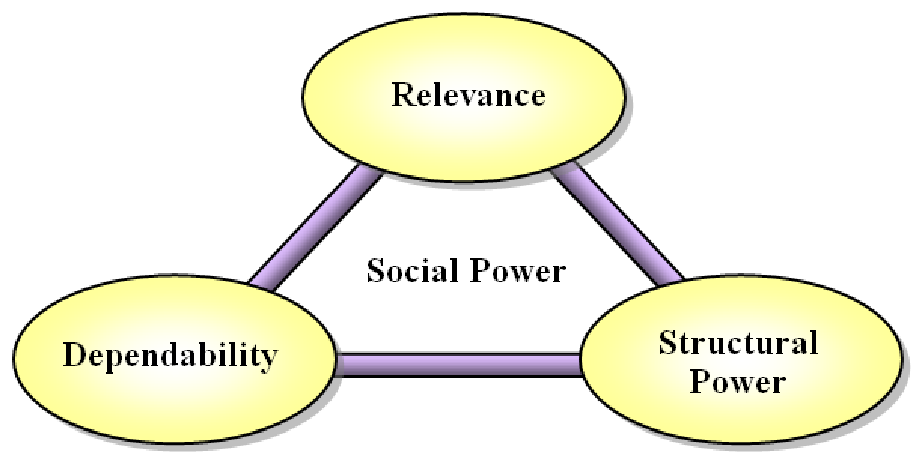
This is where the math happens. Using SNA, the system calculates the Dependability Index and Social Power of a node.
The Concept of "Social Power"
Relationship establishment isn't random. It’s based on:
- Homophily: Seeking similar devices (e.g., two weather sensors).
- Heterophily: Seeking different devices to gain new capabilities.
- Propinquity: Geographic closeness.
Experiments & Analysis: Identifying Key Players
The paper argues that the "Role" of a device in an IoT network should be determined by its structural position, just like influencers in a social network.
| Metric | High Betweenness Centrality (BC) | High Closeness Centrality (CC) | High Eigenvector Centrality (EC) |
|---|---|---|---|
| VE Role | The Mediator: Bridges different clusters. | The Group Leader: Optimal for fast communication. | The Network Influencer: Connected to other powerful nodes. |
- Discovery Efficiency: By applying the "Six Degrees of Separation" theory, the authors implement a TTL (Time-to-Live) mechanism for queries. Instead of flooding the network, a query follows a path of "friends," capping at six hops to avoid infinite loops while maximizing the probability of finding the right resource.
- Trust & Malice: The Dependability Index acts as a filter. If a device has high "Shares" but zero "Applauses," it is flagged as unreliable or malicious and isolated from the social graph.
Critical Analysis & Conclusion
Takeaway: The real value of COSMOS is its ability to turn the "noise" of trillions of devices into a "structured signal." By utilizing SNA tools like Pajek or NetworkX, IoT networks can finally become self-healing and self-organizing.
Limitations:
- Computational Overhead: Calculating Eigenvector Centrality on a global scale is expensive. The authors suggest "meso-level" analysis to mitigate this, but real-time dynamics remain a challenge.
- Privacy: While they mention owner-imposed rules, the "social" nature of things could inadvertently leak sensitive metadata about the physical world.
Future Outlook: The shift from "Smart Objects" to "Social Objects" is inevitable. As autonomous vehicles and smart cities expand, the ability for a device to "ask a friend" rather than "ping the cloud" will be the difference between a responsive system and a congested one.