
Mapping the Invisible College: The Structural Evolution of China’s Management Science
Social Network Analyses on Knowledge Diffusion of China’s Management Science
This research applies Social Network Analysis (SNA) to investigate the knowledge diffusion patterns within China's Management Science community by examining the citation networks of 18 core journals over two periods (1996-2000 and 2002-2006). The study utilizes measures of centrality, structural equivalence, and visualization to map the evolution and maturity of the field.
TL;DR
How does a young academic discipline mature? By applying Social Network Analysis (SNA) to citation data from 1996 to 2006, this study reveals that China’s Management Science transitioned from a fragmented collection of papers into a dense, integrated "invisible college." The network's density surged by nearly 52%, signaling a shift from isolated specialization to interdisciplinary fusion.
Context: A Discipline in Flux
Following the Reform and Opening-up, Management Science in China was formalized as an independent subject in 1997. However, as a decussate science combining natural and social sciences, it lacked a clear "core." This paper seeks to move beyond simple citation counts to understand the relational topology of knowledge—how ideas migrate from one journal to another and which publications hold the most "power" within the community.
Methodology: The SNA Toolbox
The researcher selected 18 representative journals and divided the data into two 5-year windows to capture evolution.
- Cosine Similarity: Used to normalize citation vectors and measure how closely two journals share the same "knowledge niche."
- Centrality (Indegree/Outdegree): Identifying the "authorities" (often cited) vs. the "hubs" (those citing others).
- Block-modeling (Concor): Grouping journals based on Structural Equivalence—meaning they play similar roles in the network regardless of whether they cite each other directly.
 The Cosine function used to determine similarity between journal citation modes.
Key Insights: From Isolation to Integration
1. The Density Surge
The most striking finding is the increase in Network Density from 0.5686 to 0.8627. In SNA terms, this indicates that the "distance" between different management sub-fields (like System Engineering vs. Tech Management) is shrinking. Knowledge is flowing more freely, and the community has become more "direct and open."
2. Centrality and Power
The study highlights a significant asymmetry in citation patterns. Journals like China Soft Science (CSS) and Management Sciences in China (MSC) maintain high centrality, acting as the "gatekeepers" of the discipline.
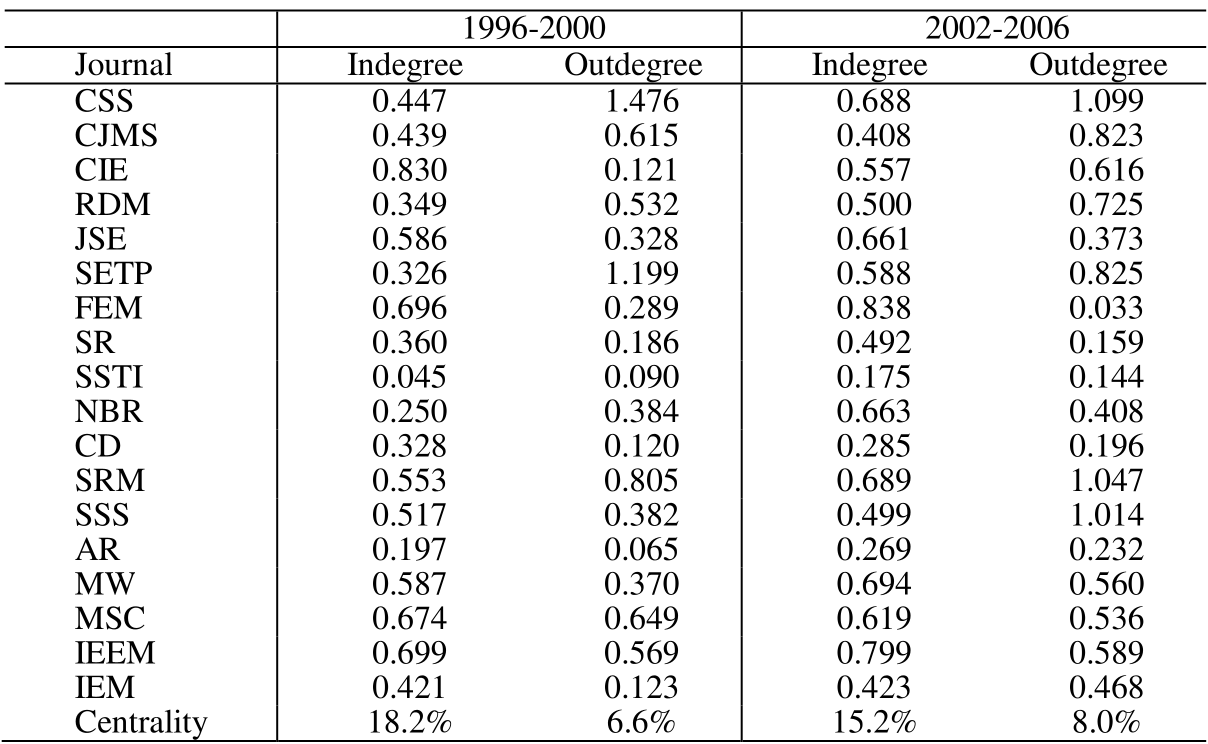 Table showing the shift in Indegree and Outdegree centrality across the two periods.
3. The Four Zones of Knowledge
Through block-modeling, the journals were categorized into four distinct functional zones:
- Zone 1: Macroscopic Management & Policy (e.g., China Soft Science).
- Zone 2: Technology Management (e.g., R&D Management).
- Zone 3: Pure Management Science (e.g., Journal of Management Sciences in China).
- Zone 4: System Engineering (e.g., Systems Engineering - Theory & Practice).
Over time, journals drifted between these zones, reflecting the "mergence" of subjects. For example, Journal of Management Science (CJMS) migrated from systemic modeling towards the management science core, reflecting a solidification of its identity.
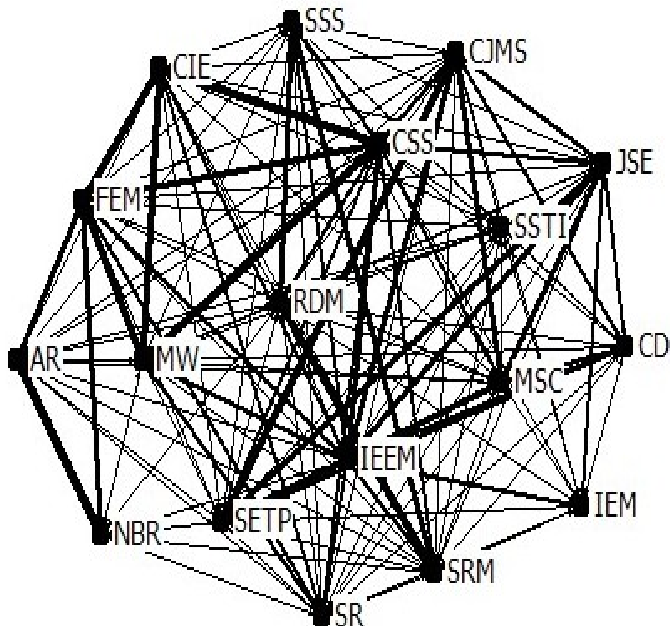 Visualization of the citation network in the first period, showing early clusters.
Critical Analysis & Conclusion
This paper successfully demonstrates that citation networks are not static; they are living maps of intellectual maturation. The QAP modulus of 0.755 confirms that while the "backbone" of the discipline is stable, the increased self-citation ratios across the board suggest that journals are also working harder to establish their unique academic "brands."
Takeaway: For researchers and policymakers, this study proves that "invisible colleges" are now firmly established in China. The next challenge for the field will be maintaining this high density of knowledge exchange without falling into "academic circularity" or excessive self-citation.