
The Invisible Org Chart: Unlocking Corporate Efficiency through Social Network Analysis
Social Network Analysis in Corporate Management
This research presents a Social Network Analysis (SNA) framework for corporate Human Resources (HR) management. It introduces methods to extract "invisible" social structures from digital footprints like email logs and phone calls, comparing them with formal organizational hierarchies to optimize knowledge flow and team performance.
TL;DR
Modern corporations are no longer just rigid hierarchies; they are complex, living social organisms. This research explores how Social Network Analysis (SNA) can be used to extract the "invisible" relationships between employees from email logs and project data. By comparing these real-world interactions with formal company structures, managers can identify hidden leaders, optimize knowledge flow, and detect "lonely" outliers before they impact team performance.
Beyond the Org Chart: The Motivation
Most companies manage their people through static directory services like Microsoft Active Directory. However, an employee's title rarely tells the whole story of their influence.
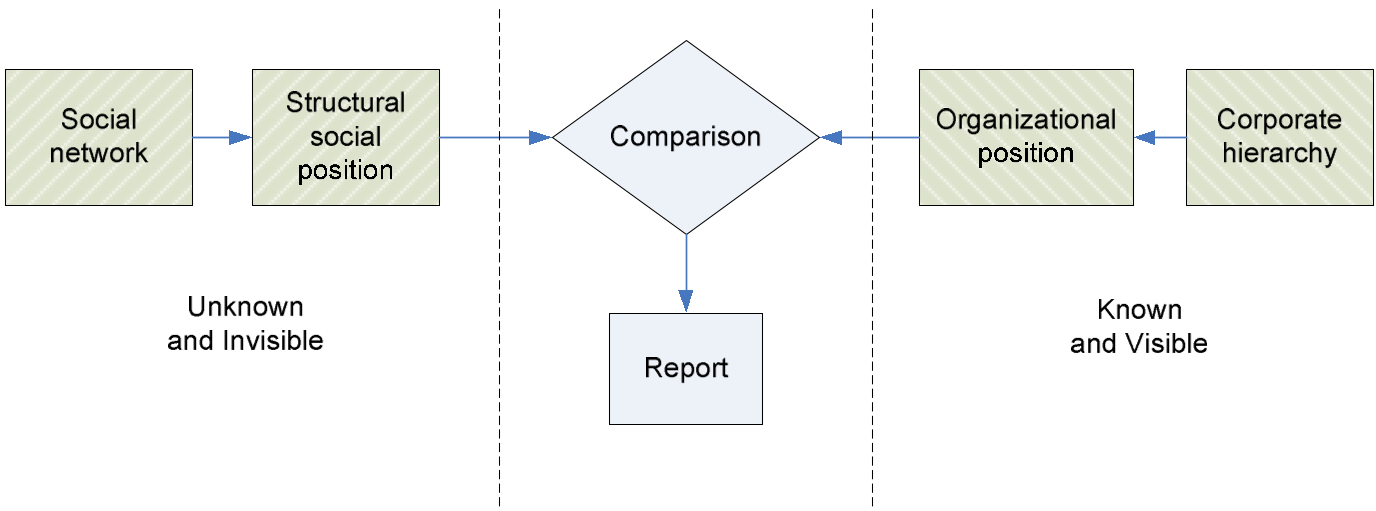
The authors argue that the "nervous system" of a company is its knowledge flow. When the formal hierarchy (who you report to) deviates significantly from the social network (who you actually talk to), inefficiencies arise. The motivation of this work is to provide a quantitative toolkit for HR managers to "see" these invisible connections and align the formal structure with social reality.
Methodology: Mining the Digital Nervous System
1. Social Network Extraction
The researchers categorize data sources into two types to build a comprehensive map of the organization:
- Direct Relationships: Explicit communication like email senders/recipients and phone call logs.
- Indirect Relationships: "Container-type" objects such as shared project memberships, forum discussions, or even sitting in the same office room.
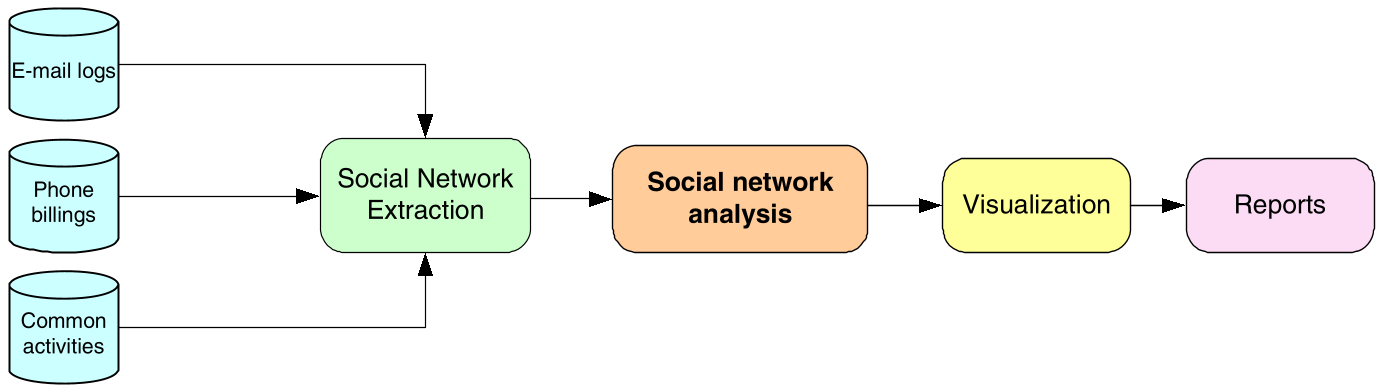
2. The Power of Centrality and Social Groups
The core of the analysis involves calculating Centrality. If a secretary has a higher centrality degree than a department director, they are acting as a "hidden natural leader" or a critical information bottleneck.
Furthermore, by performing Community Detection, the authors can identify "social groups." If an employee is socially more connected to a different team than their own, it’s a strong signal for a potential transfer to improve efficiency.
3. Social Concept Networks (SCN)
One of the most innovative sections is the introduction of Social Concept Networks. By analyzing keywords within communication (e.g., "Python," "Blockchain," "Audit"), the system links people not just by who they talk to, but what they know.
- Expert Detection: SCN identifies "hidden experts"—people who possess deep knowledge on a topic but aren't officially assigned to the relevant project.
Strategic Insights from Data
The paper outlines several high-value HR scenarios:
- Identifying "Lonely Entities": Outliers with weak ties who may be underperforming or disengaged.
- Swarm Intelligence: Recognizing independent collaborative groups that emerge spontaneously—similar to the Linux kernel developer community—and giving them the autonomy to innovate.
- Dynamic Analysis: Tracking how the network evolves after a merger or a layoff to ensure the "social health" of the company remains intact.
Critical Analysis & Conclusion
While the methodology is robust, the authors acknowledge a significant limitation: The Profile of Relationships. Current tools struggle to distinguish between a "strong relationship" meant for productive collaboration and one characterized by conflict or irony. Quantitative metrics show that people talk, but not always how they feel.
Takeaway: SNA is a powerful diagnostic tool that reveals the "hidden truth" of an organization. By bridging the gap between the official hierarchy and the social reality, companies can move toward a more agile, "swarm-like" intelligence where the right people are in the right roles based on actual influence rather than just titles.
Future Outlook: The next frontier involves integrating more sophisticated NLP to understand the emotional tone of communication and developing new metrics like "betweenness" to find the key brokers of information across silos.