
Decoding Entrepreneurial DNA: A Social Network Analysis of Business Partnerships
Using Social Network Analysis to Study Diversity in Business Partnerships
This paper utilizes Social Network Analysis (SNA) and graph mining to investigate diversity in business partnerships using a dataset of over 20,000 trade licenses from Dubai. By modeling partners as nodes and shared licenses as edges, the study identifies core community structures and motifs that define entrepreneurial behavior in a cosmopolitan hub.
TL;DR
Why do some business partnerships flourish while 70% fail? This research moves beyond traditional statistics to treat business ecosystems as evolving social networks. By analyzing three years of Dubai's trade license data, the authors reveal that successful partnerships form highly stable "Cliques" and "Core-Periphery" structures. While these networks are melting pots for different nationalities, they remain significantly closed to gender diversity.
Background: The Graph Intuition
Most entrepreneurship studies look at what a company does or who the owner is. This study asks how they are connected. In the language of Graph Theory, a business partnership is not just a legal contract; it is a weighted edge in a graph where the nodes are people. The strength of that edge (weight) is determined by how many ventures the partners share.
Methodology: High-Fidelity Graph Filtration
One major technical challenge in Social Network Analysis (SNA) is "noise"—thousands of one-off partnerships that obscure the real power structures. The authors designed a custom filtration logic:
By keeping nodes that are either very active (High Degree) or very loyal (High Edge Weight), they isolated the "Top 7 Clusters" that represent the backbone of the city's economy.
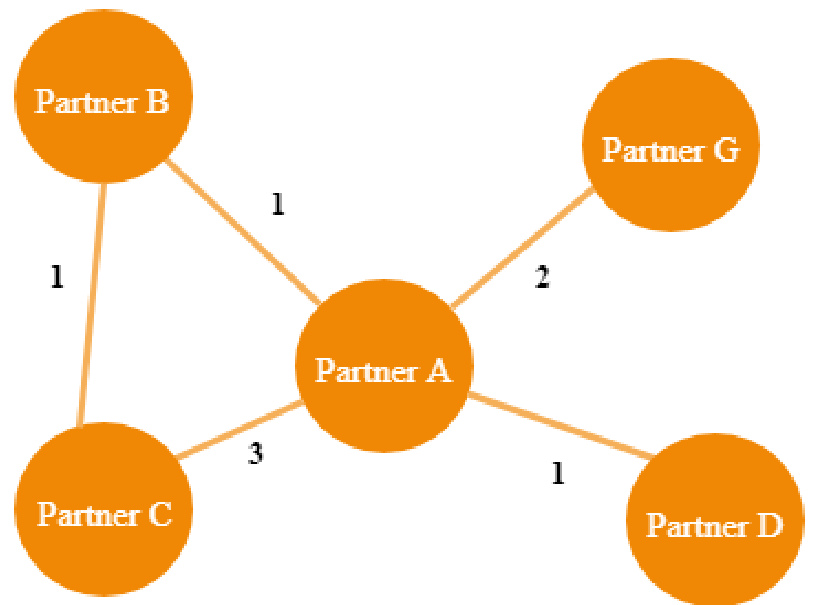 Fig 1: The model translates trade licenses into a partner-to-partner network.
Two Architectures of Success: Motifs
The research identified two primary "motifs" or patterns in how businesses are organized:
- The Clique: A group where everyone is connected to everyone else. These typically represent tight-knit groups managing a specific set of firms.
- The Core-Periphery: A "Prominent Member" (high betweenness centrality) acts as a bridge, connecting various subgroups who otherwise wouldn't work together.
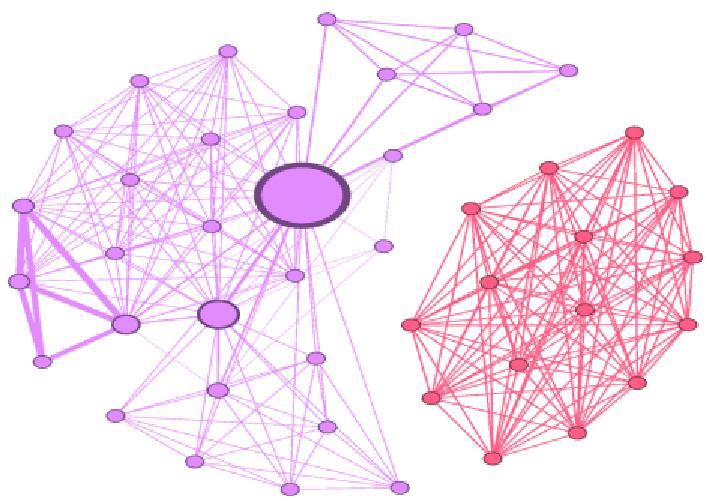 Fig 2: Visualizing the 'Bridge' partner (purple) vs. the 'Clique' (red).
Diversity: The Good, The Bad, and The Stagnant
Dubai, being a global crossroads, showed impressive Nationality Diversity. Clusters were truly multinational, often led by a prominent member whose nationality differed from the majority of the group. However, the Gender Gap was staggering:
- 4 out of 7 major clusters had zero women.
- Even the most "diverse" cluster had only 12% female participation.
Interestingly, these structures are incredibly resilient. Tracing these 126 "power players" from 2015 to 2017 showed that 90% remained active, proving that once you are part of a stable business community, your professional longevity increases.
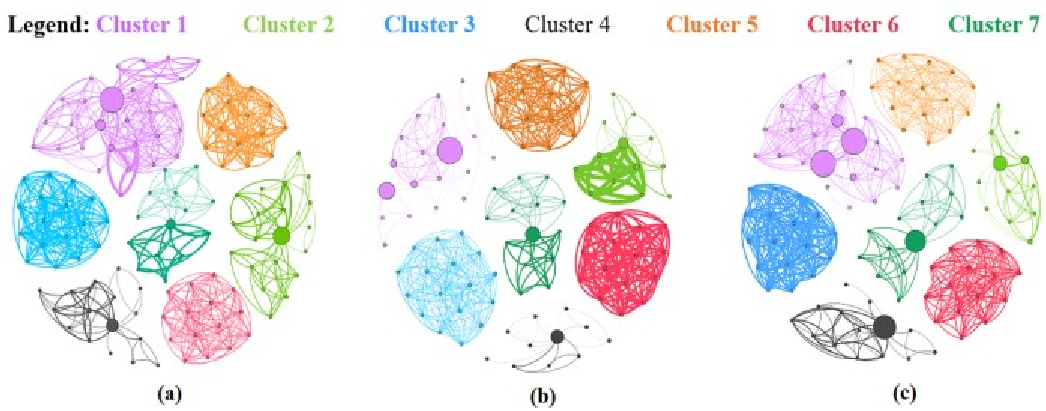 Fig 3: Evolution of the top 7 communities over 2015, 2016, and 2017.
Critical Insight & Conclusion
The study demonstrates that business success is a structural phenomenon. The high clustering coefficient (avg. 0.90) suggests that business in the Middle East relies heavily on "transitive closure"—the idea that "a friend of my partner is my next partner."
Takeaway for the Future: For policymakers, the goal shouldn't just be to encourage individual entrepreneurs, but to facilitate the entry of underrepresented groups (like women) into these high-stability cliques. Without an "in" to the existing network, individual talent remains on the periphery.
Limitations: The study excluded corporate entities (B2B). Future research should integrate corporate nodes to see how "Body Corporates" act as anchors for human social networks.