
Building the Semantic Brain: Geo-Temporal Reasoning in a Web 3.0 World
Social Network Analysis and Geo emporal Reasoning in a Web 3.0 World
This paper presents a pioneer Web 3.0 application that integrates heterogeneous data sources to automate complex social event planning in the San Francisco Bay Area. Utilizing a suite of Semantic Web technologies, the system demonstrates sophisticated coordination of social networks, geospatial data, and temporal constraints.
TL;DR
This paper demonstrates a sophisticated Web 3.0 agent designed to automate complex social planning. By federating data from Yelp, IMDb, and transit authorities into an RDF-based framework, the authors showcase a system capable of reasoning across social preferences, geospatial locations, and temporal constraints to organize the "perfect" night out.
Background Positioning
In the early vision of the Semantic Web (as famously articulated by Tim Berners-Lee), the goal was to transform the web from a collection of linked documents into a collection of linked data. This paper acts as a high-level technical validator, moving beyond theoretical ontologies to a practical, multi-agent demonstration in the San Francisco Bay Area. It explores the intersection of Knowledge Graphs, Social Network Analysis (SNA), and Pathfinding Algorithms.
Problem & Motivation: The Silo Constraint
Most web services today are "walled gardens." If you want to plan a date, you must manually check a movie site (IMDb), a restaurant review site (Yelp), a map service (Google Maps), and a transit schedule (MTC). The authors identify that the real challenge isn't just data access; it's contextual reasoning. A planning agent must understand:
- Social Context: Who likes what? Who is friends with whom?
- Spatial Context: Is the restaurant walking distance from the theater?
- Temporal Context: Can they finish dinner before the movie starts and still catch the last train?
Methodology: The Core Engine
The architecture relies on a specialized "Agent" that performs reasoning over a federated RDF store.
1. The Federated Data Layer
Instead of centralizing all data into one rigid schema, the authors use Federated Querying. They ingest data from:
- Yelp: For restaurant metadata and coordinates.
- IMDb & Yahoo Movies: For cinema schedules and ratings.
- MTC: For real-time transit and ferry schedules.
- US Census Data: To simulate a realistic social graph of 5,000 nodes.
2. RDFS++ Reasoning
The system uses RDFS++, a subset of Description Logic that allows the agent to understand hierarchies (e.g., a "Sushi Bar" is a type of "Restaurant"). This enables the agent to satisfy vague preferences like "find a casual place" by traversing the ontological tree.
3. Trip Planning and A* Search
To handle the physical world, the agent integrates a cost-based planner. Using an A search algorithm* directly on the RDF graph, it calculates optimal routes based on time, cost, and user-defined constraints (like a curfew).
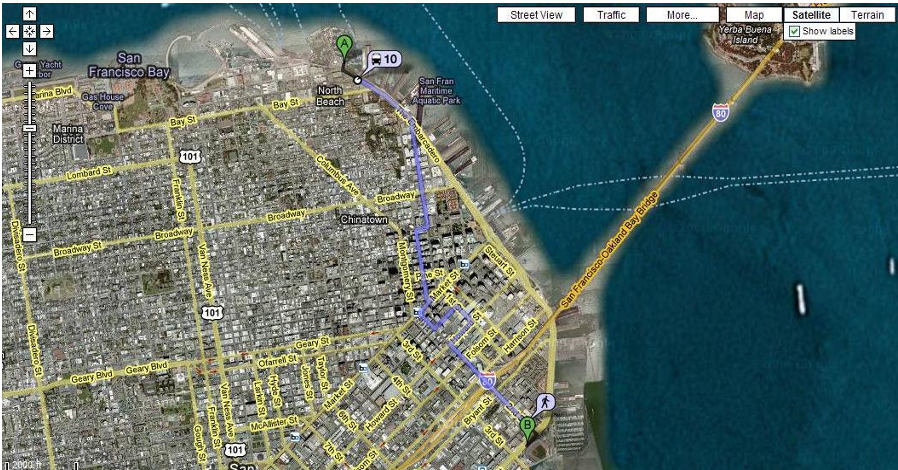 Figure 1: The transit planning module calculating multi-modal routes (BART, MUNI, etc.) within the Semantic Web framework.
Experiments: Solving Realistic Scenarios
The authors tested the agent against four complex human scenarios. One notable case involved a student group needing to find a movie that starts soon and ends in time for their next lecture, prioritizing a theater near their current location.
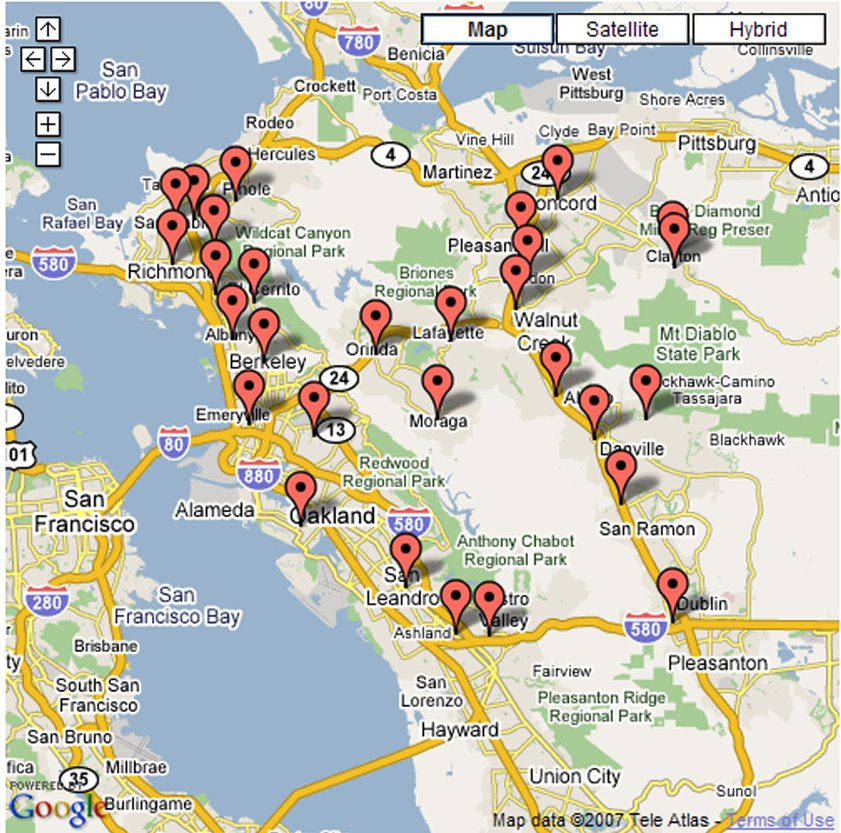 Figure 2: Visualizing the overlapping constraints of movie times and restaurant locations in a geospatial plane.
Key Strengths of the Results:
- Preference Aggregation: The agent could average the preferences of a group to select a movie.
- Constraint Satisfaction: It successfully handled "inconvenience" metrics—finding locations that are equally accessible (or inaccessible) to all members of a group to ensure fairness.
Critical Analysis & Conclusion
Takeaway
The paper proves that RDF and SPARQL-based systems are not just for academic metadata; they are powerful enough to drive real-world utility applications. By treating "transit time" and "friendship" as edges in the same graph, the agent achieves a level of automation that standard API-based apps cannot match.
Limitations & Future Work
While the reasoning is robust, the paper relies on simulated social data for the network analysis due to 2000s-era privacy and data availability issues. In a modern context, integrating this with Graph Neural Networks (GNNs) could further improve the "Social Network Analysis" component by predicting preferences even when they aren't explicitly stated in the RDF.
Final Outlook
This work is a precursor to the modern "Social Graph" applications we see today, yet it remains more ambitious in its use of logic-based reasoning than most current LLM-based solutions, which often struggle with the precise spatial-temporal arithmetic the A* planner handles with ease.