
Decoding Public Pulse: A Social Network Analysis of India's GST Launch on Twitter
A social network analysis of opinions on GST in India within Twitter
This paper presents a social network and sentiment analysis of the Indian public's reaction to the implementation of the Goods and Services Tax (GST) using Twitter data. By employing graph theory and natural language processing, the authors characterize the user interaction network as a "Small World" and quantify the prevailing public sentiment during the policy launch.
TL;DR
When India launched the Goods and Services Tax (GST) in July 2017, the digital landscape exploded. This paper analyzes that explosion, revealing a Small World Network structure where information travels lightning-fast across key hubs. Despite the historic nature of the reform, the initial Twitter sentiment was starkly skeptical, with 62% of analyzed tweets expressing negative views.
Background: The Digital Town Square
Policy feedback has moved from newspaper columns to the "Echo Chambers" of social media. The implementation of GST represented one of India's most significant tax reforms, providing a unique dataset to study how citizens react to systemic change. The authors set out to map not just what people were saying, but how they were connected when saying it.
Methodology: Mapping the GST Ecosystem
The researchers used a two-pronged attack:
- Network Extraction: Using the Twitter Streaming API, they captured interactions (mentions and retweets) to build a directed graph.
- Sentiment Scoring: Using Python's
TextBlobandTweepy, they calculated polarity scores. A score below 0.25 was strictly categorized as negative to filter for clear dissatisfaction.
The Topology of Discourse
By using NodeXL, the authors visualized the interaction network. They discovered that the #GST network is structured as a Small World Network. In such a network, even though most users aren't directly connected, they are linked by a very small number of "hops" through influential hubs.
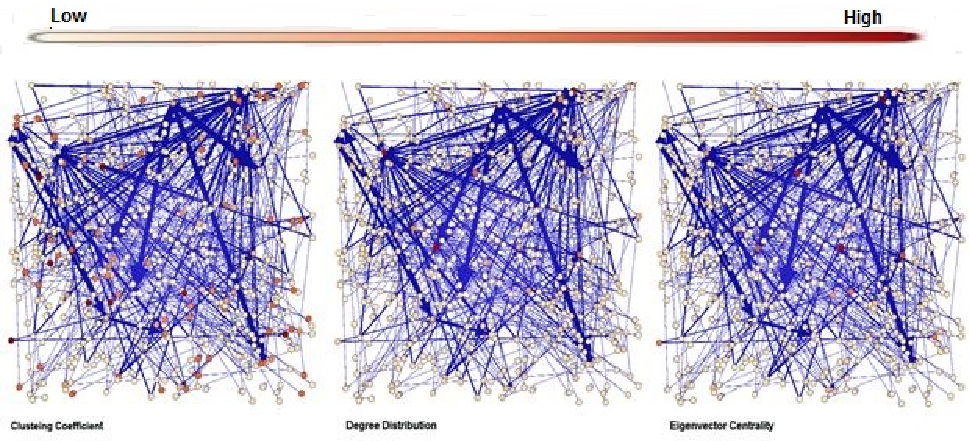 Figure 1: The complex web of interactions showing dense clusters and central influencers.
Experiments and Structural Insights
The study quantified the network's health using several key metrics:
- Clustering Coefficient (0.103): Indicates a localized "buddy system" where friends of users are also friends with each other.
- Density (0.003): While the network is vast, it is sparse, meaning most users only interact with a tiny fraction of the total participants.
The Power of Hubs
The research highlights the disproportionate influence of "Mainstream" nodes. Analyzing accounts like @narendramodi and @arunjaitley, the authors observed high Eigenvector Centrality, meaning these nodes aren't just connected—they are connected to other highly connected people, amplifying their reach.
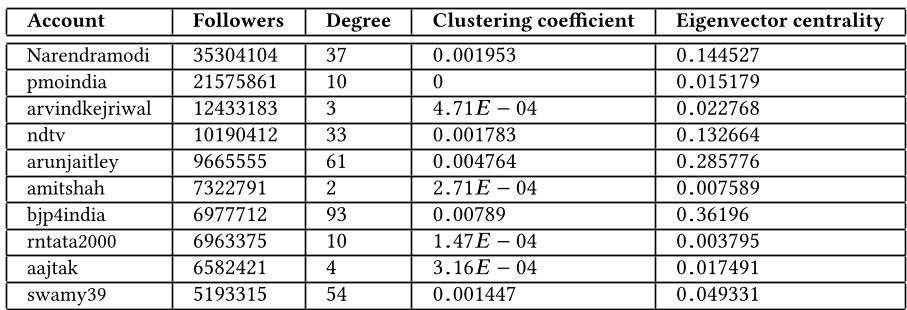 Table 1: Centrality measures for top Indian Twitter accounts during the GST launch.
Findings: The Sentiment Gap
The most striking result from the sentiment analysis was the disparity in public opinion. Despite the government's push for a "One Nation, One Tax" narrative, the Twitter corpus leaned heavily negative.
- Positive Sentiment: 38%
- Negative Sentiment: 62%
This negative tilt suggests that during the initial "Midnight Launch," concerns regarding implementation, complexity, or economic impact outweighed the perceived benefits in the digital discourse.
Critical Analysis & Conclusion
While the paper provides a solid snapshot of public sentiment, it acknowledges the limitations of the 140-character era. The "Echo Chamber" effect observed implies that negative sentiment may have been amplified by the Small World structure, where polarized views circulate rapidly within specific clusters.
Takeaway: For policymakers, this research proves that social media isn't just "noise"—it is a structured, measurable network that can provide a "temperature check" on national reforms within 24 hours of implementation. Future work could benefit from Temporal Analysis to see if this 62% negativity subsided as the tax system stabilized.