
Physician Networks: Why "Weak Ties" Dictate how Doctors Prescribe
Social-network analysis in healthcare: analysing the effect of weighted influence in physician networks
This paper introduces a weighted social network analysis (SNA) approach to model physician relationships and the diffusion of pain medications. By moving beyond binary links to weighted edges based on organizational and professional similarities, the authors achieve significantly higher accuracy in predicting real-world medication adoption patterns in a large US healthcare dataset.
TL;DR
Medicine doesn't just spread through journals; it spreads through people. This research proves that a physician’s prescribing behavior is heavily influenced by their professional network. By replacing simplistic "yes/no" connections with weighted influence models, the researchers were able to predict medication adoption with over 90% accuracy, highlighting that co-workers in the same hospital group (IDN) are the true engines of medical innovation.
Background: The Binary Blind Spot
In the world of Social Network Analysis (SNA), we often assume that if two people work together, they influence each other equally. However, in a complex hospital environment, this is rarely true. Most prior work used Binary Relationships, treating a close mentor the same as a casual acquaintance. The authors of this paper argue that this lack of "tie strength" data leads to massive misinformation in sociomedical research.
Methodology: Quantifying the "Vibe" of Professional Ties
The researchers utilized a massive dataset of US physician affiliations (HCOS) and prescription histories. They compared three distinct architectures:
- Binary Approach: Standard 0 or 1 connection.
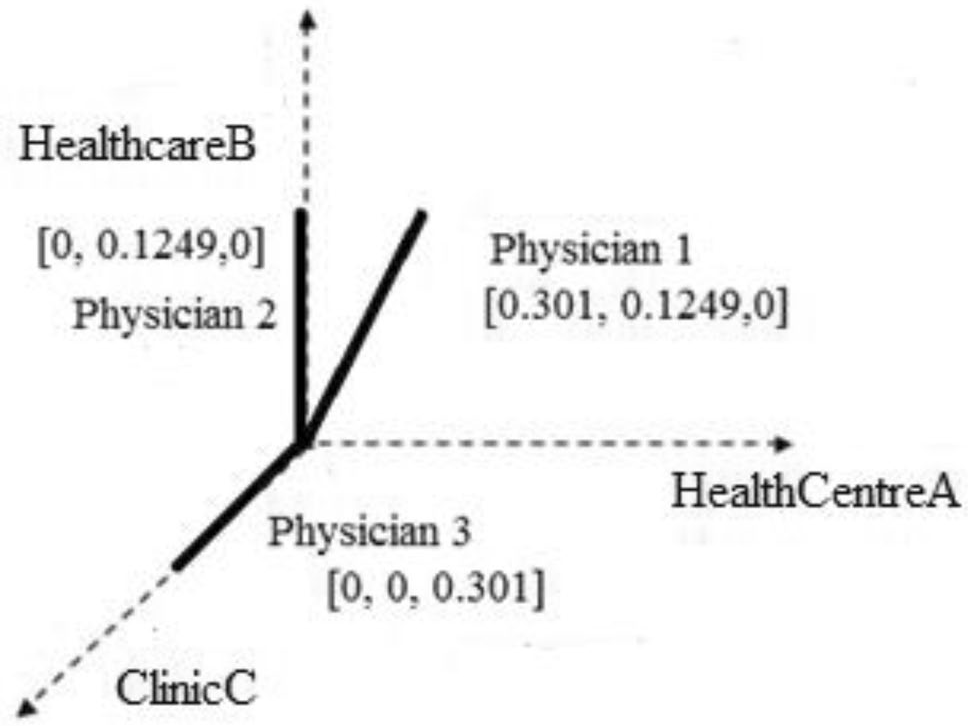
- Weighted-Equal (W-EW): Every shared attribute (Specialty, Hospital, etc.) adds a fixed weight.
- Weighted-Unequal (W-UW): Uses TF-IDF (Term Frequency-Inverse Document Frequency) to calculate similarity.
The Intuition of Weighted-Unequal (W-UW)
The brilliance here lies in the TF-IDF logic: if two physicians share a rare specialty (e.g., Nephrology), their connection is weighted more heavily than if they both practice General Medicine. This mimics the real-world intuition that specialists in niche fields are more likely to know and influence one another.
Experiments: Testing Medication Diffusion
The team tracked the adoption of four highly prescribed pain medications (N, U, V, and P). They used the General Threshold Model, where a physician adopts a drug once the "influence pressure" from their neighbors exceeds a certain threshold.
Key Result: The Triumph of Weights
The difference in predictive power was staggering. In a 6-month window, the Weighted-Unequal model predicted 90-97% of actual influence edges, while the traditional binary model sat at a dismal 5%.
Deep Insight: The Power of the IDN
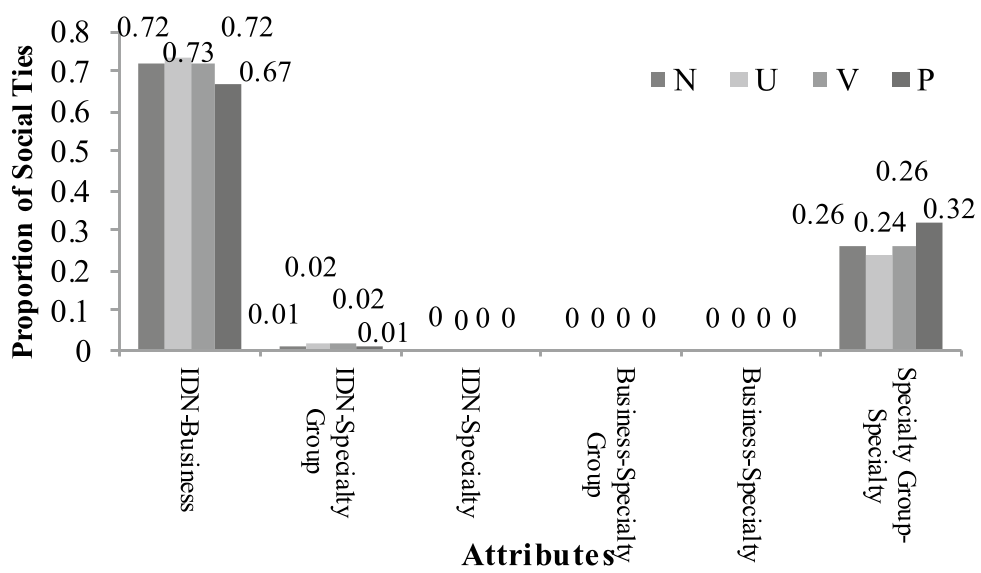
Analysis showed that the highest volume of influence didn't come from sharing the same specialty. Instead, it came from being in the same Integrated Delivery Network (IDN) and Hospital.
This confirms Granovetter’s famous "Strength of Weak Ties" theory: information in healthcare travels most effectively through broad professional networks (acquaintances at the same hospital group) rather than through tight-knit, insular circles (homophilic specialty groups).
Critical Analysis & Conclusion
Takeaway
- Tie Strength Matters: Binary networks are insufficient for modeling healthcare diffusion.
- Organizational Influence: Hospital and IDN affiliations are the primary drivers of adoption, likely due to shared protocols and frequent informal interactions.
Limitations
The study assumes "influence" based on the timing of prescriptions. In reality, external factors (pharmaceutical reps, insurance changes) also play roles. Furthermore, the Activation Threshold () was randomized; future work should attempt to learn this threshold from behavioral data.
Future Outlook
As healthcare moves toward Big Data, these weighted models will be essential for public health officials to disseminate life-saving guidelines effectively. By identifying the "weighted hubs" in physician networks, we can ensure that the best medical practices spread faster than ever before.