
The Social Fabric of Elites: Analyzing High-Level Player Networks in League of Legends
Social Network Analysis of High-Level Players in Multiplayer Online Battle Arena Game
This paper presents a social network analysis (SNA) of League of Legends (LOL) players, specifically focusing on high-level competitive tiers. By leveraging official API data, the authors construct a friendship network based on team formations and analyze the interplay between player rank and social connectivity.
TL;DR
Is being "challenger" a lonely road? This study applies Social Network Analysis (SNA) to League of Legends (LOL) to uncover how the best players in the world form teams. By crawling data from the Korean server, researchers found that while most players stick to their own rank, elite players (Challenger and Master) actually maintain smaller social circles than their Diamond counterparts, often forced to bridge the gap between tiers due to a limited talent pool.
Problem & Motivation: Beyond the Matchmaking Algorithm
In MOBA games like League of Legends, the focus of data science is usually on win rates, gold-per-minute, or individual skill. However, LOL is inherently social. Players don't just exist in a vacuum; they form teams, build communities, and interact much like users on Twitter or Facebook.
The motivation behind this research is to understand the Social Structure of these interactions. Current matchmaking systems primarily use Elo-based skill ratings, but they often ignore the "who-knows-who" element. By understanding how high-level players choose their teammates, developers can improve matchmaking fairness and team-building features.
Methodology: Mapping the Summoner's Rift
The researchers built a custom crawler targeting the top players on the South Korean server—widely considered the most competitive region in the world.
- Seed Selection: Started with the top 100 players.
- Edge Definition: In this network, an "edge" (link) exists between two players if they are part of the same organized team.
- Tier Segmentation: Players were categorized into leagues: Challenger (Top), Master, Diamond, and Platinum.
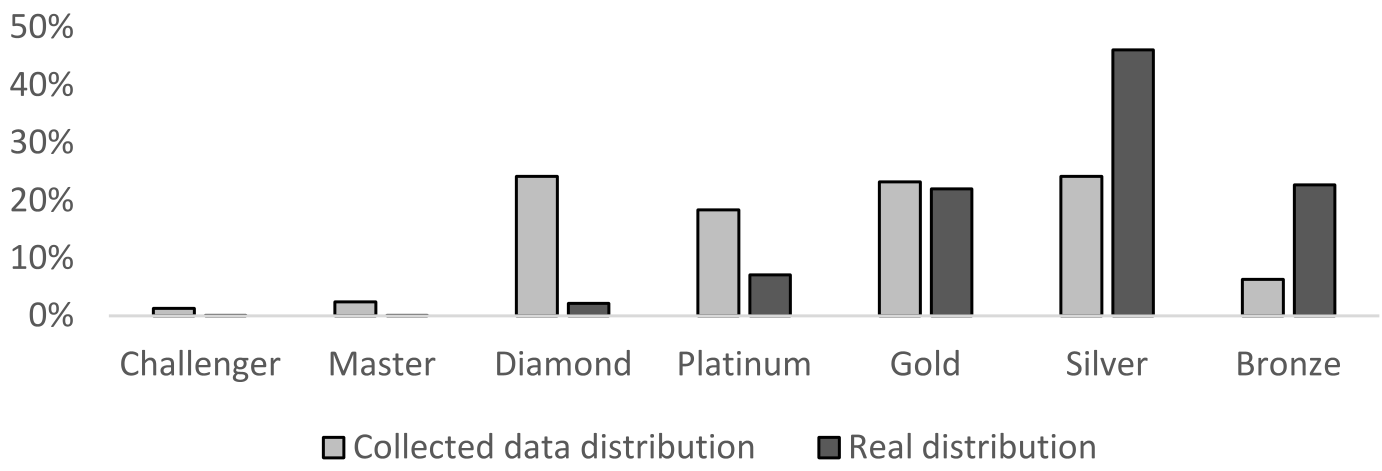
The methodology focuses on the "Social Graph" behavior: do high-ranked players have more friends because they are "famous," or fewer because they are highly exclusive?
The "Lone Wolf" Effect at the Top (Results)
The data provided several counter-intuitive insights into the social behavior of elite gamers:
- Friendship Density: Diamond players were the most "social," with an average of 3.103 friends. In contrast, Challengers had the lowest social connectivity, averaging only 2.139 friends. This suggests that as skill increases, the pool of "acceptable" teammates shrinks, leading to more exclusive and smaller social circles.
- Rank Homophily: As shown in the cross-league analysis table, players strongly prefer their own rank. For instance, 41.3% of Diamond players' teammates are fellow Diamonds.
- The Master-Diamond Bridge: Interestingly, Master-tier players showed a higher tendency to play with Diamond players (14.2%) than with Challengers (1.4%). This is likely due to the "Scarcity Effect"—there simply aren't enough Challengers online at any given time to form a full social team.
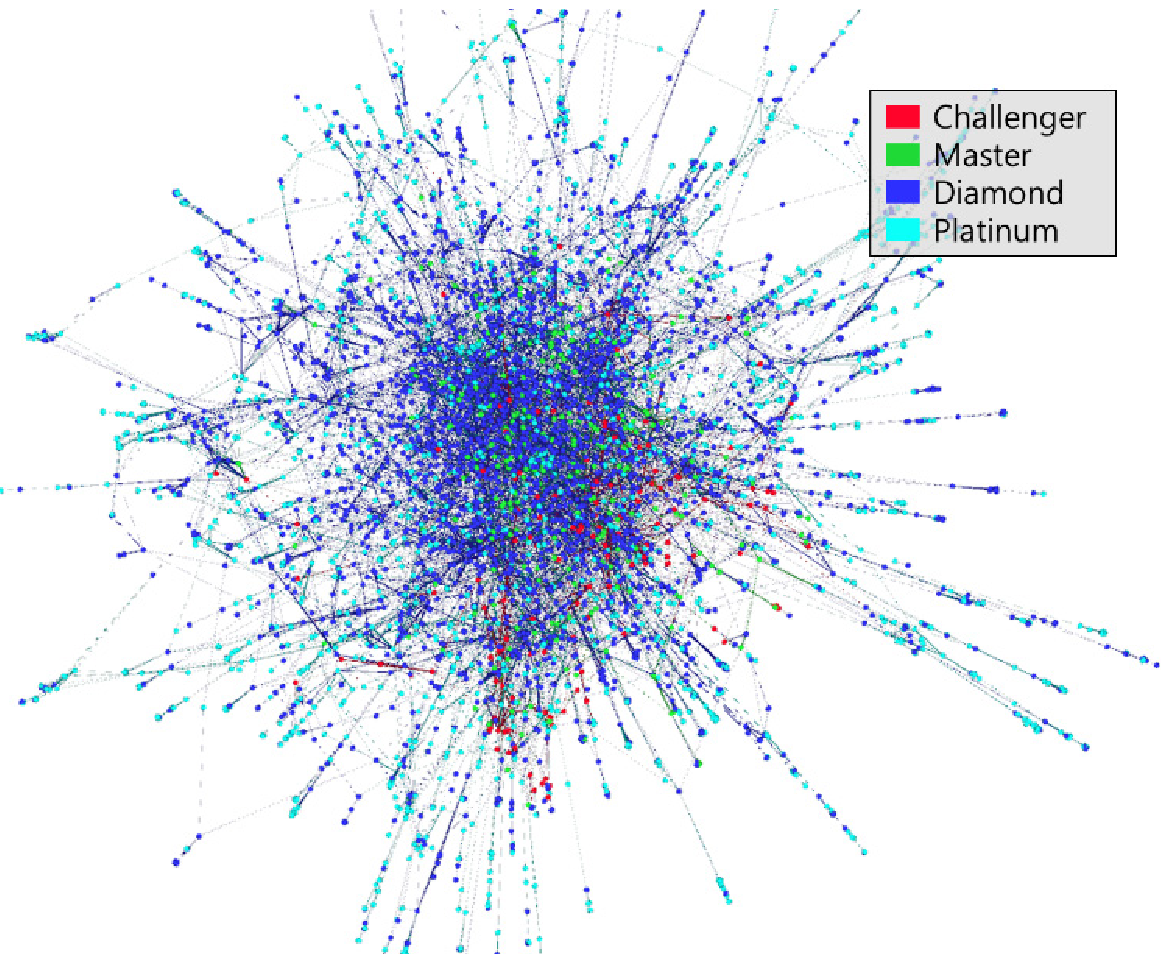 Fig: Visualization of the core social network of ~6,000 players.
Analysis & Takeaways
This paper provides a unique look at how professional-level skill impacts social behavior. The key takeaway is that higher rank leads to social concentration. While mid-tier players have a wide net of potential friends, the "Apex" players form a highly insular community.
Limitations
The study was conducted in 2014, and LOL's social features (like the transition from ranked teams to "Flex Queue") have evolved. Furthermore, the seed-based crawling method naturally biases toward the top of the ladder, leaving the "Bronze" and "Silver" social structures largely unmapped.
Future Directions
For developers, these results suggest that matchmaking for elite players shouldn't just look at MMR (Matchmaking Rating) but also at Social Latency—how long it takes to find a peer from a player's already small social circle. Understanding these graphs is the first step toward building "Smart Clans" that can predict which players will synergize based on their shared network neighbors.