
The Architecture of Power: Decoding French Corporate Interlocks via Social Network Analysis
A Social Network Analysis of Interlocking Directorates in French Firms
This study employs Social Network Analysis (SNA) to investigate interlocking directorates among French listed companies (CAC 40 and SBF 250 indices) across 1996, 2005, and 2010. It systematically maps the bipartite board-director relationship to identify structural shifts and the dominance of financial institutions.
Executive Summary
TL;DR
This research dissects the "social fabric" of the French economy by analyzing interlocking directorates—the practice of shared board members—across major listed firms. By applying Graph Theory, the study reveals that while the network is becoming less dense due to regulatory pressures, it remains a "small world" dominated by massive financial hubs.
Academic Positioning
This work transitions from a purely financial view of corporate governance to a Structuralist perspective. It positions the French corporate landscape as a "Cohesive Core" system, contrasting it with the more fragmented models found in the US or UK.
Problem & Motivation: Beyond "Rubber-Stamp" Boards
Traditional management theory often views boards of directors as passive entities. However, the author argues that boards are active nodes in a resource-exchange network. The motivation for this study stems from a critical gap: while we know firms are connected, we lack a longitudinal understanding of how these connections evolve under changing governance codes (like the Viénot Reports) and whether a firm’s market capitalization dictates its strategic "reach" in the boardroom.
Methodology: The Bipartite Duality
The study treats boards and directors as a Two-Mode (Affiliation) Network.
- Nodes: Mode 1 consists of Directors; Mode 2 consists of Boards (CAC 40/SBF 250).
- Edges: A link exists if an individual sits on a specific board.
By transforming this bipartite graph into a one-mode projection (firm-to-firm), the author measures Degree Centrality (number of direct partners) and Betweenness (the "brokerage" potential of a firm).
(Note: Architecture involves the mapping of shared directors between CAC 40 and SBF 250 indices to identify central "hubs" like BNP Paribas.)
Experiments & Results: The Rise and Fall of Dense Ties
1. The Thinning Network
The data shows a clear trend: the "Old Boys' Club" is shrinking. In 1996, the number of directors holding 5+ positions was significant; by 2010, this had plummeted. This is a direct result of French governance reforms designed to limit directorships to three.
2. The Dominance of "Big Finance"
The research confirms that Financial institutions are the undisputed masters of the network. Centrality scores for banks like Société Générale and BNP Paribas consistently top the charts.
| Measure | 1996 (SBF 250) | 2010 (SBF 250) |
|---|---|---|
| Density | 0.0424 | 0.0220 |
| Clustering Coeff. | 0.444 | 0.386 |
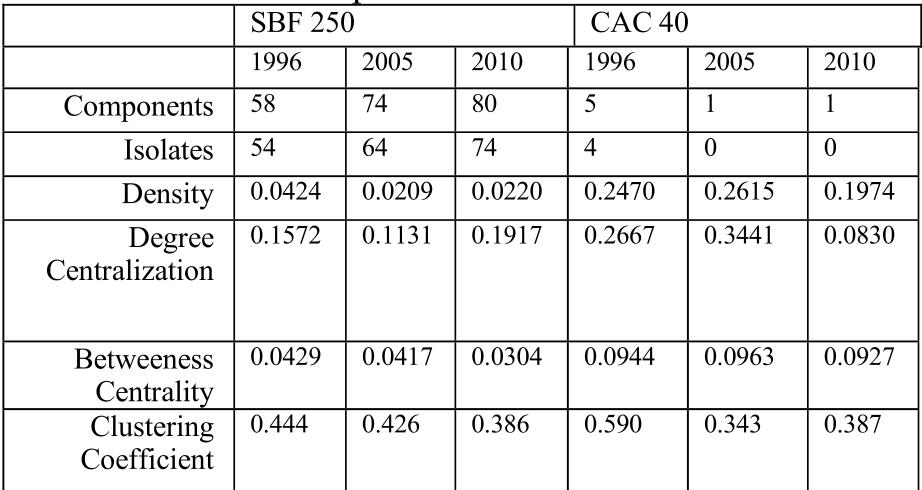 Table 3: Comparative Network Measures highlighting the drop in density and degree centralization over time.
3. Size Matters
A key finding is the Positive Correlation (0.365)* between a firm's weight in the index (Market Cap) and its Degree Centrality. In the French market, the "location" of a firm in the social graph is a function of its economic scale. Large firms don't just have more money; they have better information lanes.
Critical Analysis & Conclusion
The "Cohesive Core" Paradox
Despite a decline in overall density, the French network remains more centralized than its Anglo-Saxon counterparts. This suggests an Elite Persistence: while the total number of links has decreased, the links that remain are concentrated among a few "power brokers."
Limitations & Future Outlook
- Static Snapshots: The study relies on 1996, 2005, and 2010 snapshots. Real-time dynamic analysis could reveal more about how networks react to crises (like the 2008 crash).
- Performance Linkage: The big "so what?"—does being central actually make a firm more profitable?—remains a fertile ground for future research.
Final Takeaway
For investors and regulators, this paper proves that Corporate Governance is a network property. You cannot understand a firm’s strategy without understanding who sits at its table and where those individuals go once the meeting is over.