
Digital Resistance: Decoding the Social Topology of Iran's Green Movement
Social Network Analysis of Iran's Green Movement Opposition Groups Using Twitter
This paper presents a Social Network Analysis (SNA) of the 2009 Iranian Green Movement using Twitter data. By employing a heuristic crawling algorithm and SNA metrics, the authors characterize the topological properties and information dissemination roles within this digital political landscape, identifying a distinct polarized and hybrid structure.
TL;DR
The 2009 Iranian post-election protests marked a turning point where social media transitioned from a networking tool to a vital infrastructure for political survival. This study provides the first quantitative Social Network Analysis (SNA) of the "Green Movement" on Twitter, revealing a polarized, highly resilient, yet hierarchical digital ecosystem capable of bypassing state media blockades.
Problem & Motivation: The Science of Digital Dissent
The 13th of June, 2009, shattered the status quo in Iranian politics. As traditional opposition media were suppressed, the "Green Movement" moved to Twitter, Facebook, and YouTube. However, from a technical perspective, a critical question remained: How is a seemingly leaderless, decentralized movement organized?
Prior sociological studies captured the "spirit" of the movement, but lacked the mathematical framework to explain why the movement was so hard to silence. The authors sought to map the structural skeleton of this dissent, investigating whether the network was truly decentralized or if it hid a shadow hierarchy.
Methodology: Mining the Pulse of a Movement
To reconstruct the network, the researchers utilized a custom-built C# crawler targeting six specific semantic categories: Media, Places, Dates, People, Election, and Repression.
1. Data Engineering
The outcome was a massive graph:
- Actors: 280,565
- Relations: 856,056
- Density: 0.0000109 (A classic sparse "social" structure)
2. Strategic Visualization
By applying the Yifan Hu and Force Atlas algorithms, the researchers were able to pull the abstract relationships into a visual map, where nodes are positioned based on their attraction and repulsion—essentially a physical simulation of social influence.
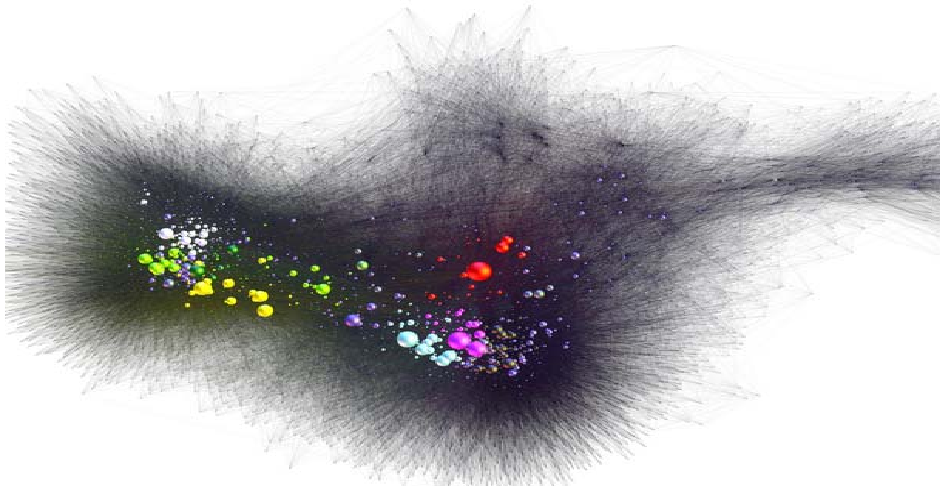 Figure 1: Visualization of the polarized network, showing the dense opposition core (right) versus the government supporter pole (left).
Methodology Highlights: The Role of Centrality
The study moves beyond simple "follower counts," utilizing Centrality Measures:
- Degree Centrality: Identifying the "popular" actors.
- Closeness Centrality: Measuring how quickly information propagates.
- Liaison Roles: Identifying the "bridges" that connect disparate clusters.
Key Insights: A Polarized & Resilient Hybrid
The analysis reveals several groundbreaking characteristics of the Iranian digital landscape in 2009:
1. The Polarization Polemic
The network is not a single monolith. It is sharply divided into two poles:
- Opposition Pole (70%): Massive, dense, and highly active.
- Government-Supporter Pole (24%): Smaller but distinct.
- Neutral/News Pole (2%): Despite being the smallest group, these produce the most information, acting as raw data sources for the other two poles.
2. High Resilience via Liaisons
The movement’s strength lies in its Liaison roles. Because many actors act as redundant brokers between groups, the network is incredibly "reliable." If the government were to arrest or block one central actor, information would simply flow through another path. This redundancy is what made the movement so difficult to suppress online.
3. The Vulnerability of the Active Core
While the network is decentralized in its outer layers, it possesses a strongly connected active core of roughly 9,500 actors. This group is responsible for "inducing" information into the network. This reveals a paradox: while the movement looks leaderless, it is highly dependent on a small percentage of information architects.
Critical Analysis & Future Outlook
This paper, published shortly after the events, correctly identified the shift toward "Networked Geopolitics."
Limitations: As an early work in this space, the study relies on a heuristic crawl that may miss "private" interactions. Furthermore, the 2009 Twitter environment was significantly different from today's "bot-heavy" landscape.
Takeaway for Today: The "Hybrid" structure found here—decentralized for resilience but centralized for information injection—is now the standard model for modern social movements. For researchers and technologists, it highlights that survival is a function of liaison redundancy, while influence is a function of gatekeeper scarcity.
References
- Bastian, M., et al. (2009). Gephi: An Open Source Software for Exploring and Manipulating Networks.
- Hu, Y. (2006). Efficient, High-Quality Force-Directed Graph Drawing.