
RLVECO: Enhancing Social Network Analysis via Hybrid Knowledge-Graph Embeddings and Convolutional Logic
Social Network Analysis using Knowledge-Graph Embeddings and Convolution Operations
This paper introduces RLVECO, a hybrid deep learning framework for Social Network Analysis (SNA) that combines Knowledge-Graph Embeddings (VE) and 1D Convolutional Operations (CO). The model excels in link prediction and node classification across diverse social graphs, achieving state-of-the-art performance by leveraging biform representation learning.
TL;DR
Social Network Analysis (SNA) is evolving beyond simple graph traversal. This paper proposes RLVECO, a hybrid deep learning framework that integrates Knowledge-Graph Embeddings (VE) and Convolutional Operations (CO). By using a biform representation learning strategy, the model achieves superior performance in link prediction and node classification, outperforming established baselines like GCN and Node2Vec on major benchmarks including Cora and CiteSeer.
The Structural Challenge in Social Graphs
Social networks are notoriously difficult to model because they are both complex and non-static. Traditional Machine Learning models often fail to capture the "hidden" properties of actors (nodes) and their ties (edges).
The authors identify a specific gap: most SOTA models rely on a single representation learning (RL) layer. While GCNs use spectral convolutions and Node2Vec uses biased random walks, they often miss the nuanced, hierarchical feature extraction possible when combining embedding spaces with convolutional kernels.
Methodology: The RLVECO RL Kernel
The core innovation of RLVECO lies in its two-fold Representation Learning layer. Instead of passing raw graph data directly to a classifier, the data undergoes a sophisticated transformation:
- Stage 1 - Knowledge-Graph Embedding (VE): Actors are mapped to a -dimensional real space where the cosine distance captures the correlation between nodes.
- Stage 2 - Convolution Operations (CO): A 1D convolutional layer processes these embeddings to extract local latent features. This is followed by ReLU activation for non-linearity and Max Pooling for dimensionality reduction.
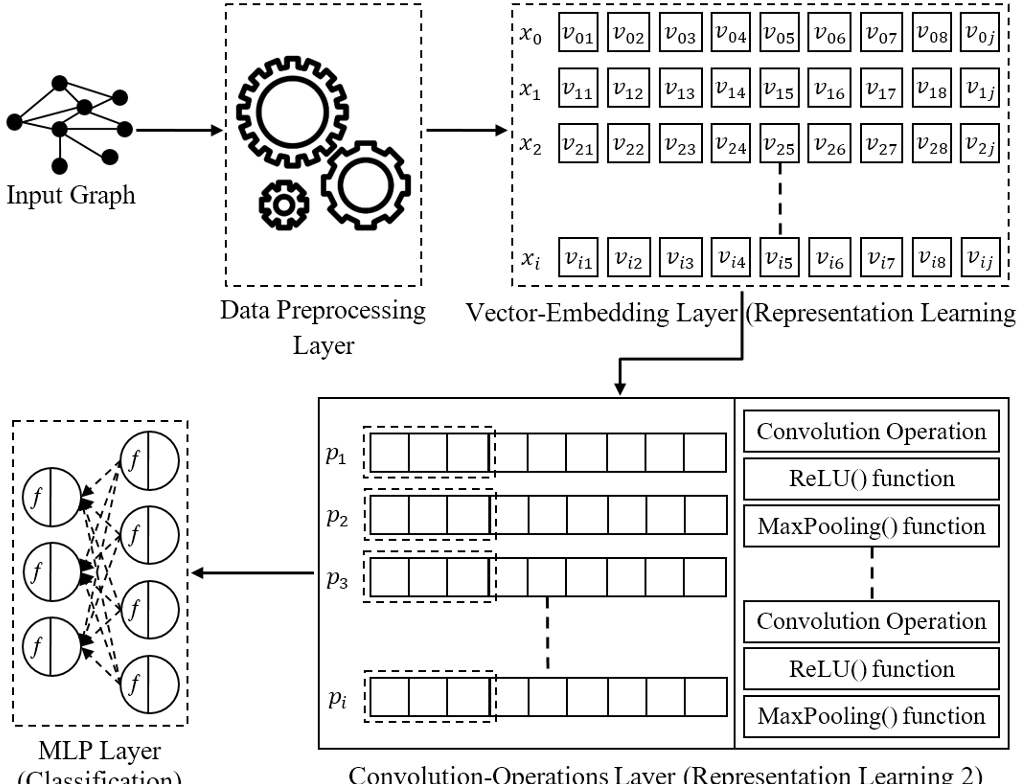
The logic is intuitive: the VE layer handles the "global" positioning of actors in a latent space, while the CO layer acts as a "local" feature extractor that understands the neighborhood context.
Experimental Battleground: SOTA Comparisons
The authors conducted extensive benchmarking across four major datasets: CiteSeer, Cora, Facebook Page-Page, and PubMed-Diabetes.
1. Link Prediction
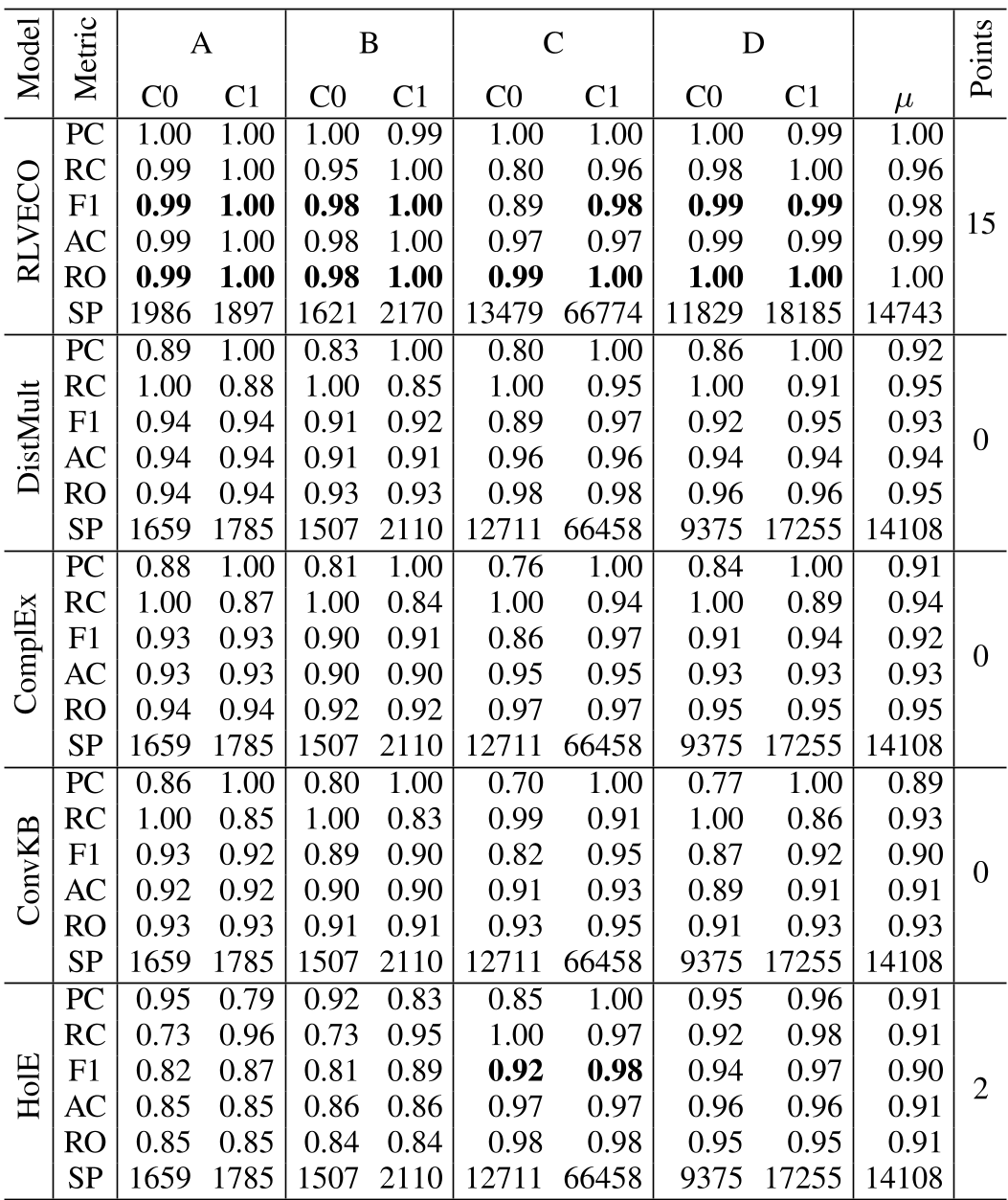
In the task of predicting whether a tie exists between two actors, RLVECO showcased near-dominant performance. Compared to specialized embedding models like DistMult and ComplEx, RLVECO maintained higher Precision and Recall across the board.
2. Node Classification
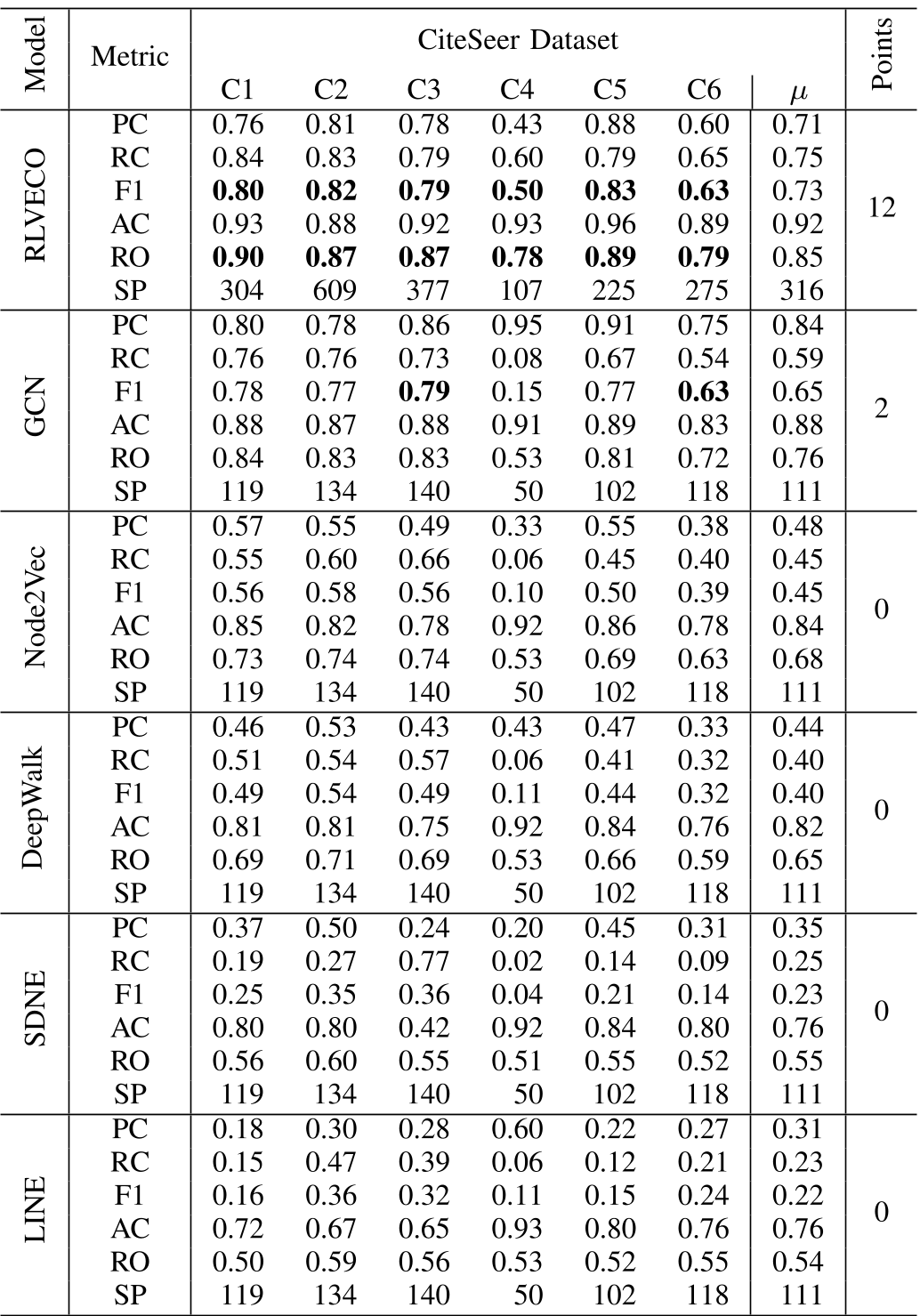
On the CiteSeer dataset, RLVECO outperformed the famous Graph Convolutional Network (GCN). While GCN achieved a mean accuracy (AC) of 0.88, RLVECO pushed the boundary to 0.92. The performance gap was even wider against older methods like DeepWalk and LINE, highlighting the efficacy of the hybrid approach.
Critical Analysis & Insights
Why does RLVECO work so well?
- Feature Synergy: By treating the social graph as a Knowledge Graph, the model can apply triadic logic (head, relation, tail) which is more expressive for certain types of link prediction.
- Preprocessing Quality: The authors emphasize a strict transcoding of categorical data into discrete numeric formats without semantic loss, ensuring the neural network receives high-entropy signals.
- Regularization: The use of L2 regularization, Dropout, and a specific "Neuron Pruning" formula helped the model avoid the common pitfall of overfitting in Dense/MLP layers.
Limitations: One notable constraint is that RLVECO requires a systematic preprocessing stage to transcode entities. Furthermore, while it outperforms GCN in accuracy, GCN's ability to handle raw vectorized features directly (when available) remains a strength RLVECO aims to integrate in future iterations.
Future Outlook
The success of RLVECO suggests that the future of SNA lies in hybridization. Moving forward, the research team intends to scale the model to even larger datasets and explore other open problems in social network analysis, such as community detection and influence maximization.