
Beyond the Graph: Bridging Social Network Mining and Business Strategy
Social Network Analysis and Mining for Business Applications
2011-04-01
Summary
Problem
Method
Results
Takeaways
This comprehensive review integrates Social Network Analysis (SNA) and mining techniques with the APQC Business Process Classification Framework. It categorizes key methodologies—including community detection, influence propagation, and expert finding—mapping them directly to real-world corporate functions like Marketing, CRM, and Knowledge Management.
## TL;DR
While most data scientists view social networks as abstract nodes and edges, this work provides a roadmap for translating graph theory into business value. By mapping technical domains—Trust, Communities, and Propagation—to the **APQC Process Classification Framework**, the authors reveal how social mining can revolutionize Churn Prediction, Viral Marketing, and Internal Knowledge Management.
## The Missing Link: Why Graph Theory Often Fails in Business
The fundamental pain point identified by Bonchi et al. is the **deployment gap**. Academics frequently treat nodes as anonymous entities, focusing on "Small World" phenomena or degree distributions. However, in a corporate setting, a node is a customer with an LTV (Life Time Value) or an employee with specific expertise.
The paper argues that treating customers as isolated individuals is a relic of 20th-century marketing. Instead, today's business intelligence must account for **Implicit Connections**—relationships inferred from repeated SMS logs, co-visitation patterns on social pages, or proximity logs.
## Methodology: The Technical Toolkit for Business
The authors categorize the "Business of SNA" into four critical pillars:
### 1. Reputation and Expert Finding
Centrality measures like **PageRank** and **HITS** are adapted to find "Social Prestige."
- **Physical Intuition**: An expert isn't just someone with the right keywords in their profile; they are a "hub" in the interaction history graph.
- **Application**: Routing customer support tickets to the right internal specialist based on their "Local Trust" score within a specific topic domain.
### 2. Community Structure and Network Dynamics
Determining how groups form and disappear over time.
- **Core Mechanism**: Using **Modularity Maximization** to find dense clusters.
- **Insights**: The "Forest-Fire Model" describes how new nodes connect to subgraphs, mimicking a fire spreading through a network.
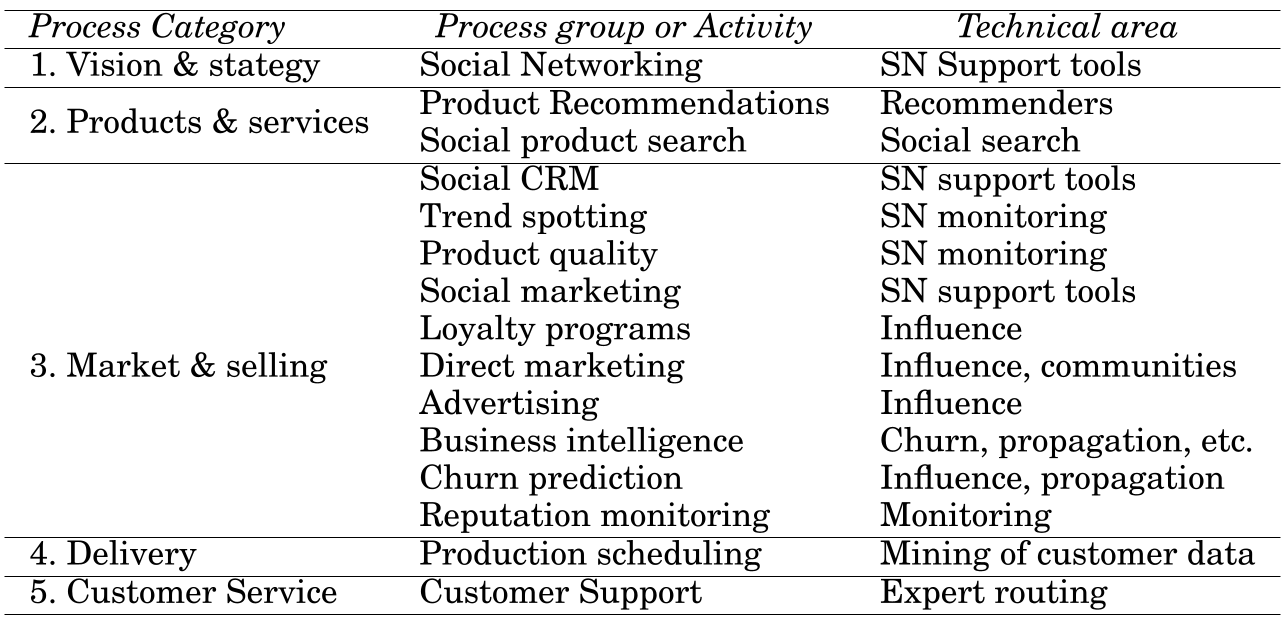
*Table: Mapping technical areas like Recommenders and Influence to specific Business Categories.*
### 3. Influence Propagation (The Viral "Free Lunch")
Viral marketing involves targeting a small "seed set" to trigger a cascade.
- **The Challenge**: Distinguishing between **Contagion** (I bought it because you did) and **Homophily** (We both bought it because we are similar).
- **Optimization**: Selecting the most influential nodes is NP-hard, but **Greedy Algorithms with Submodular Functions** provide a 63% (1 - 1/e) approximation of the optimal spread.
## Critical Results and Business Churn
One of the most impactful applications discussed is **Churn Prediction**. In telecommunications, if a "hub" individual leaves a network, their peers are significantly more likely to follow. By using SNA to identify these high-risk hubs, companies can apply targeted retention strategies that are far more cost-effective than broad-spectrum discounts.
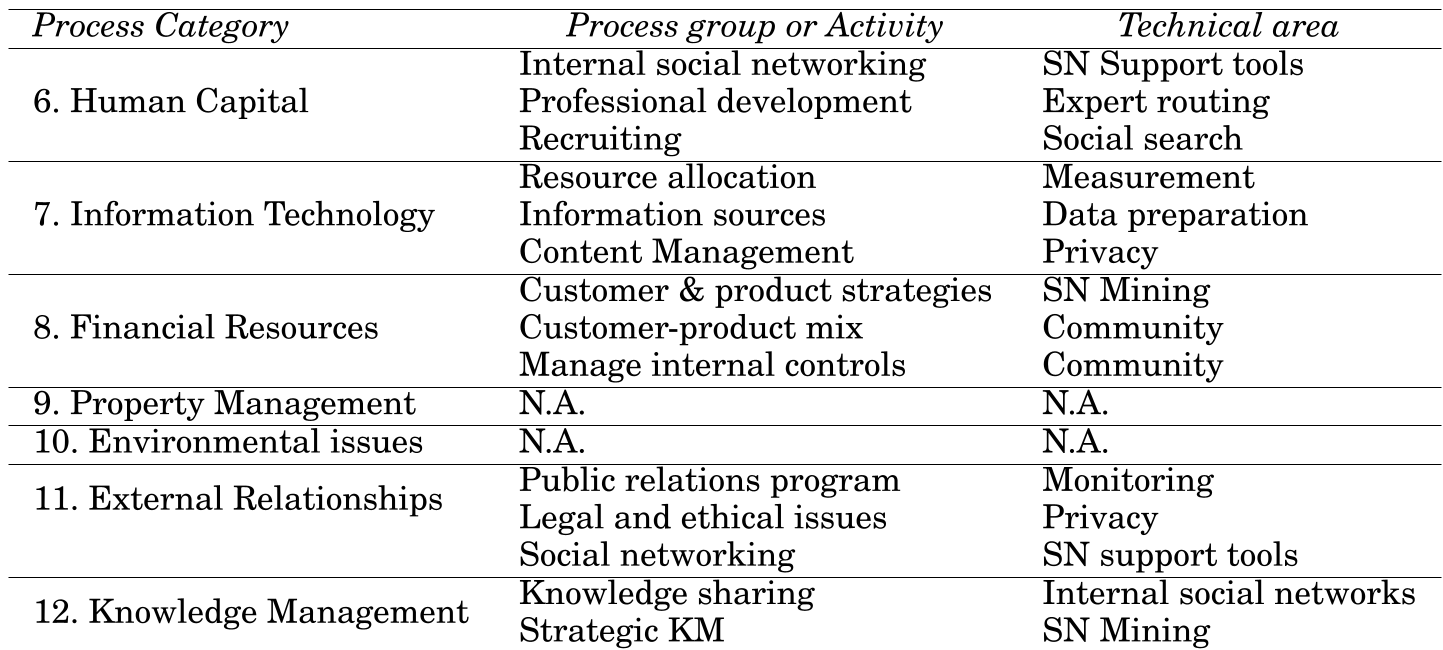
*Table: Applications in Human Capital and Information Technology, focusing on Internal Knowledge Sharing.*
## Deep Insight: Privacy as a Business Constraint
A standout section of the paper addresses **Anonymization**. The authors warn that simply removing names (PII) is insufficient. Due to the "Small World" property, the **topology** itself can act as a fingerprint.
- **Takeaway**: Businesses must find a balance between "Data Hiding" and "Data Disclosure," using techniques like k-anonymity or noise addition to prevent structural re-identification.
## Conclusion: The Future is Social
The authors conclude that "Computational Social Science" will fundamentally change how corporations communicate. The shift moves from static Intranets to dynamic, presence-aware collaboration tools where **Expert Routing** and **Knowledge Capitalization** are automated.
**Limitations**: The paper notes that cultural factors and varying legal ethics across borders remain major roadblocks that algorithms alone cannot solve. However, for the data scientist, the message is clear: the network is not just a data structure—it is the strategy.