
Deciphering the Digital Heart: A Social Network Analysis of Online Dating
Social network analysis of an online dating network
This paper presents a comprehensive Social Network Analysis (SNA) of a major Australian online dating platform. By applying graph theory metrics like Bow-Tie structure, reachability, and degree centrality, the authors characterize user behavior and interaction patterns to inform the design of more effective "people-to-people" recommendation systems.
TL;DR
Online dating is more than just a search engine for partners; it is a complex, dynamic social ecosystem. This research analyzes a snapshot of a leading Australian dating network to reveal that while we claim to have "deal-breakers," we ignore them 90% of the time. By mapping the network using graph theory, the authors provide a blueprint for next-generation recommendation systems that focus on action rather than description.
The "Say-Do" Gap: Why Current Matching is Broken
The fundamental motivation for this study is a classic human paradox: we don't know what we want until we see it. Current platforms heavily rely on explicit filters—height, education, smoking habits—yet users consistently engage with people who fall outside these self-imposed boundaries. Existing recommendation systems fail because they treat dating like buying a vacuum cleaner on Amazon (item-item) rather than a bilateral social interaction where popularity and network position (Inductive Bias) play a massive role.
Methodology: Mapping the Dating Graph
The authors modeled the dating network as a Bipartite Graph, where edges represent directed communication (messages/emails) between male and female nodes.
1. The Bow-Tie Structure
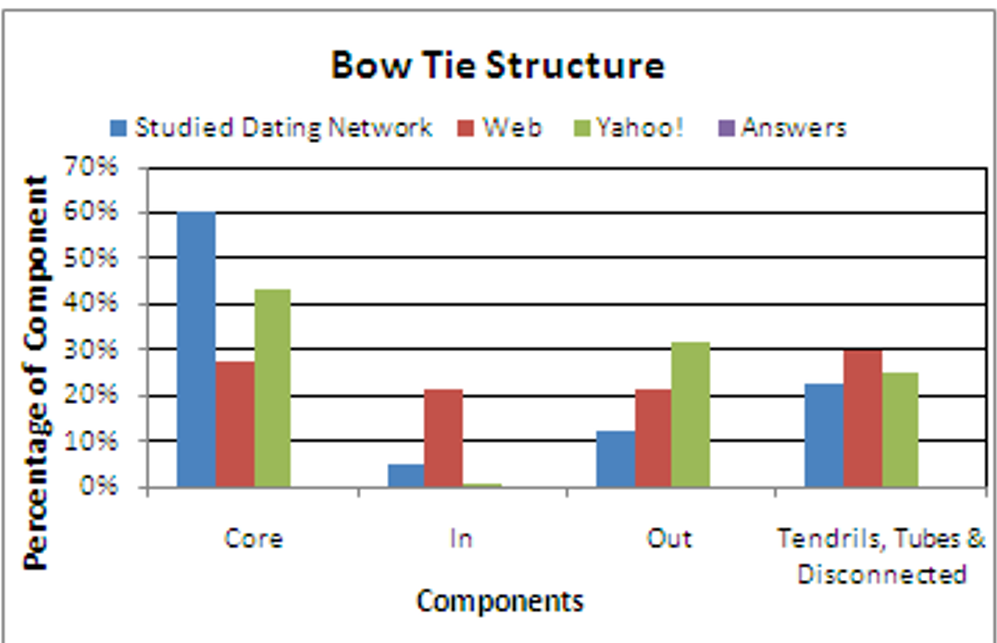
To understand the macro-dynamics, the study used the Bow-Tie model, identifying that 60% of users reside in the SCC (Strongly Connected Component) or "Core." This is significantly higher than general web graphs, indicating a highly engaged community where information flows freely.
2. Popularity and the Power Law
By analyzing Indegree (popularity) and Outdegree (activity), the researchers confirmed that dating networks follow a Power Law distribution. A tiny fraction of "elite" users receive the vast majority of attention, while the "long tail" of hundreds of thousands of users receives very few interactions. This suggests that "prestige" is a critical feature for any ranking algorithm.
3. Attribute Breakage Analysis
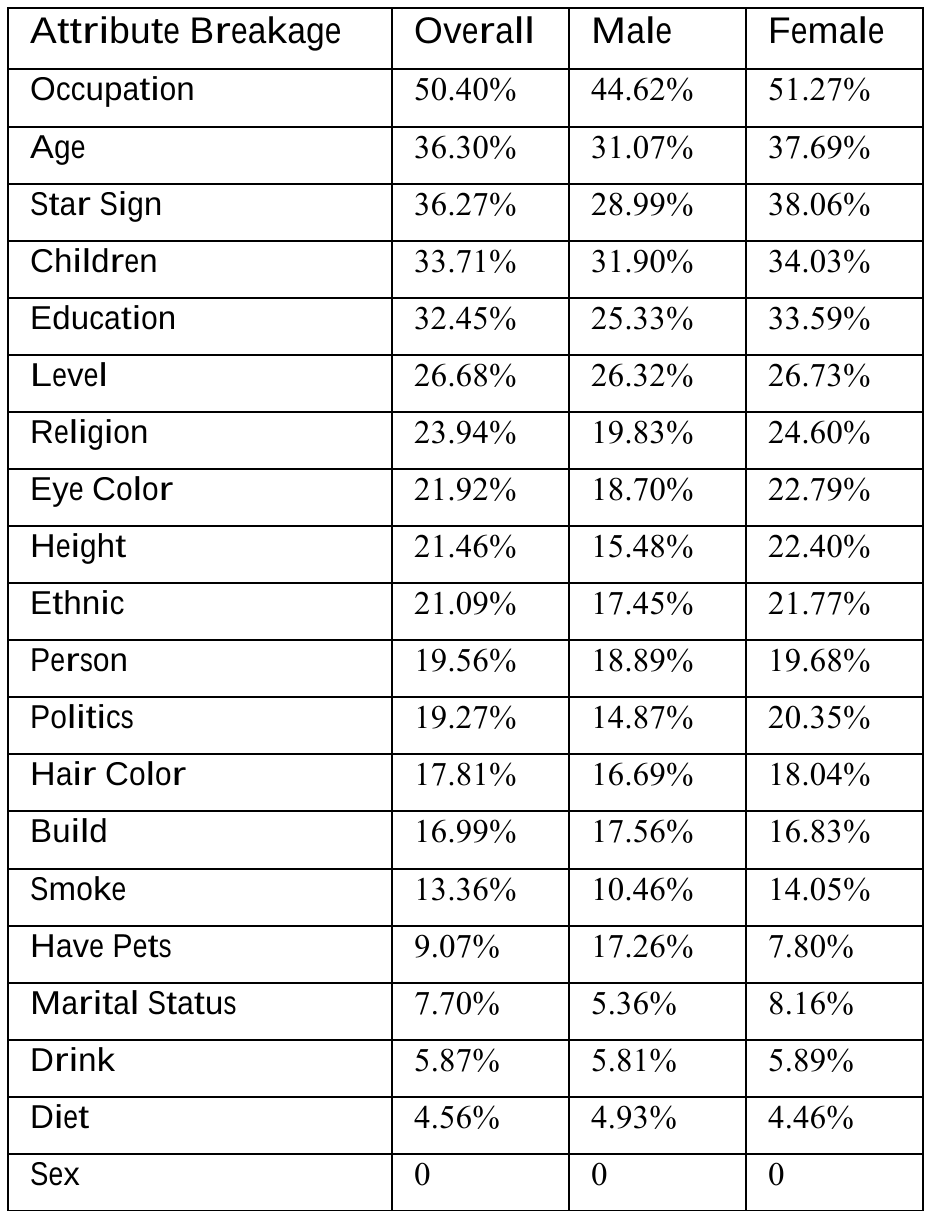
This is the most striking part of the methodology. The authors tracked "successful" messages (where a reply was sent) and compared the receiver's profile against the initiator's stated "Ideal Partner" criteria.
Key Results and Insights
The 90% Rule
In 90% of successful matches, at least one preference was broken. This proves that stated preferences are "soft" rather than "hard" constraints.
- The Most Broken Attribute: "Occupation" topped the list, with an overall breakage rate of ~50.4%.
- The Age Paradox: While users rank "Age" as the second most important attribute in their profiles, message receivers were surprisingly tolerant, overriding age preferences frequently to respond to interested parties.
Small World, No Clusters
The network showed a small-world phenomenon (Average path of 4.9), but a Clustering Coefficient of 0. Why? Because in a heterosexual dating network, your "friends" (competitors of the same gender) do not link to each other. You only link to the "other side," preventing the formation of traditional social triangles.
Critical Analysis & Conclusion
Takeaway
The paper concludes that effective dating recommendations cannot be built on "search filters" alone. Instead, they must incorporate:
- Behavioral Weighting: What a user clicks on should outweigh what they wrote in their bio.
- Reciprocity Metrics: Understanding that receivers are more tolerant than initiators allows the system to "nudge" users toward slightly out-of-bounds but high-probability matches.
Limitations
The study focuses on a 2011 snapshot. In the modern era of "Swipe" culture (Tinder/Bumble), the cost of initiating a contact has dropped to near zero, likely exaggerating the Power Law and Indegree imbalance even further. Furthermore, the analysis primarily covers heterosexual interactions, leaving a gap in understanding how same-sex networks—which are not bipartite—differ in structure.
Future Outlook
The next frontier is using Graph Neural Networks (GNNs) to predict link formation in these bipartite structures, treating the "Attribute Breakage" not as an error, but as a latent feature of human attraction.