
Unmasking the Consensus: Using Social Network Analysis to Detect Opinion Spammer Cliques
Toward understanding the cliques of opinion spammers with social network analysis
This paper investigates the identification of opinion spammers on product review platforms using Social Network Analysis (SNA). By applying K-core and Clique analysis to a real-world dataset from a major electronics forum, the authors demonstrate that spammers exhibit significantly higher social connectivity and tighter group structures than legitimate consumers.
TL;DR
Online reviews are the new digital currency of trust, yet they are increasingly manipulated by professional "spammer cliques." This research moves beyond analyzing what is said to how these actors interact. By applying Social Network Analysis (SNA) techniques like K-cores and Cliques, the study successfully identifies coordinated groups of spammers who artificially inflate consensus. The key finding: spammers are significantly more "connected" than normal users, operating in tight-knit teams to dominate the narrative.
The Evolution of the Problem: From Lone Wolf to Coordinated Packs
Prior research often treated spammers as individual outliers. However, modern "opinion spam" is a team sport. Opportunistic firms hire groups of people to post reviews and—critically—to reply to their colleagues' posts. This creates a false sense of majority and social consensus.
The challenge is that these accounts, when viewed in isolation, look like active and passionate consumers. The real signal is buried in the network structure: the suspicious reciprocity of their interactions.
Methodology: The Geometry of Manipulation
The authors leveraged a unique dataset from the 2013 "Samsung Leaks" in Taiwan, focusing on the Mobile01 forum. They modeled the ecosystem as a graph where authors are nodes and interactions (posts and replies) are edges.
1. K-Core Analysis
K-core analysis identifies sub-groups where every member has at least connections within that group. It filters out the "noise" of casual users, leaving behind a core of highly active, interconnected participants.
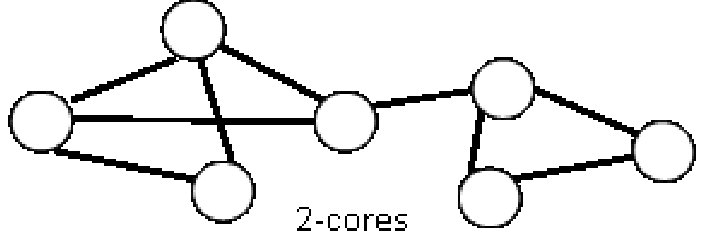 Figure: K-core visualization helps identify the "inner circle" of a social network.
2. Clique Analysis
A "Clique" is the strictest form of social grouping where every member is directly connected to every other member (a complete subgraph).
- 3-Clique: A triangle of three people all talking to each other.
- 5-Clique: A group of five where all 10 possible pairs are connected.
The logic is simple: the chance of five random consumers all replying to each other's specific threads by pure coincidence is statistically near zero.
Critical Findings: Where Spammers Hide
The results revealed a stark contrast between ordinary behavior and coordinated operations:
- Hyper-Connectivity: While the general network was sparse (density 0.0002), the spammer-only network was nearly 180 times denser (density 0.036).
- The "Core" Concentration: Frequency distributions showed that while 50% of normal users were in the lowest 1-core tier, nearly 20% of spammers occupied the highest 23-core tier.
- Clique Inhabitation: As the "strictness" of the group increased (from 3-cliques to 5-cliques), the percentage of confirmed spammers within those groups increased dramatically, reaching 14.61% in 5-cliques.
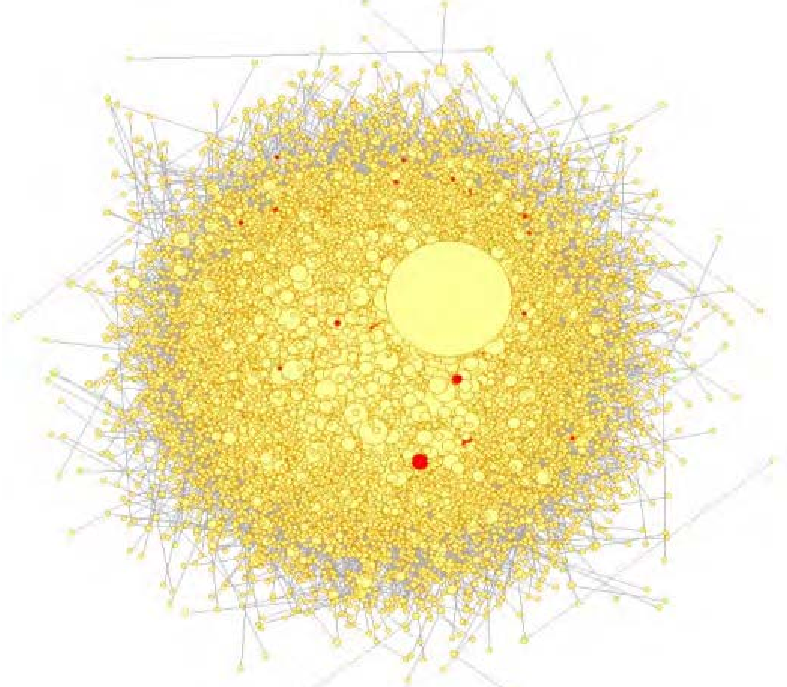 Figure: The Global Network. Red dots (spammers) gravitate toward the central, high-density hubs, unlike yellow dots (consumers) which remain peripheral.
Deep Insights: The "Team" Structure
A fascinating discovery was that the 187 identified spammers didn't all work together. They were clustered into three distinct sub-groups (A, B, and C). Structure suggests that spammers likely operate in specific "workflow teams." Members of Team A interact heavily with each other to support a specific campaign but rarely interact with Team B. This "compartmentalization" is a hallmark of professionalized opinion manipulation.
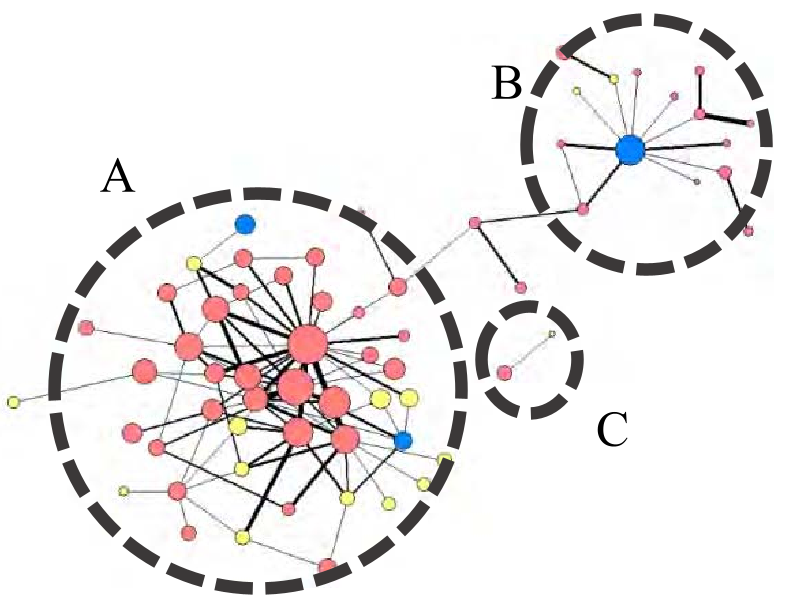 Visualizing the silos: Spammers tend to talk to their own teammates, forming isolated, dense islands of activity.
Conclusion & Taking it Forward
The study proves that Social Network Analysis is a powerhouse for modern platform integrity.
- Takeaway: If you see a "5-Clique" on your platform where five users are consistently validating each other's reviews, there is a very high probability you have found a professional spamming cell.
- Limitations: This approach requires interaction data (replies). It might be less effective on platforms like Amazon where users rarely "chat" in the review section, favoring platforms like Reddit, TripAdvisor, or specialized forums.
- Future Vision: Integrating these structural SNA features into Real-time Machine Learning pipelines will allow platforms to flag coordinated attacks long before the "fake" consensus manages to deceive the average consumer.