
Deciphering the Social Fabric of Science: A Multi-Relational SNA Approach
Social Network Analysis in Scientometrics
The paper investigates scientometric enhancements through Social Network Analysis (SNA) using a multi-relational dataset (DBLP and OPI) of over 1 million scientists. It introduces a triad closure analysis and betweenness centrality study, ultimately proposing a "Conditional Probability Model" to predict career development based on structural motives.
TL;DR
This study moves beyond simple citation counting to map the "Deep Structure" of the scientific community. By analyzing over 1 million records from DBLP and the Polish "People of Science" database, the authors identify how weak ties (committees) and strong ties (co-authorship) drive professional success, revealing a hidden hierarchy of research "bridges."
The "Weak Tie" Paradox in Academe
Most researchers believe that publishing high-impact papers is the sole driver of a career. However, this paper argues that Scientometrics—the measurement of science—must account for the sociological layers of collaboration. The core challenge is that while co-authoring a paper represents a "strong tie," serving on a Program Committee (PC) or Editorial Board represents a "soft link." These soft links, often overlooked, are actually the glue that closes the "circles" of scientific influence.
Methodology: The Multi-Relational Network
The authors constructed a massive dataset from DBLP and WikiCFP, identifying three primary predicates:
- : Author publishes at venue .
- : Author joins the committee/board of venue .
- : Authors and co-author a paper.
The 100x Rule
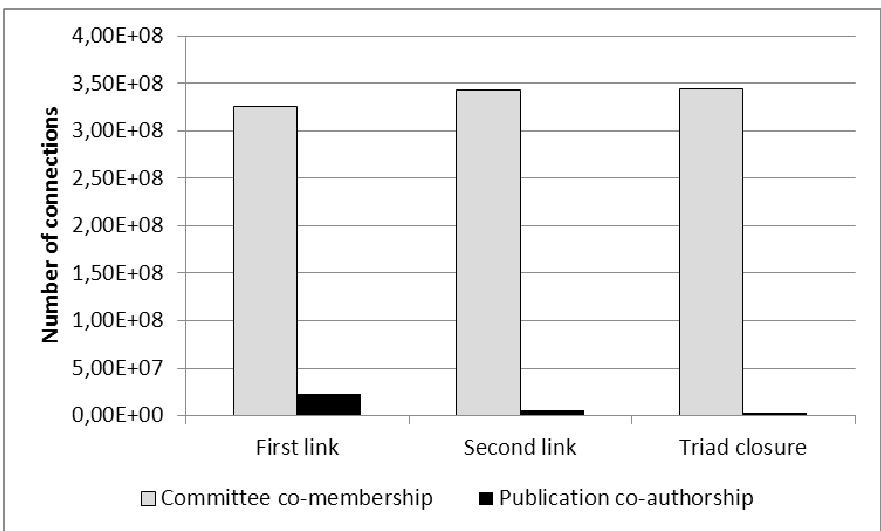
By analyzing the number of participants in events, the authors calculated a "strength correction coefficient" (). This mathematically proves that a co-authorship tie is roughly 100 times stronger than simply sitting on the same committee. However, as the network evolves, the probability of closing a relationship "triad" shifts from being authorship-driven (87%) to being nearly 50% committee-driven.
Structural Insights: The Peaks of Power
One of the most striking findings is the distribution of Betweenness Centrality. Instead of a smooth power-law curve, the data shows distinct "peaks."
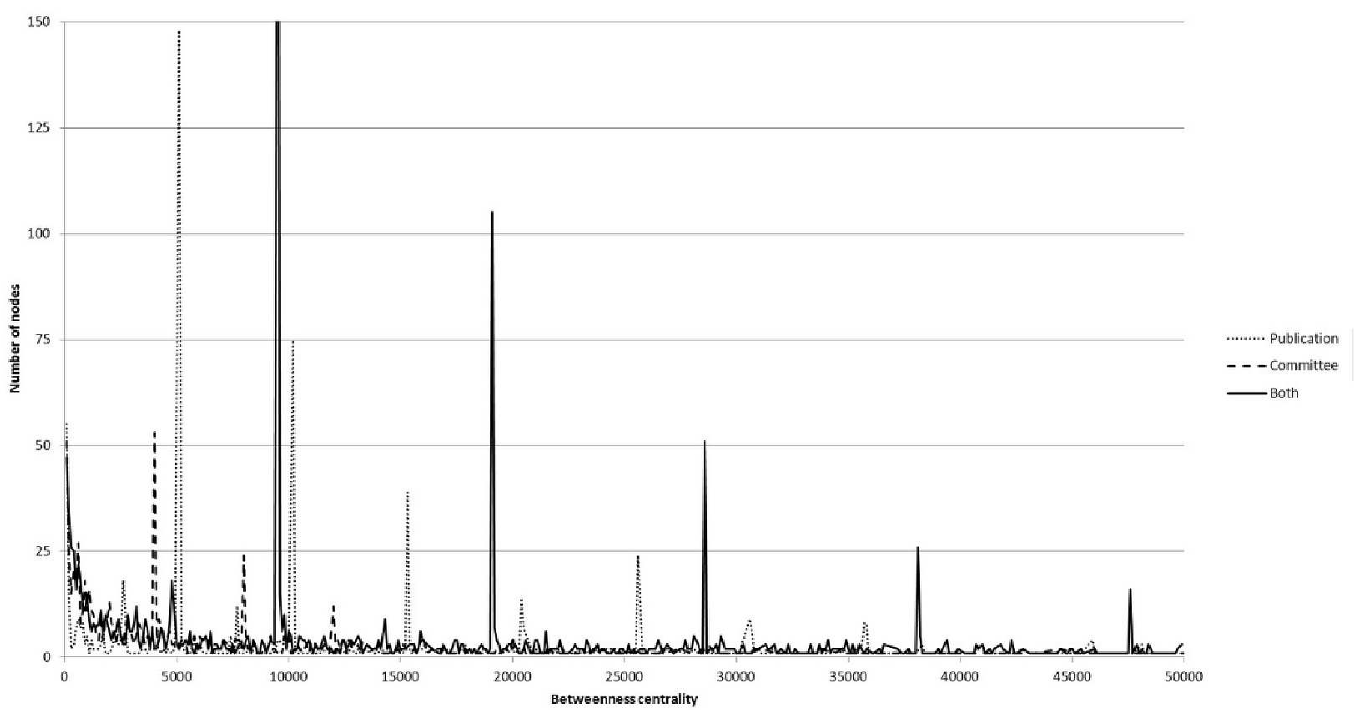
The "Bridge" Hypothesis: These peaks represent "Leaders" or elite professors who act as routers between isolated research groups. If group A has members and group B has members, the leader bridging them gains a centrality boost proportional to . This explains the discrete jumps in importance within the scientific hierarchy.
Modeling the Academic Career (The 6 Motives)
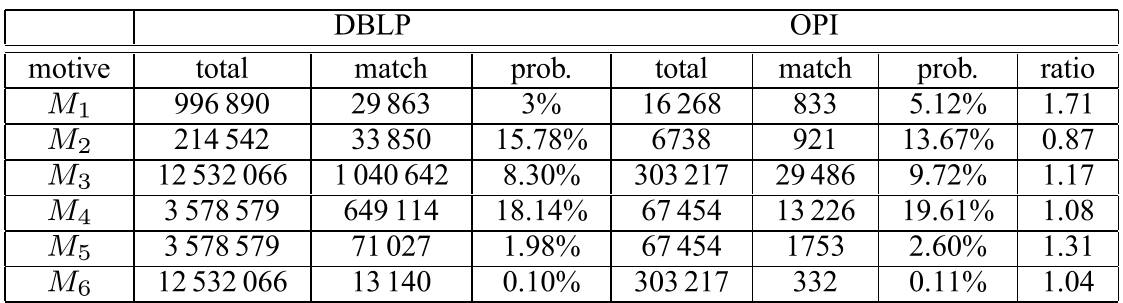
The paper introduces a Conditional Probability Model to predict the future of a scientist's career. They identified six "motives," or repeating patterns:
- Motive 1 (Publish then Member): Only ~3-5% of authors are invited to a committee after a publication.
- Motive 2 (Committee Persistence): Once you are in a committee, there is a 50.7% chance (at peak) you will be "cloned" into the next year’s committee.
- Motive 5 (The Member-to-Author Gap): Surprisingly, sitting on a committee together almost never leads to a new joint publication (near 0% probability), debunking the idea that committees are high-intensity collaboration hubs.
Critical Analysis & Conclusion
Takeaway
The research highlights that the "Scientific Small World" is maintained by a small cadre of highly connected individuals. For a young scientist, the transition from "Author" to "Committee Member" is the hardest barrier to break, but once crossed, the "cloning" effect makes the position highly stable.
Limitations
- Geographic Bias: While the DBLP data is global, the detailed affiliation analysis is limited to Polish scientists.
- Causality vs. Correlation: The model provides probabilities but does not strictly prove that a committee seat causes future success, or if it is merely a symptom of existing prestige.
Future Outlook
The authors propose building a Bayesian Network recommendation engine. This tool could theoretically tell a PhD student: "If you publish in Conference X, you have a 12% higher chance of being a gatekeeper in 3 years." This moves scientometrics from a retrospective record-keeping tool to a prospective career-planning guide.