
Decoding Virtual Ties: Social Network Analysis in MUVEs
Social network analysis in virtual environments
This paper presents a methodological framework for applying Social Network Analysis (SNA) to extract and visualize interaction structures from Multi-User Virtual Environments (MUVEs). Using a case study from the SciCentr program, it demonstrates how unstructured Internet Relay Chat (IRC) logs can be transformed into directional communication matrices to identify key participants and engagement patterns.
TL;DR
While graphical fidelity in virtual worlds has skyrocketed, the way we analyze the conversations within them remains stuck in the era of flat text logs. This paper introduces a robust methodology to transform messy IRC chatlogs from Multi-User Virtual Environments (MUVEs) into formal social networks. By mapping "who talks to whom" using temporal proximity, the researchers provide a visual and mathematical lens to evaluate engagement, power dynamics, and social structure in digital learning spaces.
The "Chatlog" Problem: Motivation
Researchers investigating virtual environments often face a daunting wall of text: thousands of pages of Internet Relay Chat (IRC) logs. These logs are semi-synchronous and persistent, but unlike forum threads, they lack explicit structure. Who is leading the conversation? Who is being ignored?
Prior work has explored "Semantic Networks" (what is being said), but the authors argue that Structural Networks (who is connecting to whom) are equally critical. Understanding the "flow" of information is essential for assessing the health of an online community, especially in educational settings where student-led inquiry is the goal.
Methodology: Turning Text into Ties
The core challenge is defining a "link" between two users in a flat chat file. The authors propose two clever heuristic parameters to build a communication matrix:
- The Loop Parameter: Resets a participant’s "sender" status once they post a new message, preventing them from being linked to themselves in a way that skews the data.
- The Temporal Parameter: Since IRC is fast-paced, a user is only considered "connected" to others who respond within a specific window (set to 30 seconds for this study).
By applying these rules, the sequential log is transformed into an matrix where each cell represents the strength of the directional relationship between participants.
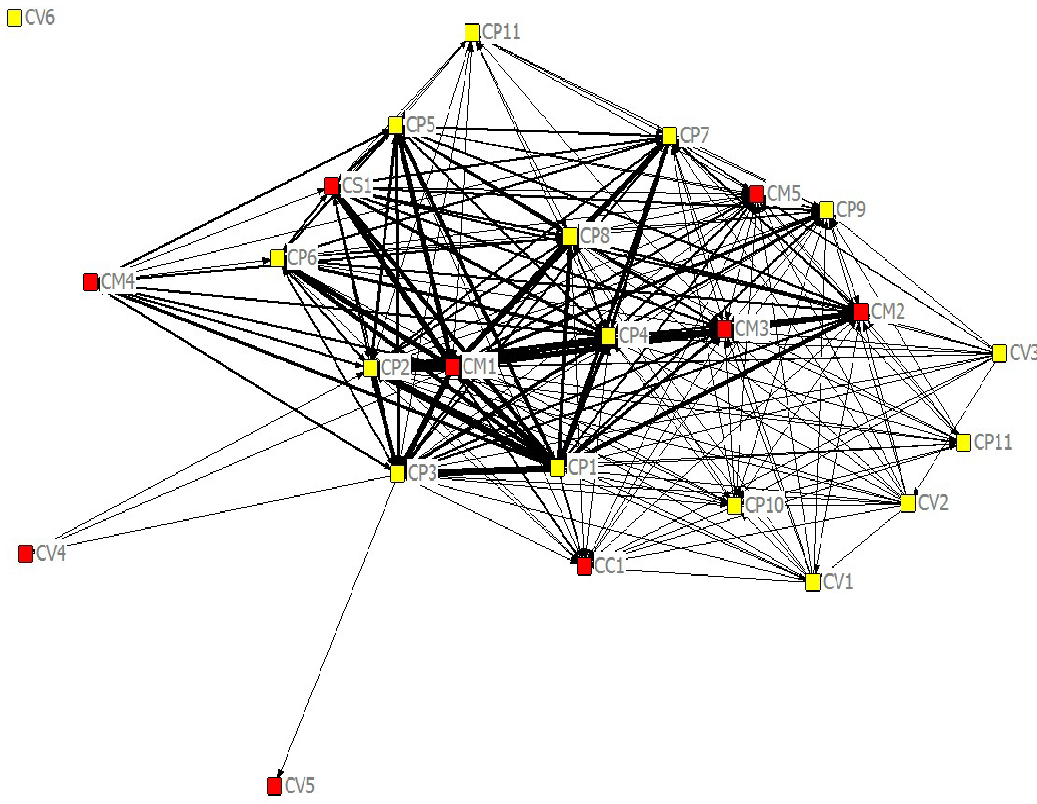 Figure 1: Sociogram of a MUVE interaction where node color represents roles (light for students, dark for mentors) and line thickness represents tie strength.
Key Insights from the Case Study
The researchers applied this method to two "SciCentr" project sites—school programs where students build virtual worlds.
- Core vs. Periphery: In one school, the network revealed a tight-knit "core" of active students and a "periphery" of visitors and less active members.
- Student-Centricity: A major win for the educational design was finding that students often had higher Degree Centrality scores than mentors. This proves the mentors were facilitating rather than dominating the conversation.
- Hidden Isolates: Numerical data might show a user was "present," but the structural map (shown below) can identify an isolated actor—someone visually present in the world but socially disconnected.
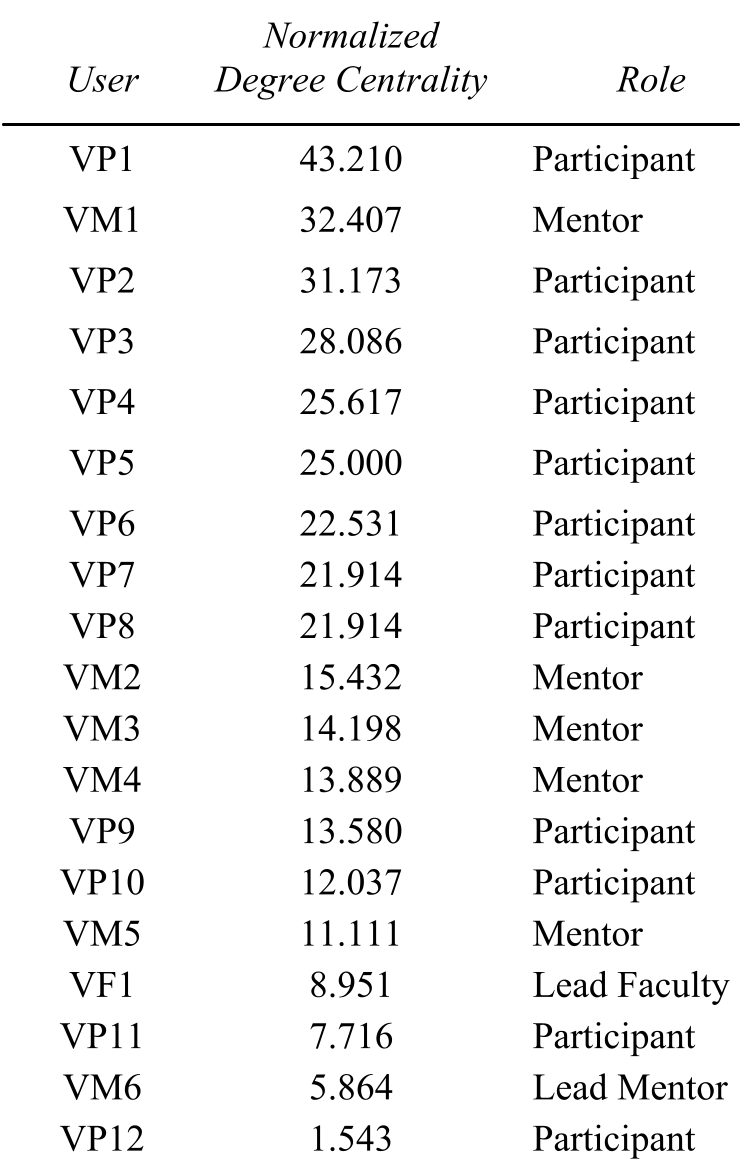 Table 1: Quantitative ranking of users by Degree Centrality, showing the dominance of certain student participants (VP1).
Critical Analysis & Conclusion
The strength of this work lies in its simplicity and portability. By using IRC logs—a universal feature of MUVEs—it provides a standard way to measure social health without needing complex proprietary data.
Limitations & Future Work
However, the "30-second rule" is a blunt instrument. It doesn't account for users who may be typing a long response or instances where multiple sub-conversations happen simultaneously (a common IRC phenomenon). To move forward, the authors suggest:
- Incorporating "Betweenness" Centrality: To identify "bridges" or gatekeepers in the network.
- Longitudinal Analysis: Tracking how a social network evolves from a group of strangers into a structured community over weeks.
- Spatial Integration: Combining chat data with avatar proximity (i.e., you are more likely talking to someone standing "near" you in the 3D space).
In an era where the Metaverse is becoming a serious tool for education and work, the ability to map the invisible social lines of our digital interactions is more vital than ever.