
Unified Complexity and Algorithms for Social Network Anonymization
Social Network Anonymization via Edge Addition
The paper investigates social network anonymization via minimum edge addition, introducing the "k-label sequence anonymity" framework for edge-labeled graphs. It establishes a unifying hardness proof for multiple anonymity models and provides polynomial-time algorithms for specific bipartite graph cases (k=2 for labeled, all k for unlabeled).
Executive Summary
TL;DR: This paper tackles the challenge of protecting privacy in social networks represented as edge-labeled graphs. By introducing "k-label sequence anonymity," the authors provide a powerful framework that proves several existing anonymity models (Neighborhood, k-Hop, k-Symmetry) are NP-hard. However, they also uncover "islands of tractability," demonstrating that certain bipartite graph anonymization tasks can be solved optimally in polynomial time.
Positioning: This work serves as a foundational theoretical anchor in the field of graph privacy. It transitions the discourse from "practical heuristics" to a rigorous "complexity landscape" analysis, bridging the gap between table-based k-anonymity and complex structural graph data.
Problem & Motivation: Beyond Simple Degrees
In the era of data mining, releasing social network data (like PatientsLikeMe or Netflix) is vital for research but poses massive privacy risks. Early attempts at anonymization relied on k-degree anonymity, ensuring every node shares its degree with at least others.
The authors argue this is insufficient:
- Edge Labels: Relationships aren't just connections; they carry data (e.g., transaction types, ratings). An adversary knowing a sequence of labels can easily re-identify an individual.
- Subset Focus: Often, only a subset of users (e.g., those who didn't opt-in for data sharing) needs anonymization, a nuance previous "global" models ignored.
- Unified Hardness: The field was fragmented with various definitions of anonymity without a clear understanding of why they are difficult to compute.
Methodology: The "Table Graph" Framework
The core innovation is the Table Graph. By encoding a standard k-anonymous table problem into a specific graph structure, the authors create a "master reduction."
1. Hardness via Reduction
By showing that k-label sequence subset anonymity is NP-hard for , they create a domino effect. Because a "Table Graph" is constructed such that label sequence similarity implies structural similarity, they successfully prove the NP-hardness of:
- Neighborhood Anonymity: Ensuring isomorphic local subgraphs.
- 1-Hop Anonymity: Concealing the distribution of neighbors' degrees.
- k-Symmetry: Forcing nodes into large orbits under graph automorphisms.
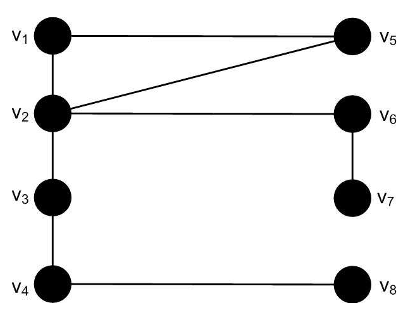 The figure above illustrates the bipartite representation of clinical/social data, forming the basis for the Table Graph logic.
2. Algorithmic Breakthroughs for Bipartite Graphs
While general graphs are hard, Bipartite Graphs (common in consumer-product or patient-medicine data) offer hope:
- Unlabeled Case: Using Dynamic Programming, the authors solve the Degree-Based Subset Anonymization Problem (D-BSAP) in time.
- Labeled Case (k=2): They reduce the problem to a Min-Cost Perfect Matching in Hypergraphs. By showing their cost function satisfies the "simplex condition," they leverage existing P-time algorithms for hypergraph matching with edges of size 2 and 3.
Experiments & Results
The paper's "experiments" are primarily theoretical proofs and complexity analysis.
| Task Type | Graph Structure | Anonymity Target | Complexity |
|---|---|---|---|
| Arbitrary | Labeled | Label Sequence | NP-Hard () |
| Bipartite | Labeled | Label Sequence | P () / NP-Hard () |
| Bipartite | Unlabeled | Degree | P (Any ) |
The DP algorithm for unlabeled bipartite graphs is notably efficient, scaling linearly with the number of nodes and the maximum degree , making it viable for large-scale social datasets.
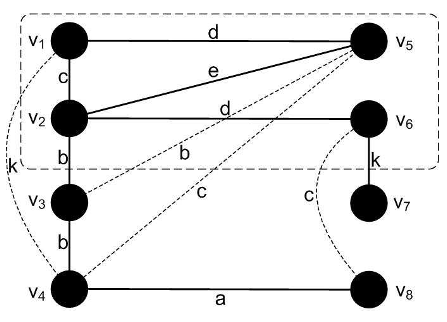 Example of edge addition (dotted lines) to achieve 2-anonymity while minimizing the cost of new edges.
Critical Analysis & Conclusion
Takeaway
The study proves that the complexity of anonymization is highly sensitive to the alphabet size of labels and the required group size k. The introduction of the Table Graph is a brilliant theoretical contribution that simplifies future hardness proofs in this domain.
Limitations
- Edge Addition Only: The paper focuses exclusively on adding edges. In real-world scenarios, edge deletion or node swapping might be more effective for preserving certain graph utilities.
- Utility Trade-offs: While minimizing the number of edges added is a proxy for "data utility," the paper doesn't evaluate how these additions impact specific graph mining tasks (like community detection or link prediction).
Future Outlook
The next frontier is the development of approximation algorithms for the NP-hard cases identified here. As social networks become increasingly multi-modal and multi-relational, the "label sequence" approach will likely evolve into "feature-vector anonymity" in the latent space of graph neural networks.