Are You Moved by Your Social Network? Decoding the Link Between Friendship and Physical Mobility
Are you moved by your social network application?
This paper explores the intersection of online social networks (OSN) and physical opportunistic networks by analyzing a Bluetooth-based mobile application deployed among 28 conference participants. The study establishes a strong correlation between users' self-defined "Social Graphs" and their physical "Contact Graphs," demonstrating that social closeness and node centrality can significantly optimize message forwarding in Delay-Tolerant Networks (DTNs).
TL;DR
Is your Facebook friend also the person you are most likely to bump into at a conference? According to this study from SIGCOMM 2008, the answer is a resounding "yes." By tracking 28 participants via a custom smartphone app, researchers discovered that our virtual social circles (who we call friends) and our physical mobility (who we actually meet) are mirrors of each other. Most importantly, they proved that "Social Centrality" is the secret sauce for efficient data routing in mobile networks.
Problem & Motivation: The Gap Between Digital and Physical Socializing
In 2008, the rise of Facebook and MySpace created virtual communities, but these platforms were largely disconnected from the physical world. While researchers in Delay-Tolerant Networking (DTN) were trying to find ways to pass data between mobile devices using "opportunistic contacts" (like digital "handshakes" via Bluetooth), they lacked empirical data on whether these physical meetups had any rhyme or reason.
The authors asked a fundamental question: If I want to send a file to a stranger, should I give it to a "social butterfly" even if they aren't going in the same direction?
Methodology: The Conference Experiment
To test this, the team deployed a specialized social networking app at the ACM CoNEXT conference.
- The Social Graph: Participants explicitly selected their friends from the attendee list.
- The Contact Graph: Devices logged every Bluetooth encounter (within ~10 meters) during the 3-day event.
- The Routing Logic: They tested "Forwarding Rules." For example: "Only pass the data to someone who has more friends than you (Centrality)" or "Only pass it to a friend of the destination (Distance)."

Key Insight 1: Social Closeness = Faster Connection
The data revealed a striking correlation. The "Inter-contact time" (the gap between meetings) was significantly shorter for friends.
- Friends: 6-minute median gap.
- Friends of friends (Distance 2): ~30-minute gap.
- Strangers (Distance 4): Nearly 1-hour gap.
Physical proximity isn't random; it is driven by social intent. People attend the same sessions and social mixers because they are socially connected.
Key Insight 2: The Power of Centrality
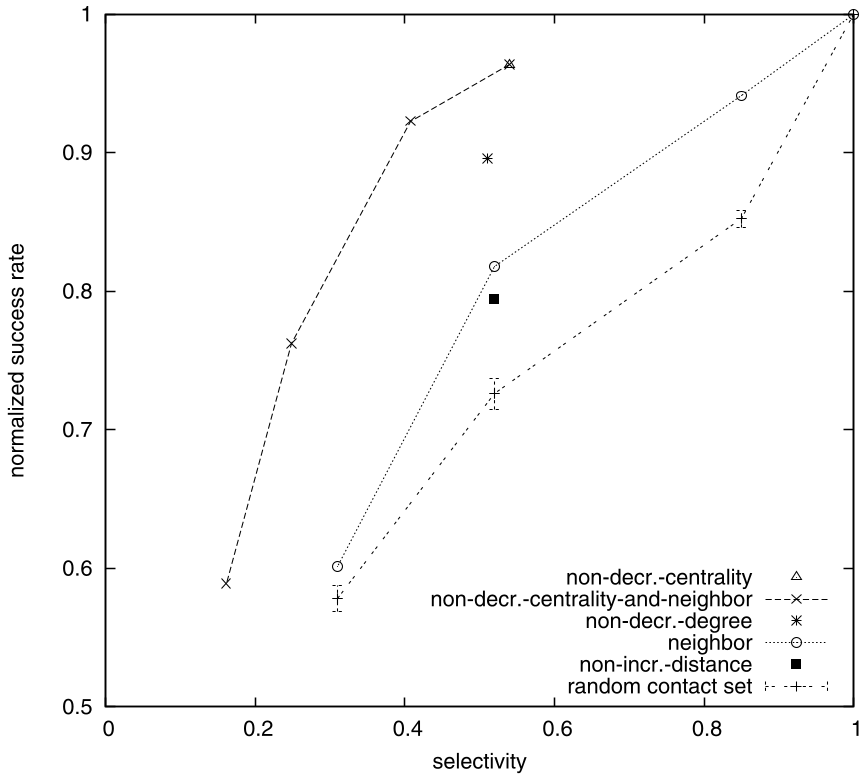
The paper introduced several heuristic rules for "Forwarding Paths." The most impressive was Non-Decreasing Centrality.
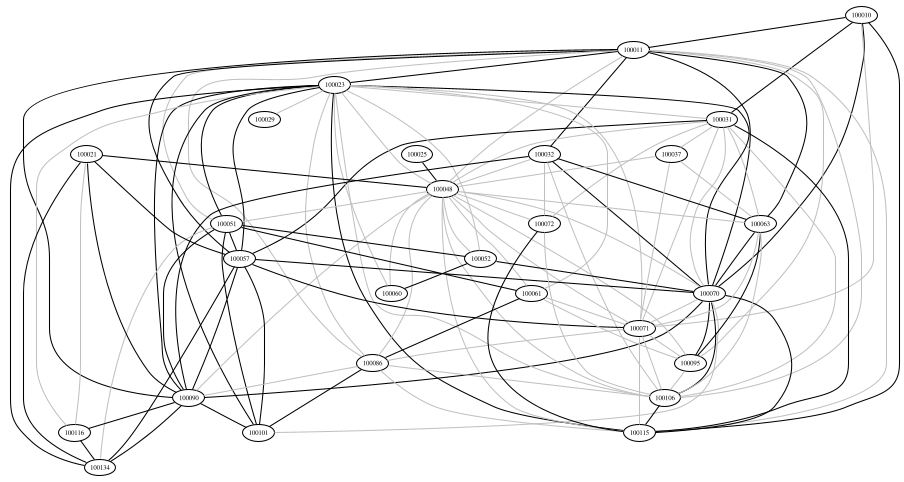
The logic is simple: pass the message to someone who is more "central" in the social network (someone who sits on many shortest paths between people).
- The Result: This destination-unaware strategy outperformed almost everything else, reaching 95% of the success of flooding while using only a fraction of the network energy.
- The Contrast: Passing data to someone just because they are a "neighbor" of the destination was actually less efficient than passing it to a highly central node.
Critical Analysis & Conclusion
Takeaway
Social networks aren't just for sharing photos; they are highly efficient "blueprints" for physical data networks. If you know the social hierarchy, you can predict the best way to move data across a city or a conference hall without needing a central server or cellular signal.
Limitations & Future Work
The study was conducted in a highly controlled, small-scale environment (28 people in a single venue). In a city-scale scenario (e.g., Manhattan), the "centrality" of a person might change as they move between different social hubs (work, gym, home). Furthermore, calculating "Centrality" requires global knowledge of the network—something a single phone doesn't have.
The Future: Modern research is looking at how to calculate these social metrics in a distributed way, allowing your phone to "feel" how important it is to the network without ever seeing the full map.