
Social-Network-Assisted Recruitment: Solving the MCS Cold-Start Problem
Social-Network-Assisted Worker Recruitment in Mobile Crowd Sensing
This paper proposes a social-network-assisted worker recruitment framework for Mobile Crowd Sensing (MCS), introducing the Basic-Selector and Fast-Selector algorithms. By leveraging influence propagation on social networks, the method achieves significantly higher temporal-spatial coverage compared to traditional recruitment techniques, particularly in cold-start scenarios.
TL;DR
Mobile Crowd Sensing (MCS) often struggles to recruit enough workers when a platform is new—a classic "cold-start" problem. This paper moves away from isolated user pools and instead uses Social Networks as recruitment engines. By selecting strategic "seeds" to spread task information, and optimizing for Trajectory Diversity rather than just "number of clicks," the proposed Fast-Selector algorithm achieves superior sensing coverage with high computational efficiency.
The Problem: The "Echo Chamber" of Mobility
Standard recruitment assumes users are just points on a map. But in reality, we are connected. If you recruit a group of friends, they likely hang out in the same places.
Current Influence Maximization (IM) algorithms focus on making a "post" go viral. However, in MCS, virality is useless if 1,000 workers all sense the same coffee shop while the rest of the city remains dark. The challenge is twofold:
- The Cold Start: How to find workers when no one has the app?
- Redundancy: How to ensure influenced users don't have overlapping routines?
Methodology: Beyond Simple Virality
The authors suggest that the probability of a user accepting a task isn't just about who told them, but also MCS-specific factors:
- Topical Interest: Does the task match the user’s history?
- Incentive Attraction: Is the reward high enough?
The Algorithm Duo
To find the best "seeds" (initial users to target), the paper introduces:
- Basic-Selector: A greedy approach using Monte-Carlo simulations. It’s accurate but painfully slow (taking up to a day for small networks).
- Fast-Selector: The star of the paper. It uses a Two-Phase strategy.
- Phase 1 (Budget-Insensitive): Uses a heuristic called
Rank Utility. It picks users who have a high social degree (to spread the word) but different trajectories from existing seeds (to spread the coverage). - Phase 2 (Budget-Sensitive): Once the budget is nearly exhausted, it switches to a more cautious selection logic to ensure every remaining dollar maximizes coverage.
- Phase 1 (Budget-Insensitive): Uses a heuristic called
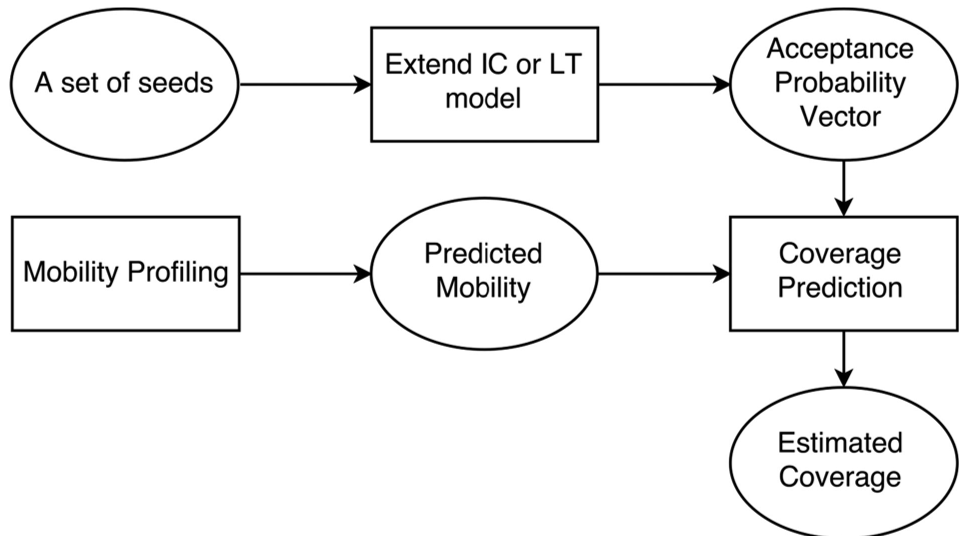 Figure 1: The flow of estimating temporal-spatial coverage from a set of seeds.
Experimental Evidence
Tested on Brightkite and Gowalla datasets (real-world social + mobility data), the results were clear. Traditional methods like MaxDegree (picking the most popular people) created "clusters" of coverage but left huge holes.
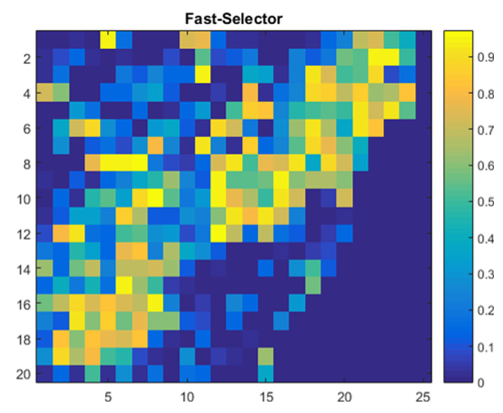 Figure 2: Heatmaps comparing MaxDegree (left) vs. Fast-Selector (right). Note how Fast-Selector distributes coverage more uniformly across the grid.
Efficiency vs. Effectiveness
While Basic-Selector is the theoretical gold standard, Fast-Selector achieved nearly the same results at 100x the speed. This is critical for smart city applications where recruitment needs to happen in near real-time as tasks change.
Critical Insights & Takeaways
- Trajectory Diversity is King: In MCS, a worker's value is defined by where they go. If your recruitment doesn't penalize spatial overlap, you are wasting your budget.
- Phased Optimization: The "Two-Phase" approach in Fast-Selector is a clever engineering trade-off. It acknowledges that when resources are abundant, we can be "fast and loose," but when the budget is tight, we must be "slow and precise."
- Future Path: The next frontier is Dynamic Incentives. Should we pay "seeds" more than the people they recruit? The paper’s brief foray into "Budget Splitting" suggests this is a rich area for future optimization.
Conclusion
This work provides a robust bridge between Social Network Theory and Ubiquitous Computing. By acknowledging that our social circles dictate our physical movements, we can build sensing systems that are both cheaper to start and more effective at scale.