
SADES: Why Your Social Life Should Dictate 5G Infrastructure
Social Network Aware Dynamic Edge Server Placement for Next-Generation Cellular Networks
The paper introduces SADES (Social network Aware Dynamic Edge Server placement), a strategy for optimizing edge server locations in 4G LTE/5G networks. By integrating application-layer social network group data with physical-layer base station (BS) topology, SADES identifies influential BSs for server placement to minimize redundant data transmissions.
TL;DR
Traditional cellular networks are "blind" to social contexts, causing data to travel thousands of miles just to reach a neighbor in the same group chat. This paper proposes SADES, a placement strategy that uses social group data to position Edge Servers at the most "influential" base stations. The result? A massive 92.6% drop in latency and a 51% boost in throughput.
The "Centralized Cloud" Bottleneck
In current 4G LTE architectures, when you send a message to a WhatsApp or Telegram group, that data packet typically journeys to a centralized application server (often in a different city or country) before being routed back to your friends who might be standing right next to you.
This "hairpin" effect wastes precious backhaul bandwidth and adds significant latency. As we transition to 5G, which promises Ultra-Reliable Low-Latency Communication (URLLC), this legacy approach is no longer sustainable. The bottleneck isn't the air interface; it's the routing path.
Methodology: The SADES Strategy
The authors argue that we shouldn't place edge servers randomly or just based on signal strength. Instead, we should use Social Network Awareness. They propose a three-fold mathematical framework:
- Social Degree Matrix (): Maps which base stations have the highest density of users for specific social apps.
- BS Topology Matrix (): Accounts for the physical X2 interfaces between base stations, identifying the "wired" backbone limits.
- Relationship Matrix (): Utilizes Degree Centrality to identify "influential users"—those whose messages trigger the most re-transmissions and traffic.
Algorithm Architecture
By multiplying these matrices, SADES generates a priority-based ranking of base stations. This allows operators to deploy expensive edge hardware where it will have the maximum impact on traffic offloading.
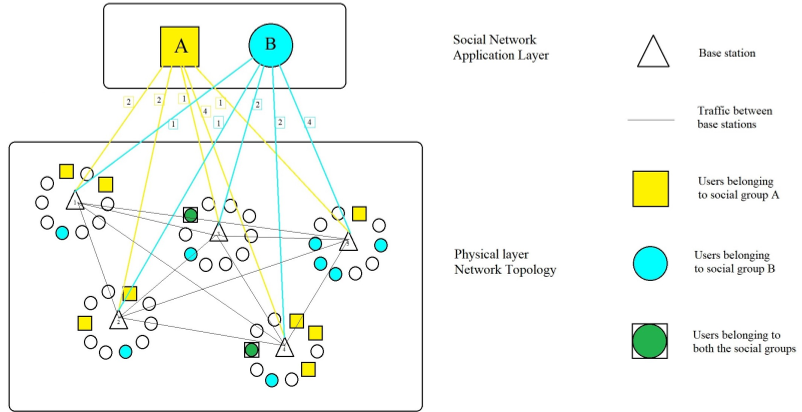 Fig 1. Conceptual overlap of Group Social Layers and Physical Base Station Layers.
Experimental Results: Quantitative Gains
The researchers tested SADES using real-world data from OpenCelliD. The performance gains were stark:
- Latency: Reduced from ~9.96 seconds (No Edge) to 0.73 seconds (Ideal SADES placement)—a 92.6% improvement.
- Packet Loss: Placing an edge server at a SADES-identified location reduced packet loss by 46.3% compared to placing it randomly.
- Throughput: Even with a single edge server shared among key base stations, throughput jumped significantly due to reduced congestion in the core network.
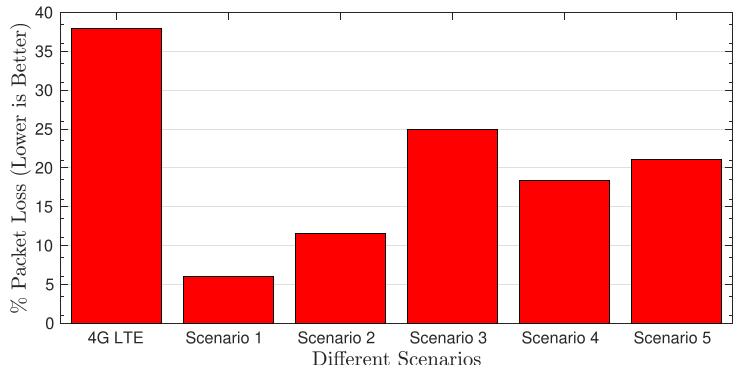 Fig 2. Packet Loss analysis showing the superiority of SADES Scenario 1 & 2.
Critical Analysis & Future Outlook
Why it works: SADES exploits the locality of interest. Social groups are often geographically clustered (e.g., students on a campus, workers in an office). By caching and processing data at the local base station, the "Socially-Aware" edge effectively turns the cellular network into a localized mesh for high-demand content.
Limitations:
- Privacy: Accessing "Social Degree" data requires cooperation between App Providers (like Meta or ByteDance) and Telcos, raising significant data privacy/silo concerns.
- Mobility: The current model assumes relatively static user associations with base stations. In high-mobility scenarios (e.g., commuters), the "influential" base station might change hourly.
The Takeaway: SADES proves that 5G isn't just a hardware upgrade; it’s a software and data intelligence upgrade. For future 6G networks, the convergence of "Social Graphs" and "Network Topologies" will likely be the standard for resource management.