
Social Network Aware Routing: Optimizing DTN Efficiency via Community Intelligence
Social Network Aware Routing for Delay Tolerant Networks
The paper introduces a "Social Network Aware Routing" protocol for Delay Tolerant Networks (DTNs) that leverages community structures and node characteristics. By utilizing "Ego Betweenness Centrality" and a modified Depth First Search (DFS) for buffer management at cut-vices, the method achieves efficient data delivery with significantly reduced buffer overhead compared to traditional flooding-based protocols like Epidemic and MaxProp.
TL;DR
In the world of Delay Tolerant Networks (DTNs), the lack of constant end-to-end connectivity makes traditional routing impossible. This paper proposes a Social Network Aware Routing protocol that moves away from "blind flooding." By identifying socially-dense communities and critical "cut-vertex" nodes, the authors achieve high delivery ratios while keeping buffer usage remarkably low.
Background: The Cost of Flooding
Delay Tolerant Networks are characterized by frequent partitions and long delays. Traditional solutions like Epidemic Routing or MaxProp rely on replicating packets at every encounter. This "shotgun" approach ensures delivery but at a terrible price: it exhausts the limited buffer space and bandwidth of mobile nodes.
The authors' core insight is that mobile nodes are not random; they move in communities (friends, colleagues, or social groups). If we can map these social structures, we can route messages more surgically.
Methodology: Communities and Cut-Vertices
The proposed framework operates in two distinct phases: Community Formation and Intelligent Buffering.
1. Community Detection
Nodes maintain a "Familiar Set" based on contact duration (). When nodes meet, they exchange local knowledge to determine if they belong to the same community. The paper specifically addresses:
- Birth/Death: The emergence and dissolution of connections.
- Split/Merge: How communities evolve as nodes change directions.
- Overlapping Communities: Nodes that act as bridges between two distinct social groups.
2. The Routing Algorithm
The algorithm utilizes Ego Betweenness Centrality, a metric that identifies how vital a node is in linking others without requiring a global view of the network.
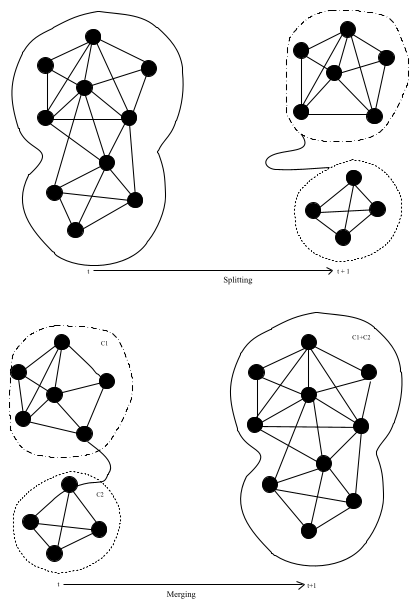 Fig 1: The dynamics of community split and merger.
The breakthrough lies in the use of Cut-Vertices. By running a modified Depth First Search (DFS), the protocol identifies nodes whose removal would disconnect a community. Instead of flooding every neighbor, messages are strategically stored at these cut-vertices. The storage duration is controlled by a TTL based on the DFS finishtime, ensuring that expired "stale" data is purged to save space.
Performance: Lower Overhead, Same Reliability
The authors compared their protocol against heavyweights like MaxProp, Epidemic, Prophet, and Spray and Wait.
Key Findings:
- Buffer Efficiency: The proposed method showed a drastic reduction in buffer occupancy compared to MaxProp and Epidemic routing.
- Delivery Ratio: Despite the reduced replication, the delivery rate remained competitive, proving that "smart" replication at cut-vertices is as effective as "blind" replication.
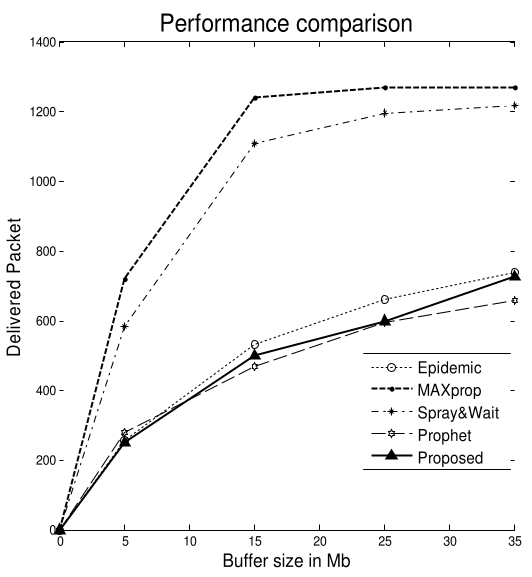 Fig 2: Buffer requirements comparison across protocols.
Critical Analysis & Conclusion
By treating a DTN not just as a set of moving points, but as a social graph, this paper provides a robust solution for resource-constrained environments.
Takeaway: The reliance on "cut-vertices" is a clever application of graph theory to physical networking. It transforms the routing problem from a probabilistic one (Prophet) to a structural one.
Limitations: The current model assumes a relatively stable community threshold (). In highly volatile environments with extreme mobility, the overhead of constant DFS updates might challenge the very buffer savings the protocol seeks to achieve. Future work should investigate more adaptive thresholding for these edge cases.
Final Thought: For developers and researchers working on P2P apps or disaster-recovery meshes, this paper proves that who carries the data is often more important than how many people carry it.