
SOCNET: Leveraging Social Trust to Solve the Ad Hoc Relay Dilemma
Architecture and characteristics of social network based ad hoc networking
This paper introduces SOCNET (Social Network Based Ad Hoc Network), a system that leverages social relationships from platforms like Facebook or Twitter to solve the incentive problem in wireless relaying. By establishing multi-hop "acquaintance" links, the network achieves near 100% connectivity to Access Points (APs) with minimal direct infrastructure contact.
TL;DR
SOCNET bridges the gap between social intimacy and wireless networking. By allowing data relaying only between "acquaintances" (up to N-hops in a social graph), the researchers demonstrated that a network can reach near-total connectivity even when only 1 or 2 nodes in a group of 10 have actual internet access.
Problem & Motivation: The "Stranger Danger" in Networking
The technical feasibility of Mobile Ad Hoc Networks (MANETs) has long been established, yet they haven't seen widespread adoption in the consumer space. The bottleneck isn't the radio—it's the incentive.
Why would you let a stranger use your smartphone's battery and data plan to browse the web? Previous research suggested paying users in micro-tokens or offering better QoS, but these require complex accounting systems. The authors identify a simpler human truth: You are far more likely to help a friend (or a friend of a friend) than a total stranger.
Methodology: Mapping the Social Graph to the Physical Layer
The core of SOCNET is the transformation of a Logical Link (social connection) into a Physical Link (data relay).
- N-hop Social Network (N-SN): The system defines "N-hop acquaintances." If , you only help direct friends. If , you help friends-of-friends.
- Logical-to-Physical Mapping: Even if only a few nodes (T) are connected to an Access Point (AP), other nodes can reach the AP by hopping through their social connections.
- Path Identification: The system forms a connection tree to minimize physical hops while ensuring every relay is "socially sanctioned."
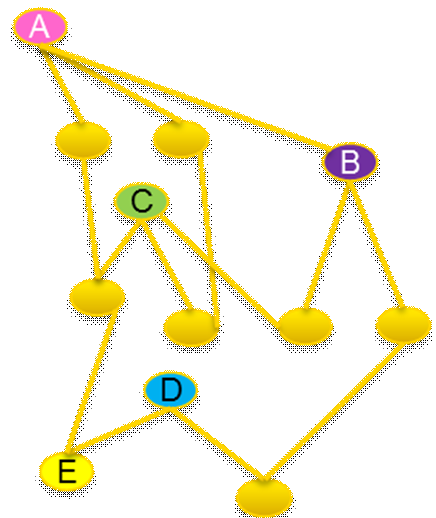 Fig 1 & 2 illustrate the transition from a flat social database to a logical N-hop network.
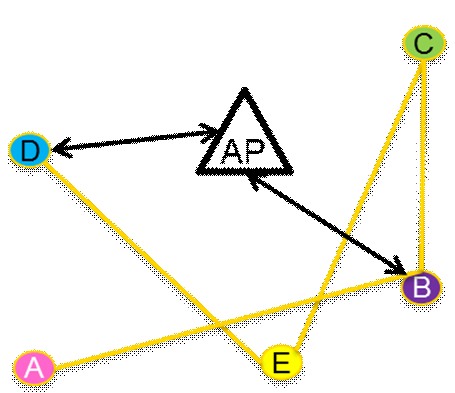 Fig 3 & 4 show how nodes A, C, and E, which lack direct AP access, utilize friends B and D to "bridge" to the internet.
Experiments & Results: The Power of "Small Worlds"
The researchers simulated a scenario with 100 nodes in a database, randomly placing 10 nodes (S=10) within the range of an AP.
The findings were striking:
- Baseline (N=0): Without relaying, connectivity depends purely on having a contract with the AP.
- The "Friend-of-Friend" Effect: When increases from 1 to 2, the connection probability skyrockets.
- Efficiency: Even when only 1 out of 10 nodes actually has an AP connection (), the network achieves nearly 100% connectivity once . This leverages the "Small World" phenomenon where most people are connected by surprisingly few social steps.
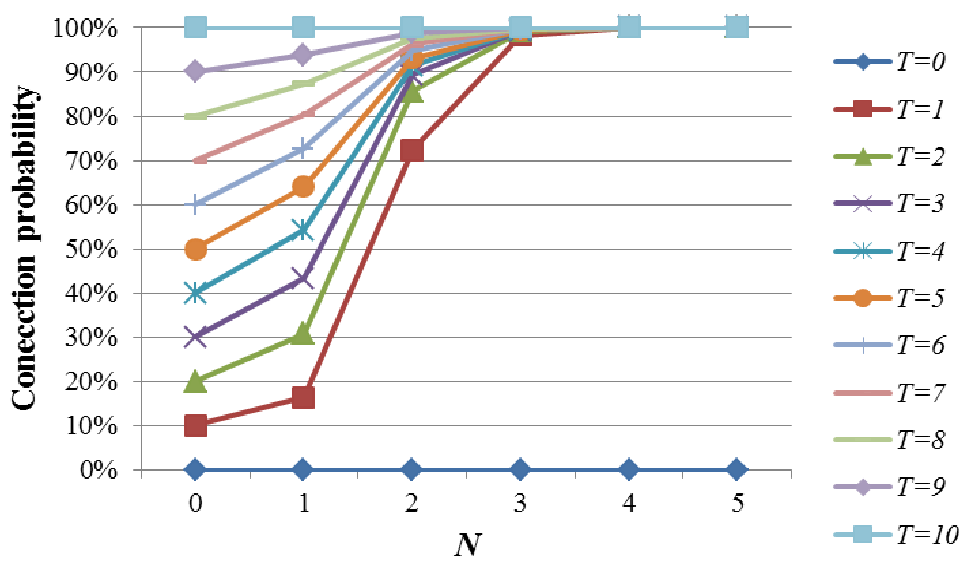 Fig 5: The dramatic rise in connection probability as the degree of social intimacy (N) allowed for relaying increases.
Critical Analysis & Conclusion
Takeaway
SOCNET proves that we don't need complex financial incentives to build community networks; we just need to tap into existing social structures. By formalizing "intimacy" as a network parameter, we can extend Wi-Fi coverage into dead zones or developing regions with minimal infrastructure cost.
Limitations
- Privacy: Accessing SNS data to build these routing tables raises significant privacy concerns that the paper explicitly leaves "out of scope."
- Power Asymmetry: In a social-based relay, popular "social butterflies" might find their batteries drained much faster than others.
Future Outlook
This work paves the way for "Socially-Aware Networking." As we move towards decentralized web (Web3) and edge computing, integrating social graph APIs into 5G/6G protocols could turn every smartphone into a trusted node in a massive, community-owned mesh.