
Turning Mobility into Utility: A Social-Network Approach to Mobile P2P File Sharing
A Social Network Based File Sharing System in Mobile Peer-to-Peer Networks
This paper introduces a social-network-based file sharing system for intermittently connected mobile P2P networks. By leveraging node mobility and social interest-based community clustering, the system optimizes message routing and file retrieval using a combination of "Index Servers" for stability and "Communicators" for global reach.
TL;DR
In the world of Mobile Peer-to-Peer (P2P) networks, frequent disconnections are usually a nightmare. This paper flips the script by proposing a system that uses social network characteristics—node interests and movement patterns—to build stable communities. By electing "Index Servers" and "Communicators," the system achieves high file retrieval rates while slashing the massive traffic overhead typically caused by flooding-based protocols.
Background: The Intermittency Challenge
Most P2P systems were designed for the "wired" or stable wireless world. In mobile ad-hoc environments where humans carry devices, the network topology is a chaotic, ever-shifting graph. Traditional protocols like Gnutella (flooding) consume too much bandwidth, while DHTs (Distributed Hash Tables) break down because they cannot maintain consistent pointers to nodes that disappear every few minutes.
The authors' insight is simple yet profound: Human movement is not random. People move based on social interests. If we can map digital file sharing to these social patterns, we can create a "predictable" structure within the chaos.
Methodology: The Social Architecture
1. Interest-Based Community Construction
Instead of treating every node as a generic relay, the system clusters nodes into communities based on:
- Keyword Similarity: A function that measures the semantic distance between users' interest groups.
- Encounter Frequency (EF): How often two nodes meet.
Nodes with similar interests and frequent contact form a cluster, localized by their social behavior rather than just physical proximity.
2. Specialized Node Roles (Stability vs. Mobility)
The paper introduces a clever division of labor based on node "Centrality":
- Index Servers: Chosen from the most stable nodes (high Egocentric Betweenness Centrality). They act as the "librarians" of the community, keeping track of who has what file.
- Communicators: Chosen from the most mobile nodes (high Eigenvector Centrality). These are the "postmen" who travel between different communities, carrying query stacks and caching results.
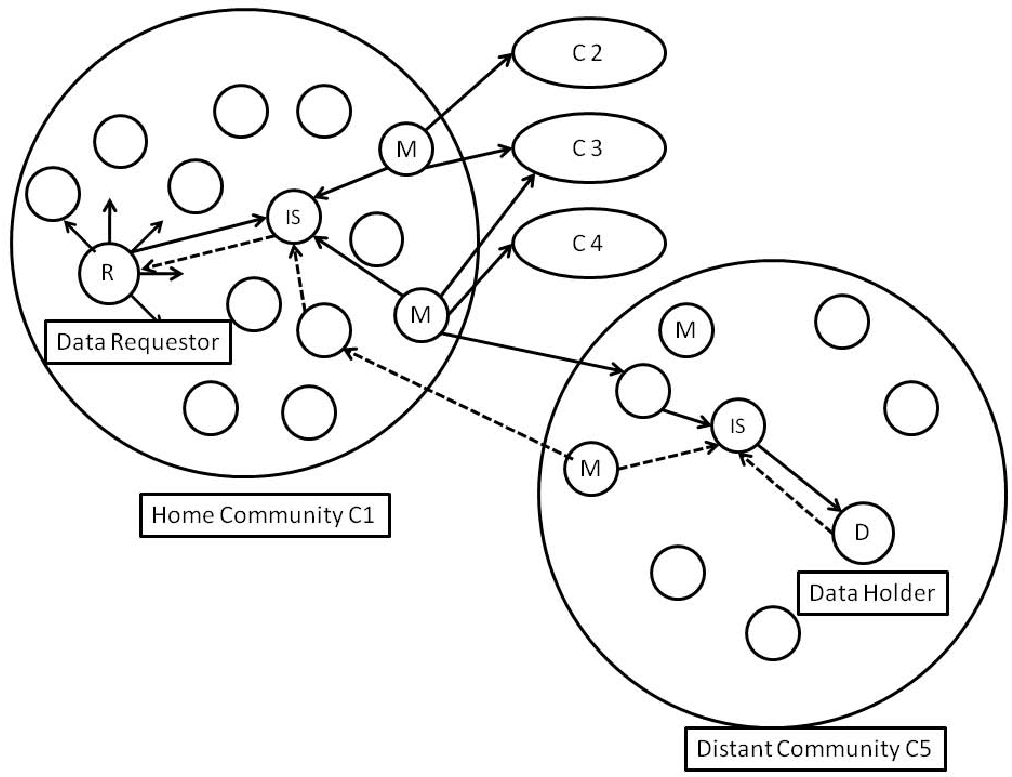 Fig 1: The architecture shows how a Requester (R) interacts with a local Index Server (IS), which then uses Mobile Communicators (M) to bridge to other communities.
3. Smart Routing via Semantic Histograms
Routing isn't done by luck. When a node needs to pass a message, it computes an Evaluation Score. This score weighs the similarity of the neighbor's interests to the destination, their past encounter frequency, and a "time-to-travel" (TTV) decay factor to account for stale information.
Experimental Analysis
Using the ONE (Opportunistic Network Environment) simulator, the authors compared their Social approach against Epidemic routing (flooding) and basic community flooding.
Key Findings:
- Traffic Efficiency: As shown in Fig. 2(b), the Social approach's overhead remains low and stable as the network grows, whereas Epidemic routing's overhead explodes. This proves that "interest-guided" routing avoids the broadcast storm problem.
- Success Rate: While Epidemic routing has a slight edge in delivery probability (due to trying every path), the Social approach catches up quickly as the network density increases (Fig 2(a)).
- Hop Count: The social approach typically requires more hops (Fig 2(c)). This is a conscious trade-off: it takes a more "scenic," deliberate path through likely candidates rather than blasting the message everywhere.
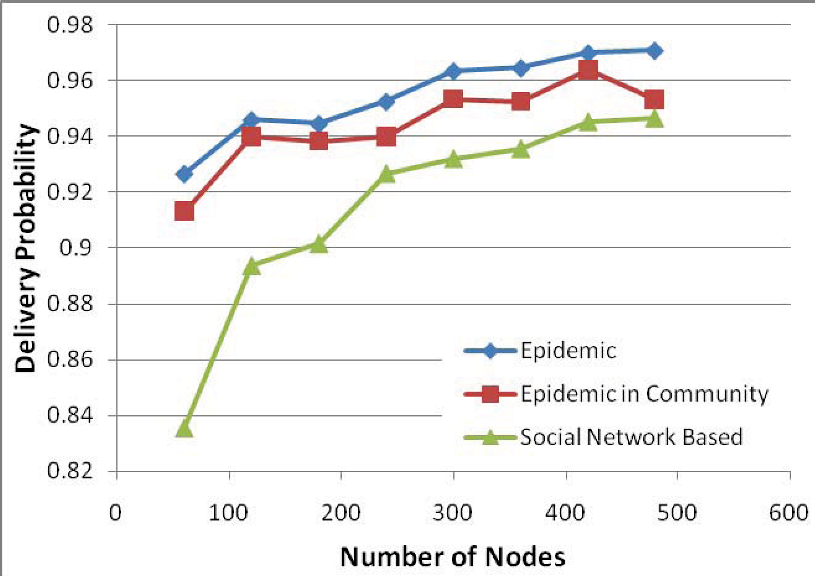 Performance metrics: (a) Delivery Probability, (b) Traffic Overhead, (c) Number of Hops.
Critical Insight & Conclusion
The brilliance of this work lies in its Inductive Bias: it assumes that human social structures are the most reliable backbone for mobile networking.
Takeaways for the Industry:
- Context is King: In decentralized systems, metadata about the "human" behind the node is more valuable for routing than raw network metrics.
- Role Optimization: Not all nodes are created equal. Identifying "super-movers" (Communicators) and "anchors" (Index Servers) is essential for scaling decentralized apps.
Limitations: The paper relies on keyword matching for interest. In a modern context, this could be significantly improved using Vector Embeddings to better understand the nuances of user content without manual keyword extraction.