
KRWK: Decoding Consumer Preference through the Lens of Social Influence Homophily
Social network-based recommendation: a graph random walk kernel approach
This paper introduces a Graph Random Walk Kernel (KRWK) approach for product recommendation solely based on social network structures. By modeling the homophily of social influence through stationary transition probabilities, the authors build a Support Vector Regression (SVR) model that achieves state-of-the-art accuracy on movie rating prediction.
TL;DR
This research moves beyond simple "trust your friends" logic in recommender systems. By treating a user's position in a social network as a signature of their influence, the authors develop a Graph Random Walk Kernel (KRWK). This method measures the similarity between how different users influence the network, achieving a significant MAE reduction to 0.99 on movie ratings and outperforming traditional trust-based models.
Background & Motivation: Moving Beyond Trust
In the era of Web 2.0, social signals are everywhere, yet traditional recommenders often struggle to use them effectively. Previous works relied on:
- Social Trust: Weighting ratings based on direct friends (too sparse).
- Homophily: Assuming similar demographics mean similar tastes (often inaccurate).
The authors argue that a user’s social influence profile—the specific way their opinions propagate through a network—is a superior indicator of their latent preferences. Their core insight is "Social Influence Homophily": if two people influence the same types of people in similar ways, they likely share similar tastes.
Methodology: The Random Walk Engine
To quantify "influence," the authors employ Random Walk with Restart (RWR). Unlike standard diffusion, RWR allows the walk to occasionally "jump" back to the starting node, ensuring the resulting probability distribution is centered around the user's local neighborhood while still exploring the global structure.
The Mathematical Intuition
The stationary transition probability represents the probability that a walk starting at node ends at node . Over the entire network, each user is represented by a vector .
However, the raw transition matrix is not symmetric, making it unsuitable for standard Kernel Machines (like SVR). To solve this, the authors define a distance measure based on these vectors and derive the KRWK: This formulation ensures the kernel is positive semidefinite, allowing it to be used within a Support Vector Regression (SVR) framework to predict specific movie ratings.
Experimental Validation
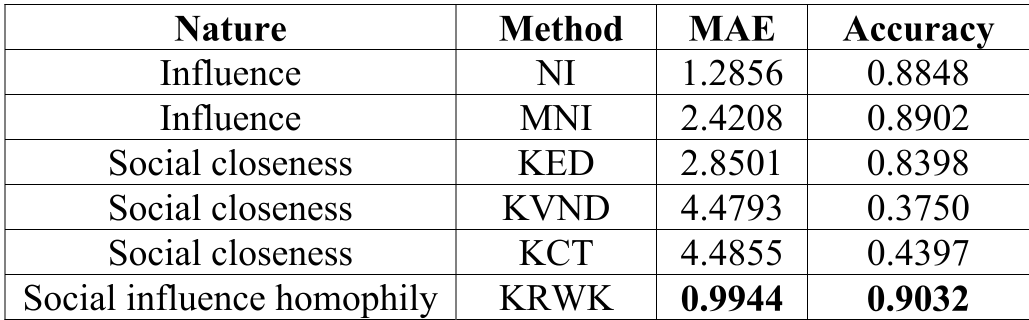
Using a dataset from MTime (a Chinese movie review site), the authors compared KRWK against five baselines, including Neighbor Influence (NI) and Commute Time Kernels (KCT).
Key Findings:
- Superior Accuracy: The KRWK achieved an MAE of 0.9944, vastly superior to Social Closeness kernels like KVND (4.47).
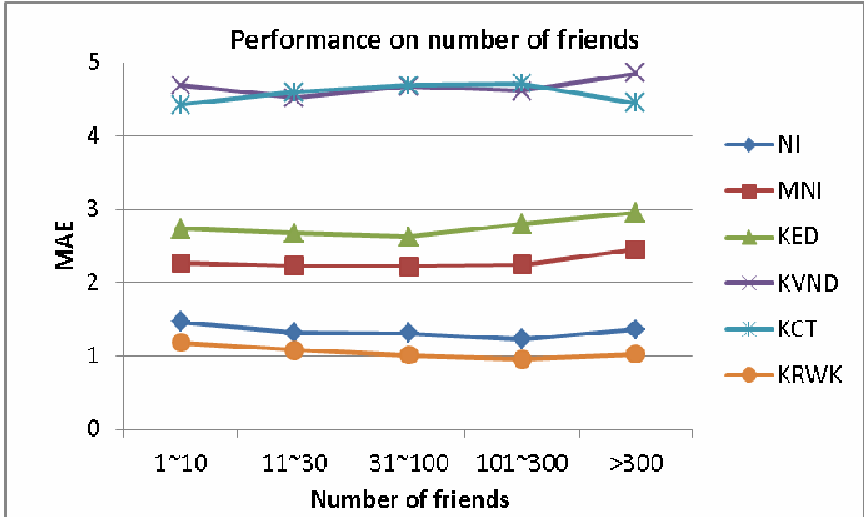
- Robustness to Connectivity: While many models fail when users have too many or too few friends, KRWK proves particularly effective for "opinion leaders" (users with >300 friends), as shown in Figure 1.
Critical Insights & Takeaways
The brilliance of this work lies in its feature engineering through graph topology. By transforming a directed graph into a valid kernel, the authors bridged the gap between graph theory and classical supervised learning.
Limitations: The computational cost of inverting the matrix can be prohibitive for massive networks (e.g., millions of nodes). Modern implementations would likely require sparse approximation or localized message-passing equivalents.
Future Outlook: This kernel-based approach serves as a precursor to modern Graph Convolutional Networks (GCNs). The idea that "who you influence" defines "who you are" remains a cornerstone of sophisticated social discovery algorithms in products today.