
Social Trust as the New PKI: Securing Mobile Information-Centric Networks
Social network based security scheme in mobile information-centric network
This paper introduces a social-network-based security scheme for Mobile Information-Centric Networks (ICN). It leverages the "Web of Trust" within social graphs to verify the binding between public keys and producer identities, replacing the need for a centralized Certificate Authority (CA) in infrastructure-less environments.
TL;DR
In the decentralized world of Mobile Ad-hoc Networks (MANETs), reaching a central Certificate Authority (CA) is often an impossible dream. This paper proposes a paradigm shift: instead of relying on a distant authority, why not trust our friends? By building a Social Trust Graph on top of Information-Centric Networking (ICN), the authors create a self-evolving security layer where public keys are verified through social "referrals," making the network more secure as it grows.
The Problem: The "Unreachable" Authority
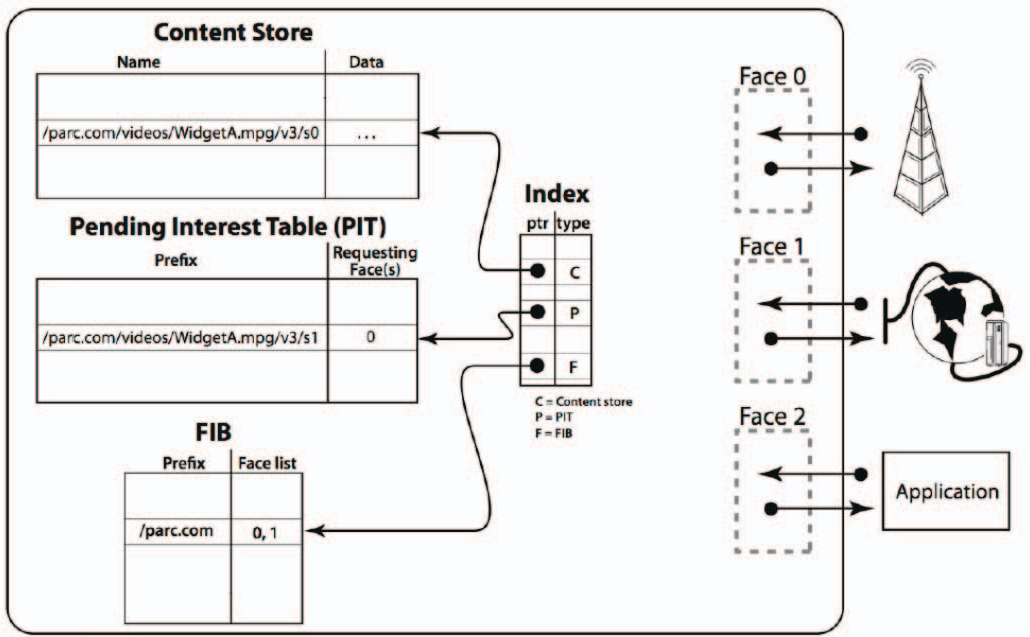
Information-Centric Networking (ICN) is revolutionary because it focuses on what data you want, not where it is. In ICN, every piece of data is signed by the producer. However, a signature is useless if you can't verify that the public key actually belongs to the person who claims to have sent the data.
In standard architectures, we use PKI (Public-Key Infrastructure). But in a mobile scenario—like a tactical emergency zone or a rural vehicular network—you can't always "call home" to a CA server. If the CA is offline, security breaks down. This creates a massive vulnerability to Man-in-the-Middle (MITM) attacks where malicious nodes switch out legitimate content for fake data.
Methodology: The Identity Bundle and the Chain of Trust
The authors suggest that if User A trusts User B, and User B trusts User C, then User A can verify User C's identity through User B.
1. The Identity Bundle (IB)
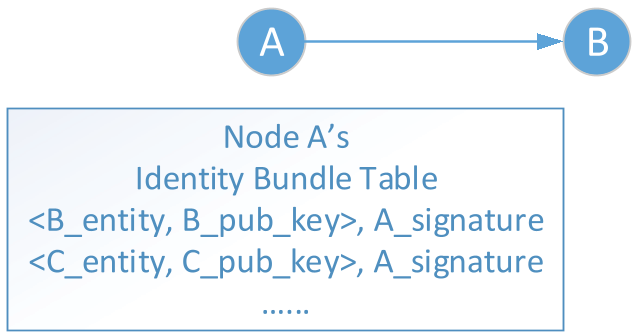
The core unit of this system is the Identity Bundle, defined as: This bundle is treated like any other piece of data in the ICN architecture. It is signed, cached, and requested by name.
2. The Social Trust Graph
Instead of a flat network, the authors build a directional overlay. If I am your friend, I sign your Identity Bundle with my private key and store it in my local table.
3. Smart Retrieval via Dijkstra
When a user needs a producer's public key, they don't just broadcast a request. They use Dijkstra’s algorithm to find the shortest path through the social graph to that producer. As the request travels, every "friend" in the chain verifies the signature of the next "friend," creating a cryptographic proof of identity that travels back to the requester.
Experiments: Popularity Breeds Security
The researchers tested this on an artificial network (1,000 nodes) and the Epinions dataset (75,879 nodes).
Key Insight: The Caching Effect
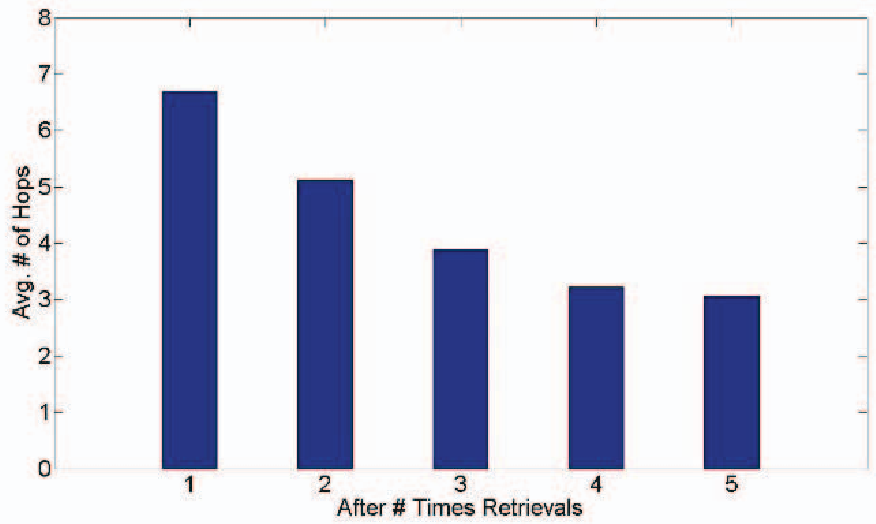
One of the most elegant results is the "Popularity Benefit." In ICN, once data is retrieved, it is cached by intermediate nodes. The same happens with Identity Bundles.
- Initial Retrieval: Might take 6-7 hops.
- Subsequent Retrievals: As the bundle is cached along the "friend chains," the distance drops to nearly 2 hops.
- Node Degree Evolution: Content producers who are requested often naturally gain more "links" in the trust graph, effectively becoming decentralized "mini-CAs" for their own content.
Critical Analysis & Conclusion
Takeaway: This work effectively demonstrates that social relationships can serve as a robust, scalable alternative to centralized security models in ad hoc environments. It brilliantly aligns the "social" nature of human interactions with the "content-centric" nature of modern networking.
Limitations:
- The model assumes a "permanent" trust relationship where "a node cannot betray its friends." In the real world, social accounts are hacked, and friendships change.
- High mobility still poses a challenge for maintaining accurate Dijkstra path calculations.
Future Outlook: This is a vital stepping stone toward Zero-Trust architectures in mobile edge computing. By combining this social trust model with lightweight blockchain anchors, we could reach a state where security is truly "infrastructure-less" and intrinsically tied to the community using the network.