
Beyond Passive Dictionaries: An Active Multi-Agent Social Network for Software Engineering
Towards Social Network Based Approach for Software Engineering Ontology Sharing and Evolution
The paper introduces a multi-agent social network framework that integrates a specialized Software Engineering (SE) Ontology with expert recommendation capabilities. By utilizing the JADE framework and OWL-based knowledge representation, it enables autonomous agents to facilitate knowledge sharing and issue resolution for geographically distributed software development teams.
TL;DR
In the world of distributed software development, miscommunication is the ultimate silent killer of productivity. This paper presents a breakthrough approach that transforms the Software Engineering Ontology from a static reference into an active, agent-driven ecosystem. By combining a multi-agent architecture with a Markov-based reputation system, the authors provide a framework where software agents can autonomously recommend solutions to project issues, ensuring that the "right" voices carry the most weight.
The "Passive Knowledge" Problem
Traditional knowledge bases like SWEBOK (Software Engineering Body of Knowledge) are essentially passive dictionaries. They provide definitions but lack the "intelligence" to act on them. When teams are spread across Australia, the US, and the UK, relying on a developer to manually search a dictionary for project context is inefficient.
The authors identify a critical gap: Situational Awareness. Remote teams often lack insight into who is doing what, leading to redundant work or unresolved bottlenecks. The overhead of constant "sync-up" meetings is high, and the knowledge resides in silos.
Methodology: The Active Agent Ecology
The core of this research is the shift from human-managed knowledge to Agent-Mediated Knowledge. The architecture consists of three specialized roles:
- User Agents: The "digital twins" of developers. They manage profiles and handle communication, living only as long as the user is online.
- Ontology Agents: The "librarians." They use the Jena toolkit and OWL-QL to query and maintain the SE Ontology, ensuring that project information is semantically consistent even as it evolves.
- Recommender Agents: The "arbitrators." This is the brain of the system, using a reputation-based voting mechanism to resolve conflicts.
The Reputation Engine (The Secret Sauce)
Instead of a simple "one person, one vote" system, the Recommender Agent uses a mathematical weighting factor.
- Domain Expertise: If a bug arises in "Project Design," a Designer’s vote carries a weight of 0.8, while a Programmer’s vote might only carry 0.2.
- The Markov Model: Reputation is not static. The system uses Markov Models to track reputation trends (upward, downward, or noisy) over time across 7 distinct "trust states." This allows the system to predict a member's future reliability based on past performance.
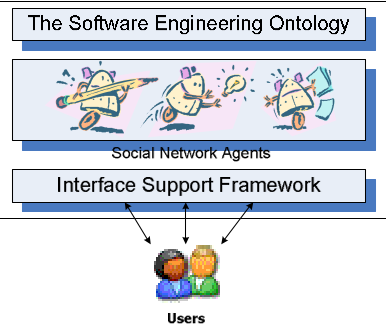 Figure 1: The system architecture showing the interaction between agents, the SE Ontology, and the team members.
Implementation & Logic
The system is built on JADE (Java Agent Development Framework), adhering to FIPA standards. This ensures that the agents can "understand" each other through a shared language (ACL) and a shared world-view (The SE Ontology).
The logical flow for a project issue resolution looks like this:
- Trigger: A developer identifies a design flaw.
- Verification: The User Agent checks if the request is "conceptually correct" against the SE Ontology.
- Consensus: The Recommender Agent polls involved parties.
- Weighting: Votes are weighted by the Markov-derived reputation and domain proximity.
- Action: The solution with the highest weighted value is finalized and the Ontology is updated automatically.
Critical Insight & Future Outlook
The brilliance of this work lies in Semantic Interoperability. By moving from syntactic data exchange to a semantic model where agents "know" what a "Design Change" implies for "Implementation," the system reduces the cognitive load on human developers.
Limitations: While the framework is robust, its success depends heavily on the initial quality of the SE Ontology. Furthermore, the "Reputation State" (0-6) may require more granular metrics in a real-world enterprise setting to prevent "political" gaming of the system.
Takeaway: This research paves the way for "Virtual Project Managers"—AI agents that don't just store data, but actively negotiate and resolve technical debt in real-time.