
SNSO: Reimagining Swarm Intelligence through Social Network Dynamics
Social Network-based Swarm Optimization algorithm
The paper introduces the Social Network-based Swarm Optimization (SNSO) algorithm, a population-based metaheuristic for unconstrained single-objective optimization. It integrates a dynamic social network topology, an extended neighborhood strategy combining real and virtual historical individuals, and a heterogeneous learning framework to achieve SOTA-level performance across 12 standard benchmark functions.
TL;DR
The Social Network-based Swarm Optimization (SNSO) algorithm is a novel metaheuristic that moves beyond simple distance-based interactions. By treating the population as an evolving social network and utilizing "virtual" historical experts, it achieves superior convergence on complex, multimodal benchmark functions compared to classic algorithms like PSO and ABC.
Background Positioning
In the landscape of Swarm Intelligence (SI), the "No Free Lunch" theorem dictates that no single algorithm is perfect for every problem. SNSO positions itself as a structural enhancement to the SI framework, focusing on how information flows between agents. It is not just a new update formula, but a re-engineering of the topology and neighborhood concepts.
Problem & Motivation: The Limits of Proximity
Most swarm algorithms (like Particle Swarm Optimization) assume that individuals should learn from their neighbors based on physical or index distance. However, in complex landscapes, being close in space often means being stuck in the same local valley.
The authors identified that:
- Static Topologies limit the "microenvironment" for learning.
- Distance-based Dynamics lead to rapid loss of diversity.
Their insight? Model the swarm like a social network, where an individual's influence is determined by their "social status" (fitness) rather than just where they are currently located.
Methodology: The Three Pillars of SNSO
1. Dynamic Social Topology
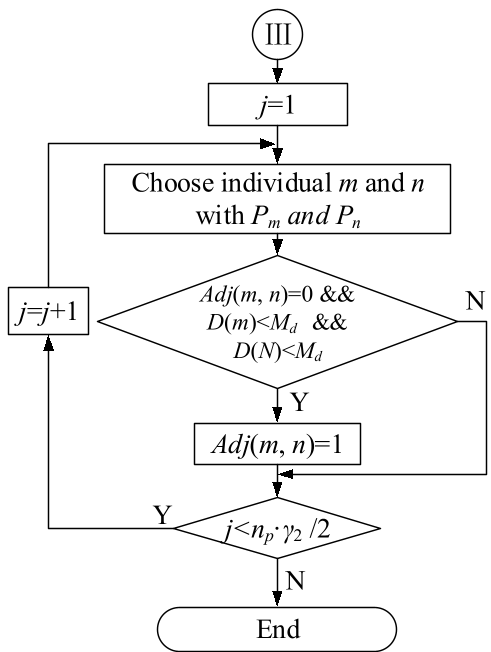
SNSO uses a social network evolution model. Instead of fixed links, the "edges" between individuals are deleted or established based on whether an individual belongs to the Normal Individual (NI) group or the Random Individual (RI) group. This allows high-performing individuals to exert influence across the entire "social fabric."
2. Extended Neighborhood Structure (EINS)
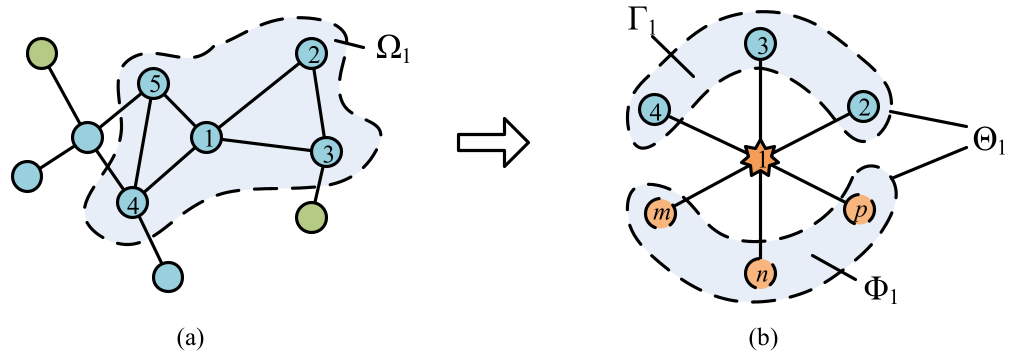
This is perhaps the most innovative part of the paper. A neighborhood for individual consists of:
- (Real neighbors): Individuals currently connected in the topology.
- (Virtual neighbors): Historical optimal solutions () from across the swarm.
This ensures that the "wisdom of the past" is explicitly used to guide the search, preventing agents from making "invalid attempts" in areas already proven suboptimal.
3. Heterogeneous Learning Behavior
The population is split by fitness:
- NI (Leaders): Learn from the best neighbor and the global best () to refine the local area.
- RI (Explorers): Focus on self-learning from their own or perform "mutations" around to jump out of local optima.
Experimental Results
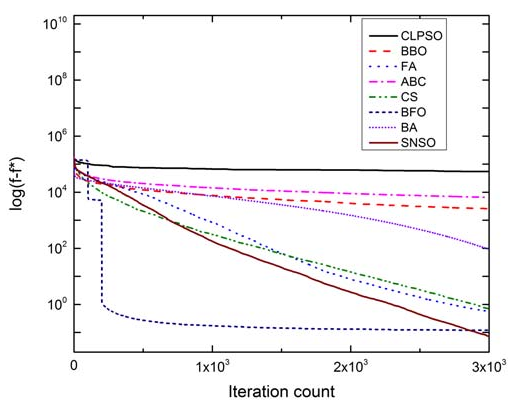
The authors tested SNSO against 7 SOTA algorithms (CLPSO, BBO, FA, ABC, CS, BFO, and BA) using 12 benchmark functions including unimodal, multimodal, and complex shifted/rotated landscapes.
- Convergence Speed: SNSO shows an "acceleration effect." Initially, the social network allows for broad exploration. Once a global region is identified, the social influence of the leaders facilitates rapid convergence.
- Precision: On (Rastrigin) and , SNSO achieved zero or near-zero error, whereas algorithms like CLPSO remained several orders of magnitude away.
Critical Analysis & Conclusion
Takeaway
The core contribution of SNSO is the formalization of "Social Influence" and "Historical Virtual Neighbors." It successfully demonstrates that metaheuristics can be significantly improved by managing the quality and variety of information sources rather than just the mathematical update step.
Limitations
- Complexity: The dynamic topology update (Algorithm 1) adds computational overhead compared to simple PSO.
- Hyperparameters: The introduction of social network parameters (like and ) requires careful tuning for different problem types.
Future Work
The authors suggest that SNSO has already shown promise in real-world applications like ship stowage planning. Future research should look into how these social structures affect the theoretical convergence proofs of the algorithm.