
Engineering Truth: A Game-Theoretic Social Network Approach to Service Trust
Social Network-Based Trust for Agent-Based Services
This paper introduces a social network-based trust model for service selection, utilizing game theory and mechanism design. The framework, called Incentive Trust Group (ITG), achieves SOTA performance in selecting trustworthy providers by aligning agent incentives with truth-telling behavior.
Executive Summary
Trust is the "invisible hand" of service-oriented architectures (SOA). When one service (the customer) needs to select another (the provider) for a composite task, it relies on reputation. This paper presents a sophisticated framework that treats trust not just as a statistical metric, but as a rational game. By combining social network analysis with a 3-step incentive mechanism, the authors ensure that independent agents are mathematically incentivized to be honest. It stands as a pivotal piece in transitioning from naive rating systems to robust, mechanism-governed trust networks.
The Core Dilemma: The Liar's Advantage
In open multi-agent systems, most trust models (like BRS or Travos) assume witnesses are generally honest or that "majority rules." However, in a competitive landscape, services often have incentives to lie—either to sabotage competitors or to boost their own utility. The fundamental problem is: How do we make honesty the most profitable strategy for a rational, selfish agent?
Methodology: Social Networks Meet Mechanism Design
The authors propose a social network represented as a tuple 〈C, P, →cc, →cp〉, where nodes are customers (C) or providers (P). Trust is evaluated through two lenses:
- Direct Assessment (DTr): Based on direct historical interaction (recency and frequency).
- Indirect Assessment (ITr): Soliciting "friendship" links (cc edges) for witness perspectives.
The 3-Step Incentive Mechanism
To achieve Incentive Compatibility (making truth-telling the optimal strategy), the authors define a utility function for witnesses :
- Step 1 (): A small reward for simply participating in the feedback process.
- Step 2 (): A similarity reward. If your report matches the "majority consensus" (), you gain utility.
- Step 3 (): The "Ground Truth" verification. Once the customer actually interacts with the provider, the witness is rewarded if their report matched the actual outcome, or severely penalized if it didn't.

The authors mathematically prove that because each subsequent incentive step is weighted more heavily than the previous ones (), agents are discouraged from "majority-gaming" and are forced toward truth-telling to avoid heavy penalties in Step 3.
Experimental Performance
The researchers compared their Incentive Trust Group (ITG) against established baselines (Fire, BRS, Travos).
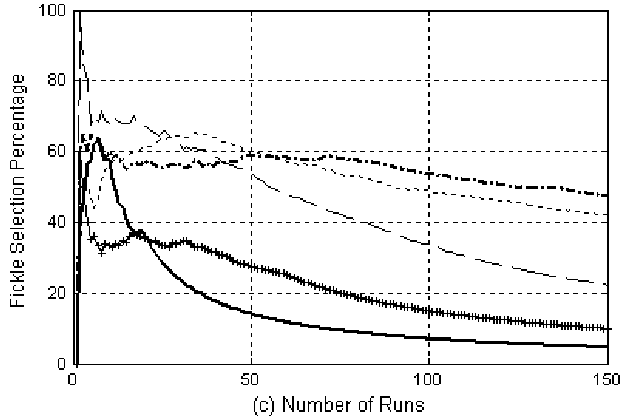
Key Findings:
- Cumulative Utility: ITG agents accumulated significantly higher utility over time compared to others, indicating more successful service pairings.
- Resilience to "Fickle" Providers: While models like Fire struggled to identify erratic providers, the ITG model’s verification step () quickly flagged them, leading to a much lower "fickle selection percentage."
- Adaptability: The model learns who to trust as witnesses. Witnesses providing "bad trust values" are adjusted downwards or removed from future solicitations via Equation 5.
Critical Insight: Why This Works
The brilliance of this paper lies in the hierarchy of rewards. By ensuring the final verification penalty () outweighs any temporary gain from consensus-gaming (), the mechanism creates a Self-Enforcing Truth environment. While earlier SOTA models treated witnesses as neutral data points, this model treats them as strategic actors, successfully applying "Taxation/Reward" logic to the information layer of service networks.
Conclusion & Future Outlook
This work provides a rigorous foundation for building trustworthy decentralized systems. By moving beyond simple reputation averaging and into incentive-compatible mechanism design, it offers a blueprint for service selection in "zero-trust" environments. Future work could benefit from exploring Collusion Resistance—investigating scenarios where a group of witnesses coordinates to lie in a way that bypasses the similarity reward checks.
Takeaway: In the future of autonomous agent-based services, trust isn't just about history—it's about the economics of the report.