
Game Theory Meets Social Networks: A New Blueprint for Agent Trust
Social Network-Based Trust for Agent-Based Services
The paper introduces a social network-based trust model for service selection in agent-based environments. It combines a dual-layer network architecture (customer-to-customer and customer-to-provider) with a game-theoretic mechanism design to ensure "truth-telling" among witnesses, achieving higher utility and reliability than traditional models like Fire or Travos.
TL;DR
In the decentralized world of service selection, knowing whom to trust is the ultimate currency. This paper proposes a robust framework that merges Social Network Analysis with Mechanism Design. By treating "truth-telling" as a strategic choice in a Game-Theoretic setting, the authors ensure that agents are incentivized to provide honest feedback, thereby optimizing service composition and utility.
The Trust Deficit in Service Selection
Standard service-oriented architectures (SOA) face a fundamental problem: rationality vs. honesty. When a "customer service" needs to pick a "provider service," it relies on witnesses. But why should a witness tell the truth? They might be lazy, malicious, or strategically lying to favor certain providers.
Existing models like BRS (Beta Reputation System) or Fire treats testimonials as static data points. They lack the teeth to punish liars or reward the brave who provide accurate, timely feedback. This paper identifies that trust is not just a calculation—it is a social game.
Methodology: The 3-Step Incentive Engine
The core innovation is a multi-stage utility function that makes lying more expensive than being honest. The authors define a social network with two types of edges:
- Customer-to-Customer (Friendship): Based on past info-sharing interactions.
- Customer-to-Provider (Business): Based on actual transaction ratings.
The "Trust Game" is governed by a utility function for any witness :
- Step 1 (): A baseline reward for simply participating and sharing data.
- Step 2 (): A reward/penalty based on the "Majority Effect"—how close is your report to the mean of all other witnesses?
- Step 3 (): The "Grounded Truth"—once the customer actually uses the service, the witness's report is compared against the observed performance. If it matches, the reward is massive; if it doesn't, the penalty is severe.

Proving Truth-Telling via Nash Equilibrium
The authors don't just hope agents are honest; they prove they will be. Using the principles of Mechanism Design, they demonstrate that "Truth-Telling" is a Nash Equilibrium.
- If a provider is bad, lying (saying it's good) leads to a heavy penalty in Step 3 () once the customer realizes they were misled.
- If a provider is good, telling the truth ensures you maximize your utility across all steps.
Experimental Results: Outperforming the Classics
The researchers tested their model against industry-standard benchmarks: Fire, Travos, and BRS.
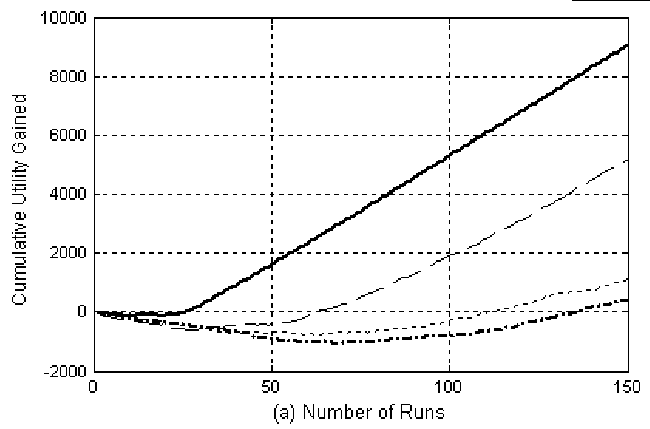
Key Findings:
- Utility Gained: The proposed model (ITG) showed a significantly higher cumulative utility curve because it filters out "fickle" and "bad" providers faster than historical models.
- Selection Accuracy: Under the ITG (Incentive Trust Group) setting, agents identified "Good Providers" over 80% of the time, whereas models like Fire struggled to cross the 60% mark in biased environments.
- Adaptability: The system adjusts witness "credibility" dynamically. If a witness provides a rating far from the observed truth, they are effectively "blacklisted" from the community's potential witness pool.
Critical Insight: Why This Matters
The genius of this paper lies in the constraint. It creates a hierarchy of importance where the "Observed Reality" () always outweighs the "Social Consensus" (). This prevents "Echo Chambers" where a group of agents could collectively lie to skew the average. In this system, one actual transaction can debunk a thousand lies.
Limitations & Future Work
While powerful, the model assumes players can verify transactions (Step 3). In completely anonymous or "one-shot" interaction environments, Step 3 might be delayed or impossible. The authors suggest that exploring other equilibrium concepts beyond Nash could further harden the system against sophisticated collusion.
Conclusion
By formalizing trust as a socially-linked game, this research provides a mathematical foundation for building more reliable autonomous service networks. It moves us away from "Blind Trust" and toward "Incentivized Accuracy."