
Beyond Democracy: The Rise of the "Benevolent Oligarchy" in Online Learning
Social Network Behavior, Thought-Leaders and Knowledge Building in an Online Learning Community
This paper investigates the nexus between social network structures and collaborative knowledge building in online learning communities. By analyzing a graduate IS course, the author identifies "Thought-Leaders"—core students whose specific interaction patterns and facilitator roles are essential for sustaining deep asynchronous discourse.
TL;DR
Is a perfectly democratic discussion the key to online learning? According to Jim Waters' research, the answer is a resounding "no." This study reveals that deep, sustained knowledge building in online communities relies on a small core of Thought-Leaders. These individuals act as high-frequency facilitators who create "positive feedback loops," ensuring that discourse moves beyond simple broadcasts into complex, collaborative inquiry.
The "Laissez-faire" Trap in Digital Education
The dream of online education is often rooted in Dewey’s ideal of participatory democracy—a space where every student contributes equally. However, the reality is often much bleaker: discussion boards filled with "post once, read none" interactions and threads that die after three messages.
The author argues that we must view online learning as a Distributed Cognition System. For knowledge to be useful, it must be critiqued and negotiated. The pain point recognized here is that without specific leadership behaviors, the "distributed" knowledge stays scattered and inactive.
Methodology: The Anatomy of Interaction
The study analyzed a 10-week graduate Information Systems course. To understand why some threads succeeded while others failed, the author mapped the social architecture of the class using two distinct lenses:
- Social Network Analysis (SNA): Measuring the "pipes" (who talks to whom).
- Role-Behavior Profiling: Measuring the "content" (what is being said).
The Taxonomy of Roles
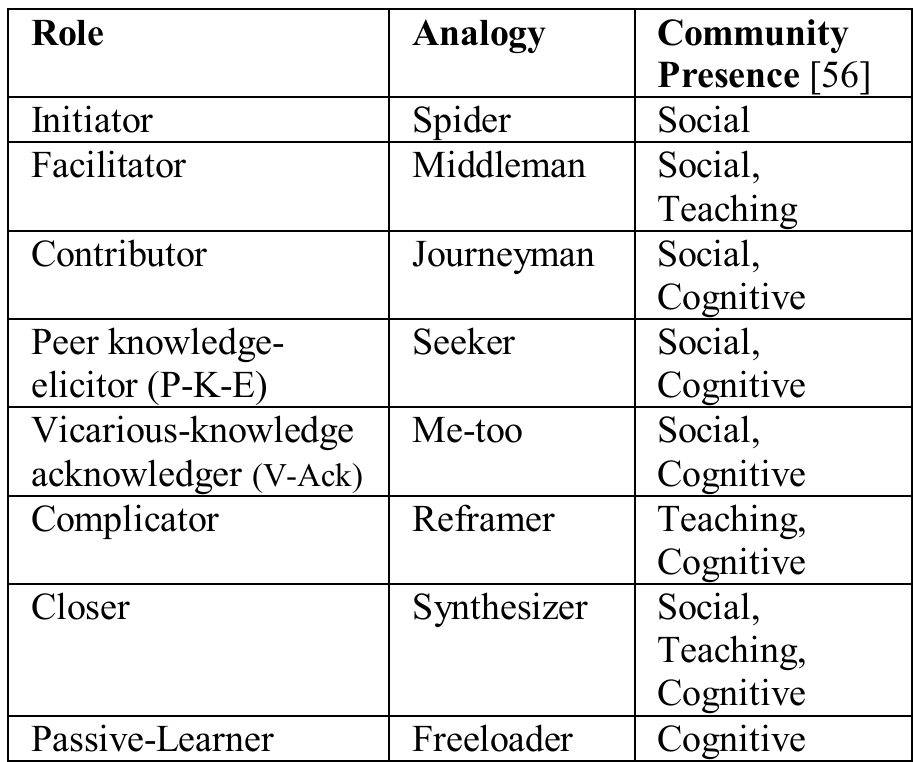
The paper introduces a fascinating taxonomy of student roles, categorizing them into archetypes such as the Spider (Initiator), the Middleman (Facilitator), and the Reframer (Complicator).
Core Findings: The "Thought-Leader" Signature
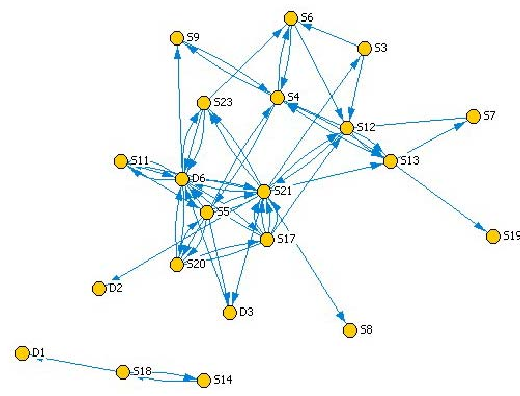
The research identified 8 core individuals (Thought-Leaders) who were present in every single "deep" thread. When these 8 were absent, knowledge building ceased.
1. High Centrality is Mandatory
The study found that Thought-Leaders exist at the center of the network. They didn't just send more messages; they had significantly higher Out-degree (sending to many different peers) and Closeness (shorter paths to everyone else).
2. The Power of Facilitation
The most striking finding was the "Facilitator" message effect. While the average message received a response ratio of 35:100, Facilitator messages achieved a 1:1 ratio. Every time a Thought-Leader encouraged the group, they received an engagement back, creating a sustainable momentum.
3. The "Benevolent Oligarchy"
As the course progressed, "knowledge cliques" began to form. Thought-Leaders started talking to other Thought-Leaders more frequently (56% of their received messages came from each other). This confirms that while the system is open, the steering of knowledge is concentrated in a small, active elite.
Critical Insight: Quality Over Volume
It wasn't just about being "noisy." While Thought-Leaders were high-volume posters, they were also qualitative "Reframers." Interestingly, the study found that Complicator messages (those that challenge assumptions) were less popular in terms of immediate likes/reads but were essential for the "deep" transitions in a thread's evolution.
Conclusion & Future Look
The takeaway for educators and community managers is clear: Engagement isn't accidental. To foster professional-grade knowledge building, you need to identify and empower Thought-Leaders early.
Limitations: The study notes that as the course progressed, students communicated with fewer individuals. This trend toward "cliques" could potentially isolate "Passive Learners" (Freeloaders), posing a risk to the long-term health of the distributed cognition system.
Moving forward, the challenge is: How do we turn a "Passive Learner" into a "Complicator"? Until we solve that, our online communities will remain dependent on the tireless work of a "benevolent few."