
Mediated Connectivity: Solving Privacy and Propagation in Mobile Social Networks
Social Network Applications using Cellular Phones with E-mail Function
This paper presents a server-mediated query propagation mechanism for social networking on cellular phones using e-mail functions. It introduces three specific applications—F2F (Friend to Friend), Q&A, and Image Retrieval—to facilitate person-to-person information discovery within a trusted digital social circle.
TL;DR
Long before the era of modern social media apps, connecting with "friends of friends" via cellular phones was a privacy and efficiency nightmare. This paper proposes a server-mediated query propagation system that uses the e-mail function of mobile phones to find people, answers, and images. By introducing a central management server, the authors successfully anonymized user identities and implemented automated "kill switches" for information requests, reducing network traffic and protecting user data.
Problem & Motivation: The Chaos of Direct Propagation
In the early days of mobile networking, social discovery relied on chain-style communication. However, a purely decentralized approach (Server-less Query Propagation) creates two critical failures:
- Privacy Leaks: To receive an answer, you have to include your e-mail address. As the query moves from friend to friend, your personal contact info is exposed to strangers.
- The "Infinite Loop" Problem: Without a central authority, there is no easy way to tell the network, "Stop! I've found what I needed." This results in wasted bandwidth and annoying notifications for the entire social graph.
The authors' insight was to move the logic of "who knows whom" and "when to stop" from the individual's phone to a specialized Management Server.
Methodology: The Query Propagation Mechanism
The system architecture consists of a Java application on the handset (NTT DoCoMo SH900i) and a CGI-based server.
1. The Workflow
When a user wants to find something (e.g., "Who plays tennis in Osaka?"), they don't e-mail their friends directly. Instead:
- The Java App sends the query and a list of friends' e-mail addresses to the Server.
- The Server broadcasts the query but keeps the issuer’s address hidden.
- Relay Users receive the e-mail. If they can’t help, they can forward it by providing their own friends' addresses to the server.
- The Server serves as a "switchboard," checking Termination Conditions (e.g., "Stop after 5 answers") before sending more e-mails.
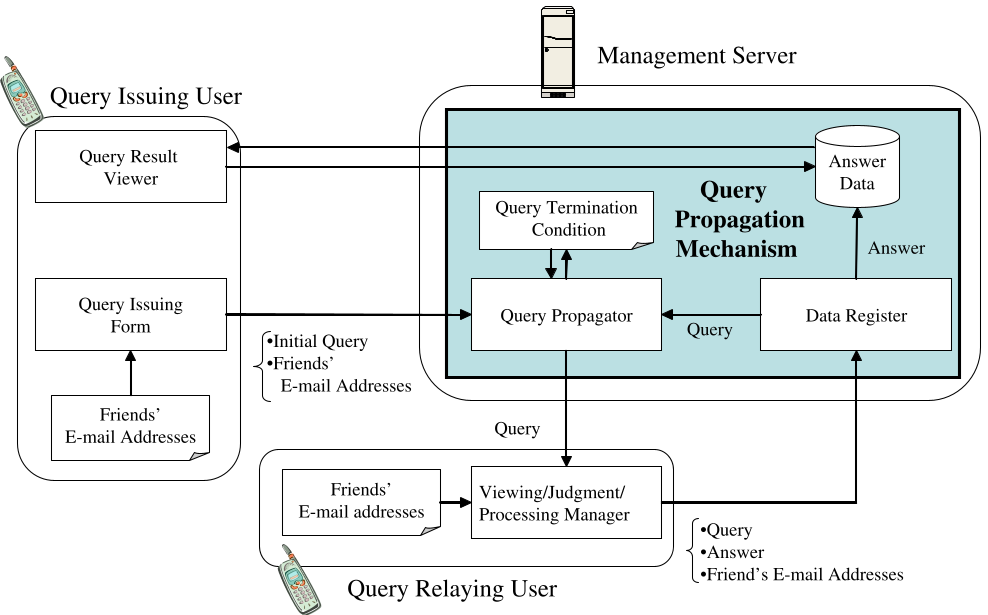 Figure 1: The proposed system structure where the server manages the flow between the query issuer and relay users.
2. Specialized Applications
The authors implemented three distinct use cases:
- F2F (Friend to Friend): Searching for people via profiles (hobbies, location).
- Q&A: Building a "statement tree" where users add opinions or answers.
- Image Retrieval (ImR): Searching for specific images using keyword metadata.
Experiments & Results: Efficiency Gains
The authors used a Power-Law Random Graph (PLRG) simulation to model a realistic social network of 200 users. They compared their method against SQP-D (Server-less Query Propagation - Direct).
The results validated the server-based approach:
- Packet Reduction: The server-based method consistently generated fewer communication packets. In direct methods, relay users must constantly ping the issuer to ask if they should keep going. In the proposed system, the server handles this logic internally.
- Scalability: Whether the search sought 1 person or 10, the server-mediated approach maintained a lower overhead.
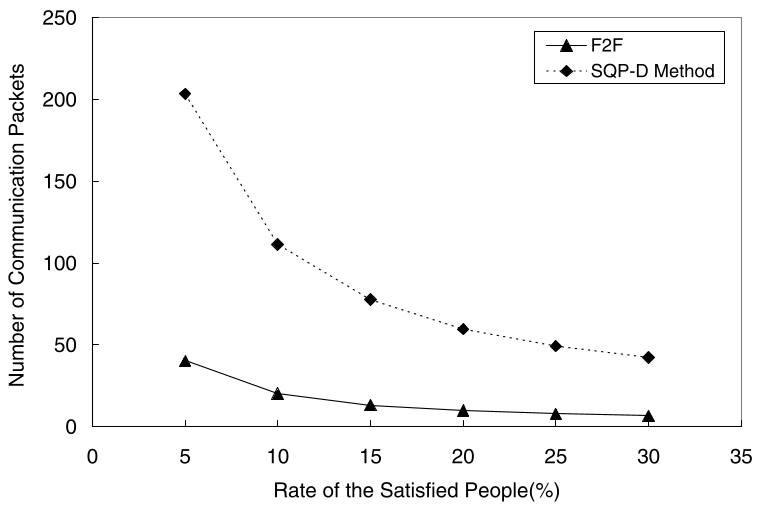 Figure 5: Performance comparison showing lower communication costs for the F2F method across varying satisfaction rates.
Critical Analysis & Conclusion
Takeaway
The genius of this 2006-era work is the realization that social graphs require a coordination layer. By decoupling the social intent (the query) from the transport layer (e-mail), the authors anticipated the architecture of modern social APIs.
Limitations
While effective for its time, the system relies on users manually providing friends' e-mail addresses for each query, which is a high-friction interaction. Modern systems solve this by syncing an entire contact list once. Furthermore, the reliance on a single management server introduces a central point of failure—a tradeoff made for the sake of privacy and control.
Future Outlook
This paper set the stage for privacy-preserving routing. Future iterations of this logic can be seen in modern "Zero-Knowledge" social protocols where search happens across a graph without any single node knowing the full identity of the participants.