
Deciphering Social Circles: Insights from the Facebook Ego-Network Dataset
10778_On the Social Network Centrality Principle for Human Centric Efficiency.
The provided document describes the "Social circles: Facebook" dataset, an anonymized ego-network collection representing social connections. It provides structural statistics for a graph with 4,039 nodes and 88,234 edges, serving as a foundational benchmark for community detection and link prediction tasks.
TL;DR
The Facebook ego-network dataset is a cornerstone of Graph Machine Learning, providing a detailed snapshot of 4,039 users and their social connections. With over 88,000 edges and an impressively high clustering coefficient, it offers a window into how "communities" naturally form within digital social spaces.
Background: The Micro-Structure of Society
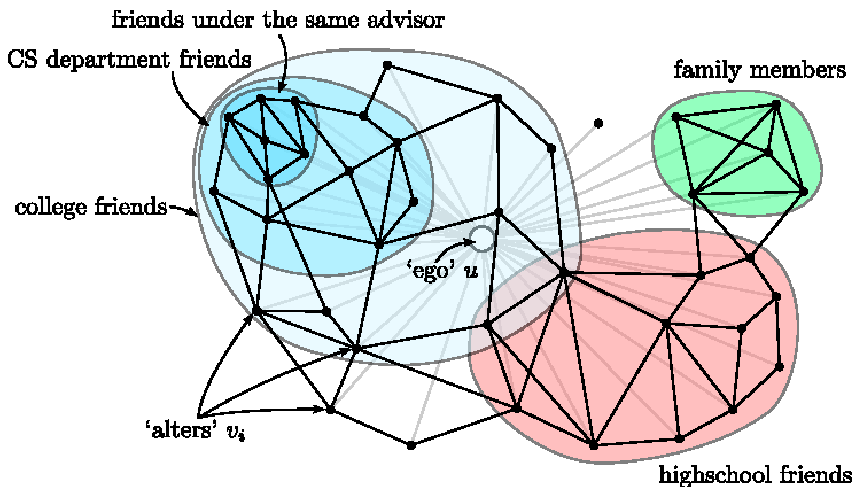
In graph theory, an Ego-Network consists of a focal node (the "ego") and the nodes to whom the ego is directly connected (the "alters"), plus the edges between those alters. This paper describes a dataset that aggregates multiple ego-networks to form a complex, interconnected graph. Situated as a classic benchmark in the SNAP (Stanford Network Analysis Platform) library, this work serves as the primary testing ground for researchers exploring Community Detection and Link Prediction.
Problem & Motivation: Why Ego-Networks Matter
Most early graph research focused either on massive, sparse web graphs or purely random Erdős–Rényi models. However, real human interaction is characterized by Homophily (the tendency of similar people to connect) and Transitivity (the "friend of a friend is my friend" principle).
The challenge was to find a dataset that was:
- Anonymized yet structurally authentic.
- Dense enough to exhibit strong community signals.
- Manageable in size for rigorous mathematical analysis.
Methodology: Mining the Social Graph
The data was collected by identifying "circles" (friends categorizations) that users manually curated. By combining these individual ego-networks into a single global graph, the researchers preserved the structural integrity of social groupings.
Structural Overview
The network exhibits a Strongly Connected Component (SCC) that encompasses the entire node set (1.000 fraction), meaning there are no isolated islands in this version of the social map.
Key Results: The Small-World Phenomenon
The empirical analysis of the dataset reveals several striking metrics that define real-world social behavior:
| Metric | Value | Significance |
|---|---|---|
| Nodes | 4,039 | Ideal size for deep-learning prototyping. |
| Clustering Coefficient | 0.6055 | Extremely high; indicates "cliquey" behavior. |
| Triangles | 1,612,010 | Massive evidence of transitive relationships. |
| Diameter | 8 | Validates the "Six Degrees of Separation" theory. |
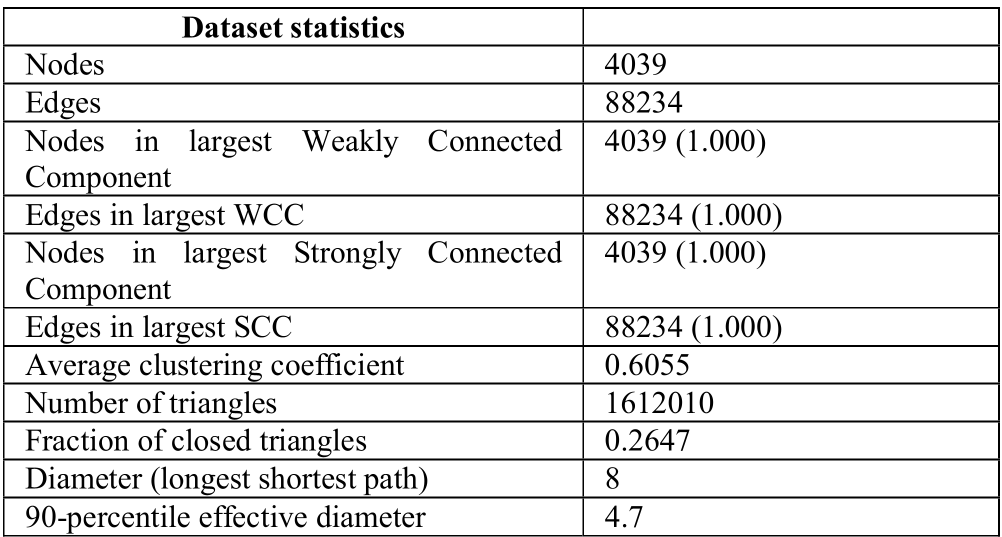
The high fraction of closed triangles (0.2647) is particularly noteworthy. In a random graph, this number would be near zero. In this Facebook dataset, it proves that if two people have a common friend, they are highly likely to be connected themselves.
Critical Analysis & Conclusion
The "Social circles: Facebook" dataset is more than just a list of numbers; it is a structural representation of human trust and association.
Takeaway: If you are developing a new Graph Neural Network (GNN) or a clustering algorithm, this dataset is your primary "sanity check." If your model cannot identify the 1.6 million triangles here, it likely won't survive the complexity of larger, noisier platforms like X (Twitter) or LinkedIn.
Limitations: As a static snapshot from the early 2010s, it does not capture the temporal dynamics of how social circles evolve. Modern research now often supplements this with dynamic datasets to account for the "growth" of edges over time.
Future Outlook: The focus is shifting toward Privacy-Preserving Data Mining. As privacy laws (GDPR/CCPA) tighten, finding ways to generate synthetic graphs that mirror the statistical properties of this Facebook dataset (like its high clustering) will be the next frontier in graph research.