
SMAG: Reforming Smoking Cessation via Agent-Based Social Chatbots
8845_Social Network Chatbots for Smoking Cessation Agent and Multi-Agent Frameworks.
This paper introduces SMAG, a chatbot framework leveraging Agent and Multi-Agent Systems (MAS) to support the "J'arrête de fumer" (JDF) smoking cessation program on Facebook. By transitioning from a single-agent state-machine to a decentralized multi-agent architecture, the system achieved a 28.9% success rate in cessation, outperforming previous non-automated campaigns by 10%.
TL;DR
The high-intensity craving of a smoker lasts only a few minutes, but a human's response time is often hours. This paper introduces SMAG, a Multi-Agent chatbot framework deployed on Facebook that automates personalized smoking cessation support. By tracking habits and using state-machine logic, SMAG achieved a 28.9% success rate—nearly doubling the efficacy of previous social network campaigns.
Context & Motivation: The Timing Problem
Smoking cessation is not just a physiological battle; it is a battle against routine and social addiction. The "J'arrête de fumer" (JDF) program in Switzerland previously relied on Facebook communities, but human moderators were overwhelmed by over 13,000 messages in a single week.
The core research intuition here is that a digital intervention must be two things: Scalable (to handle thousands of simultaneous cravings) and Personalized (to offer a specific distraction based on whether the user is at a bar or in an office).
Methodology: From Single-Agent to Multi-Agent (MAS)
The architecture of SMAG evolved through two distinct stages:
1. The Single-Agent Implementation
The researchers initially deployed a Python-based engine using a State Machine model. This ensured that each user’s journey—from demographic profiling (P1) to active cessation support (P2)—was tracked as a series of transitions in a database.
 Figure 1: Single-agent SMAG deployment using Flask, Nginx, and PostgreSQL.
2. The Multi-Agent Design (The MAS Advantage)
To overcome the limits of sequential processing, the authors proposed an MAS design. Each user is represented by a "Personal Agent."
- Gateway Agent: Dispatches social media triggers to the correct user agent.
- Sociability: Agents representing similar smoking profiles can "communicate" to identify which distraction strategies are most effective for specific clusters (e.g., users who smoke mostly during "aperitif time").
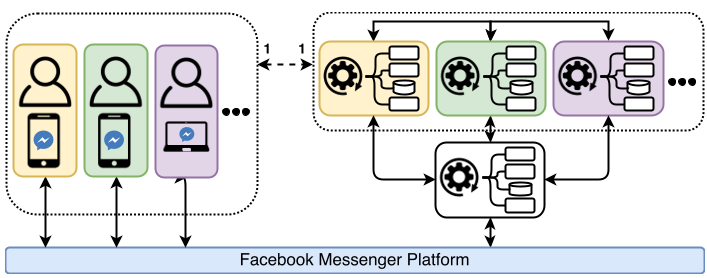 Figure 2: The Multi-Agent System architecture allowing isolated yet collaborative user modeling.
Experiments & Real-World Impact
The system was tested in a real-world Swiss campaign. The "Smoking Profile" generated by the bot provided users with a mirror of their own addiction, aggregating data by time and mood.
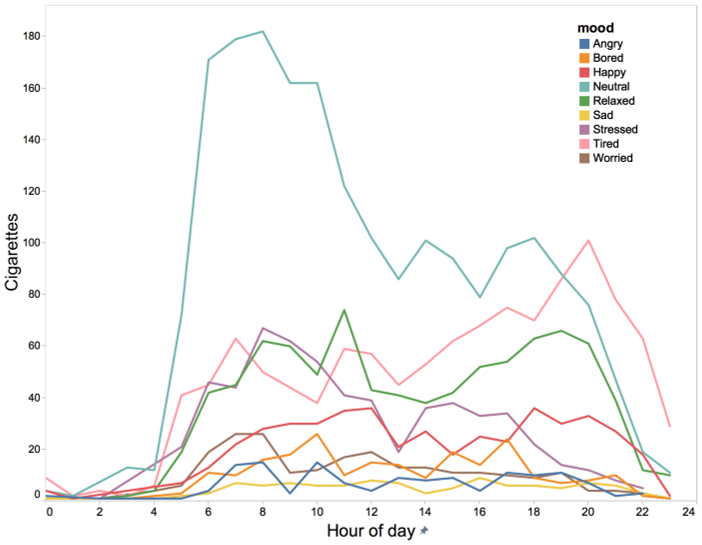 Figure 3: Visualization of smoking triggers—aggregating habit data by time of day and mood.
Key Results:
- Success Rate: 28.9% of participants remained smoke-free after 3 months (compared to 13.5% in manual trials).
- Engagement: Over 200 out of 270 participants actively used the bot for cigarette tracking.
- Scalability: The system managed the high message volume of the first week without the latency issues that lead to "craving-based relapses."
Critical Insight: The Role of QoE and XAI
The most forward-looking aspect of this research is the focus on Quality of Experience (QoE). The authors argue that an agent must estimate the "user-bother cost"—knowing when to send a motivational quote and when to stay silent to avoid annoying the user.
The paper concludes with a roadmap toward eXplainable AI (XAI). For eHealth applications, trust is non-negotiable. Future iterations of SMAG will not just provide advice but will explain why a specific distraction (e.g., drinking water vs. a breathing exercise) was suggested based on the user's historical data.
Conclusion
SMAG demonstrates that the future of digital health lies in the transition from simple "question-answer" bots to complex agent ecosystems. By treating each patient as a unique agent within a larger social system, we can provide the high-frequency, personalized support required to break deep-seated addictions.
Senior Editor's Note: While this work predates the current LLM boom, its structural approach to state management and Multi-Agent coordination remains a blueprint for building "Safe" and "Reliable" healthcare agents today.