
Beyond Demographics: Why Your Social Circle Predicts Your Next Online Purchase
Using Social Network Classifiers for Predicting E-Commerce Adoption
This paper presents a social network analysis approach to predict e-commerce adoption, specifically the intent to purchase books and computers online. By utilizing a range of networked classification techniques (e.g., wvrn, spaRC) combined with collective inference procedures, the authors demonstrate that relational data significantly outperforms traditional person-level characteristics in predictive accuracy.
TL;DR
Researchers from KU Leuven and IESEG have demonstrated that your social network ties are far more predictive of your intent to shop online than your age, gender, or computer expertise. By applying relational classifiers to a network of 681 individuals, they found that social connectivity—capturing "latent influence"—outperforms traditional demographic models, offering a new blueprint for precision digital marketing.
The "Latent Influence" Gap
For decades, Information Systems (IS) research has relied on the Unified Theory of Acceptance and Use of Technology (UTAUT). However, UTAUT has a blind spot: it measures "perceived social influence"—what people say about how others affect them.
The authors argue that this is flawed because:
- Survey Bias: People often deny being influenced by others to appear independent.
- Voluntary Context: In voluntary settings like e-commerce, perceived influence often tests as non-significant, yet we know social trends drive markets.
Their insight? Instead of asking people if they are influenced, we should look at who they are connected to and what those connections are doing.
Methodology: High-Dimensional Social Graphs
The study utilized a dataset of 681 nodes and 1,102 undirected edges. Unlike traditional data mining that treats each person as an isolated island (an attribute vector), this study uses Relational Classifiers.
The Core Framework
The authors employed the Macskassy and Provost framework, which consists of:
- Relational Classifiers (RC): Models like Weighted-Vote Relational Neighbor (wvrn) and Spreading Activation (spaRC) that estimate a person’s behavior based on the labels of their neighbors.
- Collective Inference (CI): Since not all labels are known initially, CI procedures like Gibbs Sampling or Relaxation Labeling iteratively "spread" information across the network until the whole graph is classified.
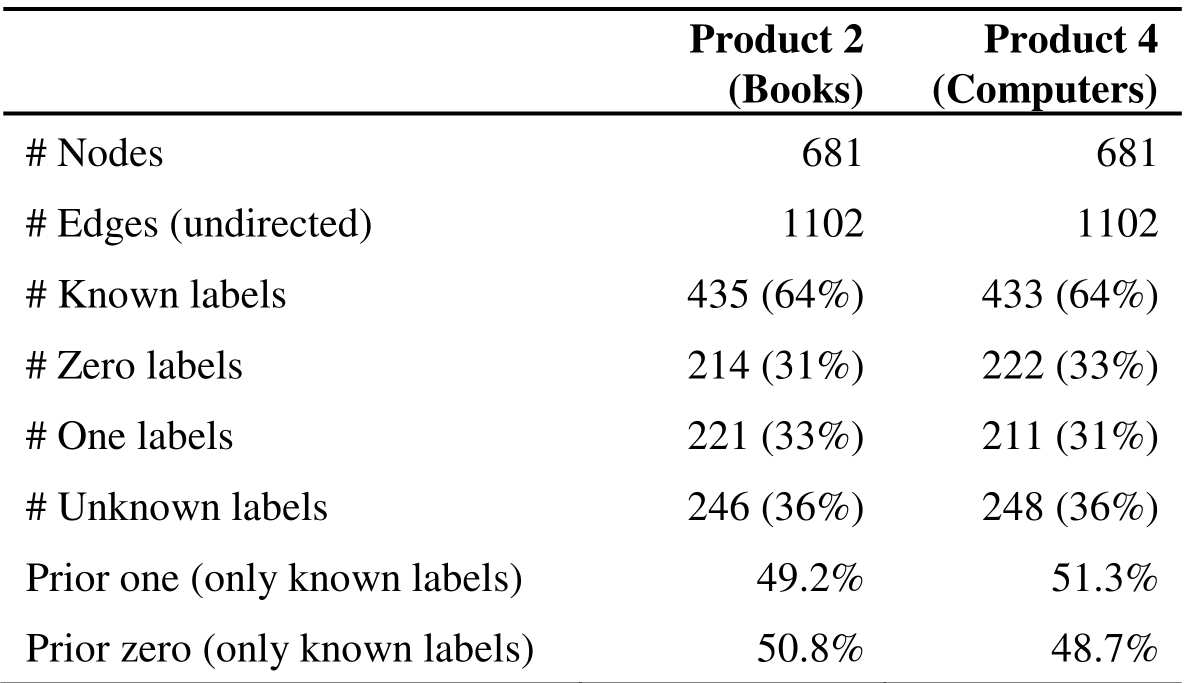 Table 1: Network statistics showing the distribution of known and unknown labels for Books and Computers.
Why Homophily Wins
The most successful models in the study, wvrn and spaRC, explicitly rely on Homophily—the sociological principle that "birds of a feather flock together." If your close friends find buying books online appropriate, the mathematical "energy" from their nodes flows to yours, increasing your predicted adoption probability.
Results: The Death of Demographic Primacy
The experiments compared 16 combinations of networked learners against a baseline of Logistic Regression (LR) using 17 individual variables (Age, Gender, City Size, Job, etc.).
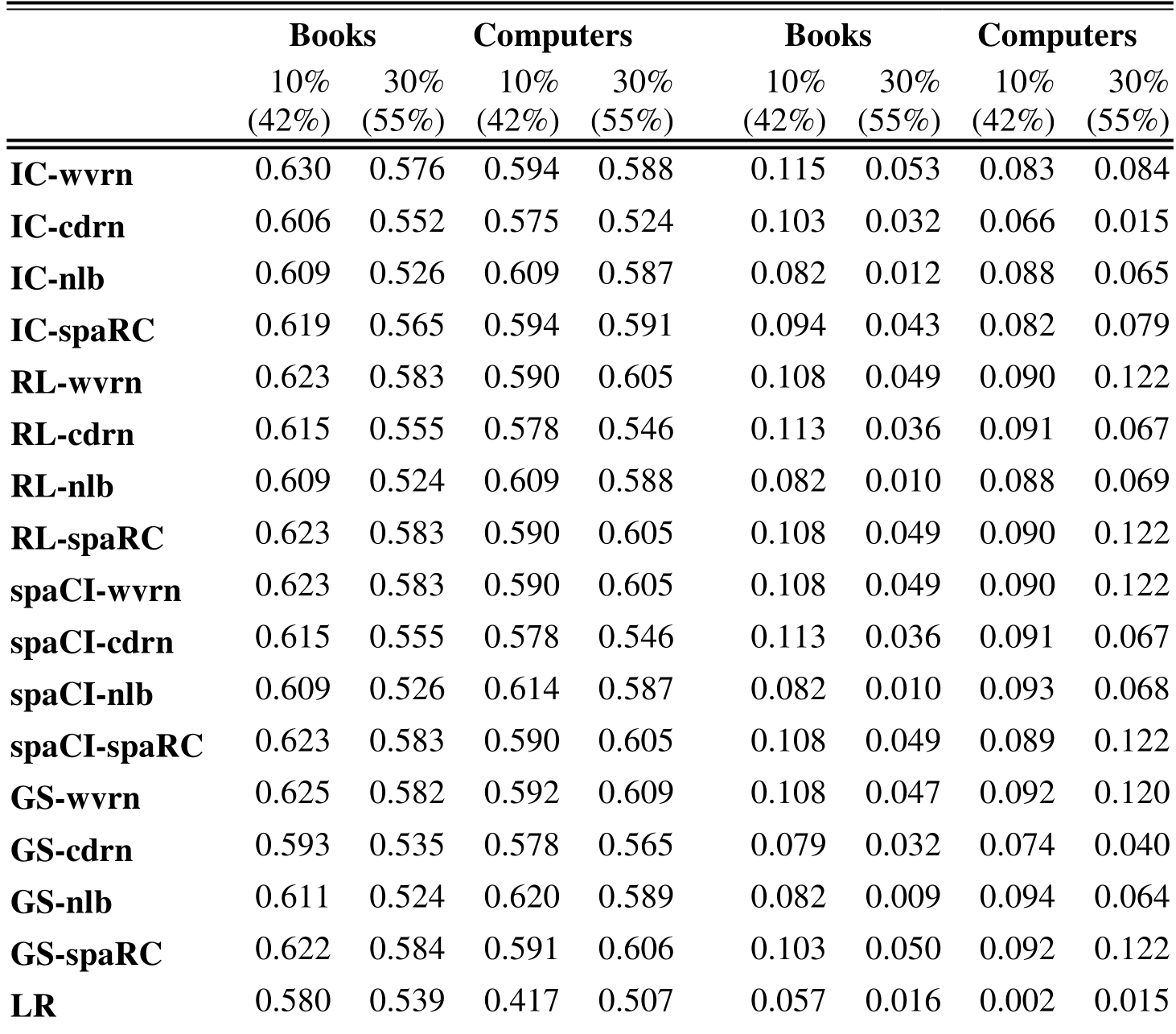 Table 3: Comparative performance. Note how LR (the bottom row) fails significantly compared to networked approaches, especially for the 'Computers' category.
Key Findings:
- Network Superiority: In almost every scenario, the network-only models beat the attribute-heavy LR model.
- Stability: Relational classifiers remained robust across different product types (Books vs. Computers), whereas LR's performance fluctuated wildly (dropping to an AUC of 0.417 for computers—worse than a random guess).
- H-Measure Gains: Using the H-measure (which accounts for misclassification costs in business), the social network models proved significantly more "profitable" for potential marketing campaigns.
Critical Analysis & Business Takeaways
This paper serves as an empirical justification for "Friends of Fans" advertising.
The "Latent" Secret
The fact that these models worked without a local model (without knowing the person's age or hobbies) suggests that social structure captures a "latent" influence that participants themselves might not even realize exists.
Limitations
While powerful, the study is limited by its sample size and the specific student-parent network structure. Furthermore, it treats "intent" as a proxy for "action." However, the signal is clear: in the digital age, a customer's location in a social graph is a higher-value feature than their demographic profile.
Future Outlook
The next step for this research is the integration of Hybrid Models—combining the best of individual attributes with the power of relational data. For practitioners, the message is simple: Stop asking who your customers are; start looking at who they know.