
CFTN: Bridging the Gap Between Social Trust and Collaborative Filtering
Social Network Collaborative Filtering Framework and Online Trust Factors: a Case Study on Facebook
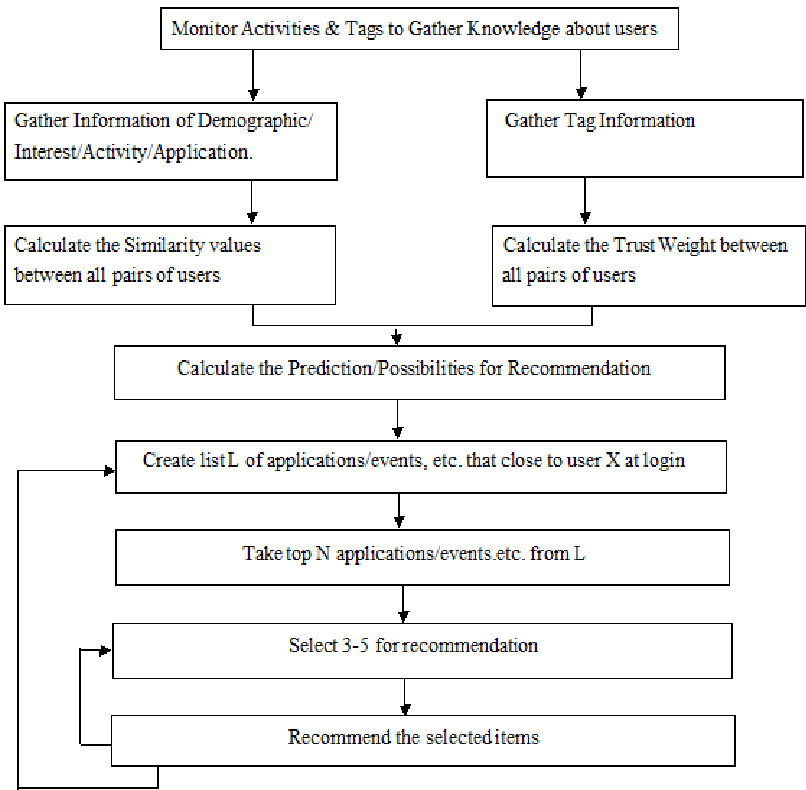
This paper proposes the Collaborative Filtering Trust Network (CFTN), a recommender framework that integrates quantitative trust factors into traditional Collaborative Filtering (CF). By leveraging data mining on Facebook user surveys, the authors establish a weighted model for "Trust by Relation" and "Trust by Reputation" to enhance recommendation accuracy.
TL;DR
The research introduces the Collaborative Filtering Trust Network (CFTN), a framework that moves beyond simple user-item similarity by embedding a quantitative "Trust" layer. By applying C4.5 decision trees and association rules to Facebook data, the authors transform "fuzzy" social relationships into mathematical weights that significantly refine the quality of automated recommendations.
Background: The "Social" in Recommender Systems
While Collaborative Filtering (CF) is the backbone of modern recommendation engines, it historically operates in a vacuum, ignoring the nuanced social fabric of platforms like Facebook. The core intuition of this paper is that a recommendation from a family member or a close colleague carries more weight than one from a casual digital acquaintance. The challenge? Quantifying that trust without asking the user to manually rate all their friends.
Methodology: Quantifying the Ineffable
The authors propose two primary axes for trust:
1. Trust by Relation (The Topology)
This utilizes the "jump count" or degrees of separation between nodes in a social graph. Trust is modeled as a decaying function based on distance:
- Tier 1: Immediate family (Strongest trust).
- Tier 6+: Public/Strangers (Minimal trust).
2. Trust by Reputation (The Behavior)
This is the paper’s most significant contribution. Instead of guessing which features matter, the authors used Data Mining to analyze the "Trace of Activities" users leave behind.
The Weighted Similarity Equation
The similarity is no longer just about common interests. It is a sum of weighted attribute differences:
Where are not arbitrary but are derived from Lift Charts generated during decision tree induction.
Key Findings: What Actually Drives Trust?
Through a case study on Facebook survey data, the authors broke down trust into four categories: Profile, Privacy, Intra-activity, and Inter-activity.
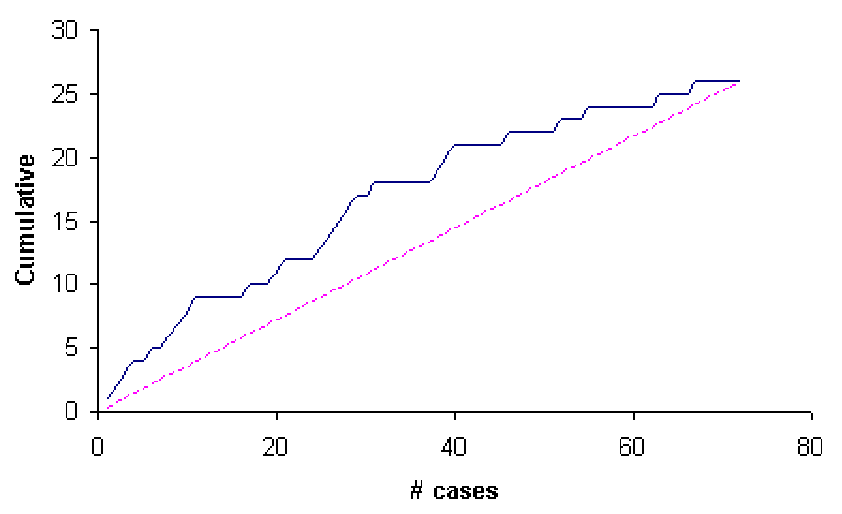
Using Lift Charts, they measured the "area under the curve" to determine which category provides the most predictive power for trust:
- Profile (32.6%): Updating info and listing significant others are high predictors.
- Privacy (24.5%): How a user manages their visibility reflects their trust level.
- Inter-activity (22.5%): Reciprocal "Pokes" and responded messages are high-confidence indicators (90%+).
The Role of Association Rules
The study used the Apriori algorithm to find hidden patterns. For instance:
- Users who investigate profiles AND create groups have a 90% probability of creating shared events, signaling a high level of "active" trust.
- Trust is highly associated with "Reciprocation"—a message replied to is worth more than a message sent.
Critical Analysis & Conclusion
Takeaway
The CFTN framework successfully moves trust from a qualitative "feeling" to a quantitative "input." By using Data Mining (C4.5/Apriori), it discovers the inductive biases of social network users, allowing the recommender system to prioritize inputs from "Trusted" sources automatically.
Limitations
- Dynamic Decay: While the paper mentions decay in trust propagation, it assumes a relatively static trust state. In reality, trust fluctuates over time based on recent interaction frequency.
- Symmetry Assumption: The authors assume trust is symmetrical (if I trust you, you trust me). On social media, "fans" or "followers" often exhibit highly asymmetrical trust relationships.
Future Outlook
As we move toward Web 3.0 and decentralized social graphs, the ability to derive trust from metadata without infringing on content privacy (via Reputation-based metrics) will be the "holy grail" of personalized discovery.
Editor's Note: This paper serves as a foundational bridge between sociological trust theories and hard-coded engineering algorithms, reminding us that in social networks, who is talking is often as important as what they are saying.