
Deciphering Digital Tribes: Clustering Social Communities Through Graph Sparsification and GMDH
Identification of the Clusters of Social Network Communities for Users with a Specific Characteristic
This paper presents a framework for identifying and clustering social network communities based on shared user characteristics (e.g., student status). Utilizing the Group Method of Data Handling (GMDH) and K-medoids clustering on a graph of 24,129 VKontakte groups, the authors successfully isolated professional interest clusters from general entertainment ones.
TL;DR
Researchers from Kazan Federal University have developed a robust methodology to categorize social network communities by analyzing the subscription patterns of specific user groups. By transforming raw VKontakte (VK) data into weighted graphs and applying the Group Method of Data Handling (GMDH) alongside K-medoids clustering, they achieved 75% accuracy in predicting professional interests and discovered a clear spatial separation between "recreational" and "educational" digital behaviors.
Background & Motivation: Moving Beyond Surveys
In economics and sociology, understanding the interests of a specific demographic usually requires mass polling—a process that is costly and prone to response bias. This paper posits that social network subscriptions are a "probabilistic proxy" for real-world interests. However, the data is messy: with over 24,000 groups for just 1,000+ students, the resulting graph is overwhelmingly dense, making it nearly impossible to distinguish meaningful professional clusters from ubiquitous entertainment groups.
The Core Challenge: Cutting the Noise
The researchers faced a fundamental "graph visualization and analysis" problem. A graph with an average node degree of ~299 (where almost every community is connected to every other) is effectively noise. To solve this, the authors experimented with two critical components: Similarity Metrics and Sparsification.
1. The Similarity Toolbox
They evaluated four ways to measure the "closeness" of two communities (A and B):
- Jaccard Index: Takes the union of groups into account, penalizing pairs where one group is much larger.
- Braun-Blanquet/Overlap: These normalize based on the size of the smaller or larger set, making them better at finding sub-communities.
- Affinity Index: Estimates whether a user's presence in two groups is independent or correlated.
2. Strategic Graph Pruning
To make clustering feasible, they tested three conversion methods:
- Threshold Cut-off: Hard removal of edges below a certain weights.
- Local Sparsification: Keeping only the "top-N" most relevant edges for each node, ensuring connectivity while reducing density.
- Non-linear Sampling: Using a probability function to favor the preservation of high-weight edges.
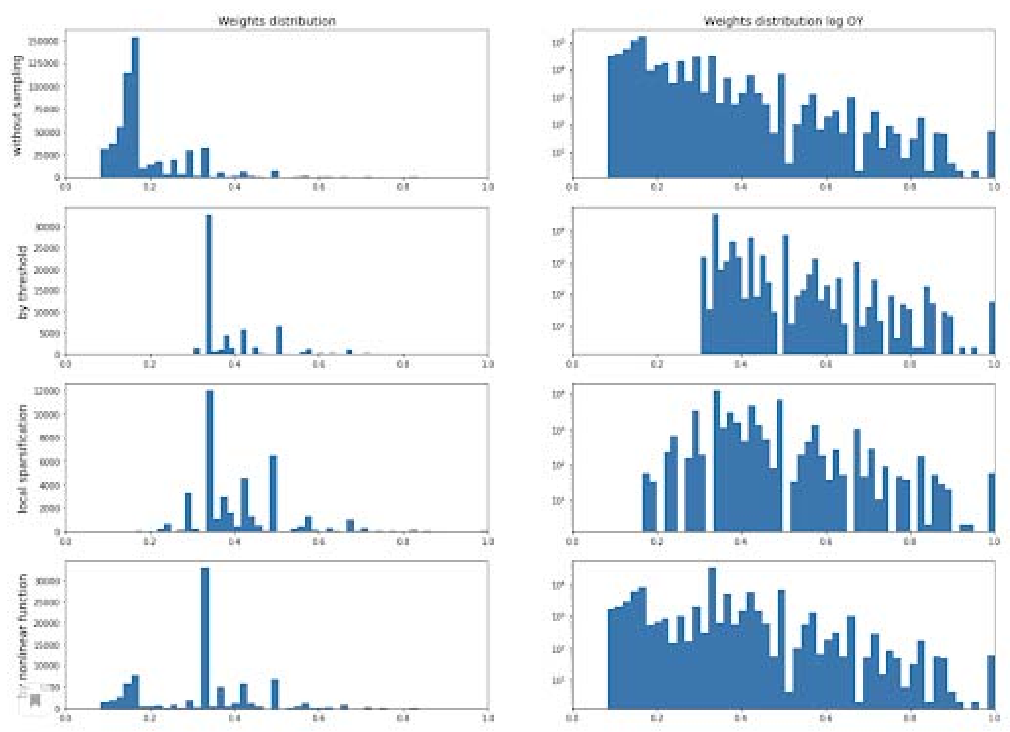 Figure: Comparison of Jaccard vs. other coefficients in weight distribution.
Methodology: From Graphs to Predictions
The authors employed the Group Method of Data Handling (GMDH). Unlike standard regression, GMDH iteratively builds a model by selecting the most informative variables (communities) to predict the output (membership in a target group).
For clustering, they chose K-medoids. Unlike K-means, which calculates centroids in continuous space, K-medoids selects actual nodes as centers. This is crucial for social networks where "average" hypothetical nodes don't exist; a cluster must be centered around an actual, influential community.
Key Results: Professional vs. Personal
The analysis of 1,168 undergraduate students revealed a fascinating dichotomy in virtual behavior:
- Professional Clusters: A distinct "Yellow" and "Blue" cluster emerged, containing programming forums (PHP, JS, Python), CyberForum, and self-development groups.
- Personal Clusters: Large "Orange" and "Green" clusters dominated by beauty, humor, and hobbies.
- Spatial Separation: When visualized, educational and professional communities grouped together at the bottom of the graph, while entertainment interests occupied the upper regions, suggesting a low overlap in how users engage with "fun" vs. "work" content.
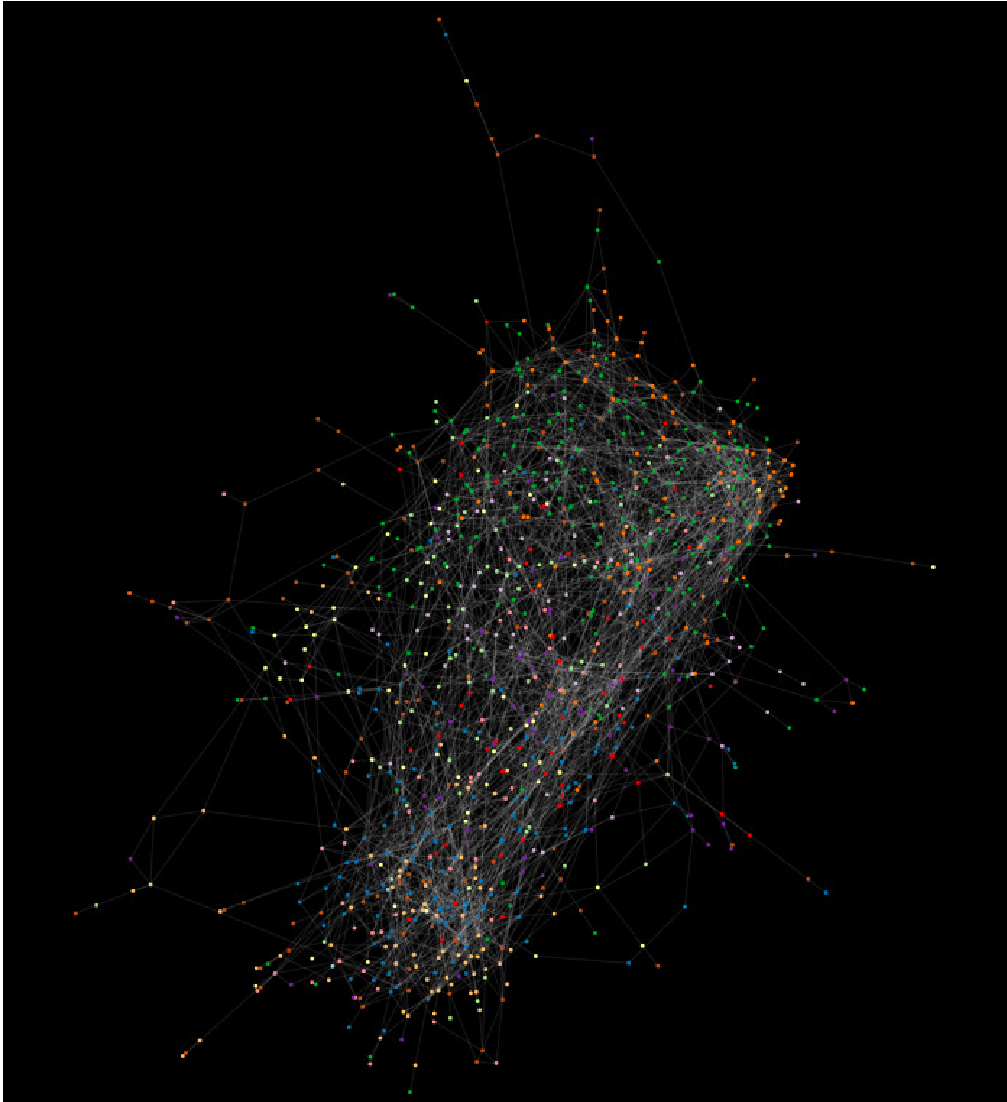 Figure: The final clustered graph showing the distinct professional (bottom) vs. lifestyle clusters.
Final Verdict & Future Outlook
This work demonstrates that social media isn't just a monolith of distractions; it contains structured professional ecosystems. The 75% accuracy in predictive modeling proves that digital footprints are highly reliable predictors of professional identity.
Takeaway: Future psychometric models could use these clusters as "predictors" of life activity. By seeing which "community cluster" a teenager gravitates toward, we might one day predict their professional success or academic trajectory with high precision.
Limitations: The study is localized to a single university (Kazan Federal University) and a single platform (VK). Cross-platform validation (LinkedIn vs. Facebook) would be the logical next step to prove the universality of these interest clusters.