
Ask and You Shall Receive? The Hidden Gatekeepers of the Job Search
Ask and you shall receive: Social network contacts’ provision of help during the job search
This study investigates the "contact side" of job networking, examining the factors that influence whether social network contacts are able and willing to help job seekers. Using a representative dataset from Washington State, it identifies that while 78% of contacts are able to help and 92% are willing, provision of support is significantly stratified by the contact's gender, employment status, and their perception of the job seeker’s work ethic.
TL;DR
We often hear that "it’s not what you know, but who you know." However, this study flips the script by focusing on the contacts rather than the job seekers. It reveals that while most people want to help, their ability to do so is limited by their own status (gender and employment), and their willingness is strictly guarded by their perception of the seeker's "work ethic."
Background: Moving Beyond the "Successful" Seeker
Most academic work on job networking is biased toward success stories—people who already found jobs through referrals. This paper identifies a critical gap: what about the people who ask for help and get a "No" or a "I don't know anyone"? To understand labor market inequality, we must look at the contact as a gatekeeper.
Problem & Motivation: The Barriers to Social Capital
The author argues that social capital involves two distinct steps:
- Accessing: Finding a contact who actually has the info or influence (Ability).
- Mobilizing: Convincing that contact to actually use their reputation to help you (Willingness).
Existing theories, like the "Strength of Weak Ties," suggest acquaintances provide better info than close friends. But this paper challenges that: if a weak tie doesn't know your work history well, they might be unable or afraid to help you, making the "weak tie" useless in practice.
Methodology: The Contact's Perspective
The researcher used the Social Networks and Employment Assistance Survey (SNEAS), targeting 350 individuals who were recently asked for job help. This allows for a direct measurement of the contact’s demographic status and their internal reasoning.
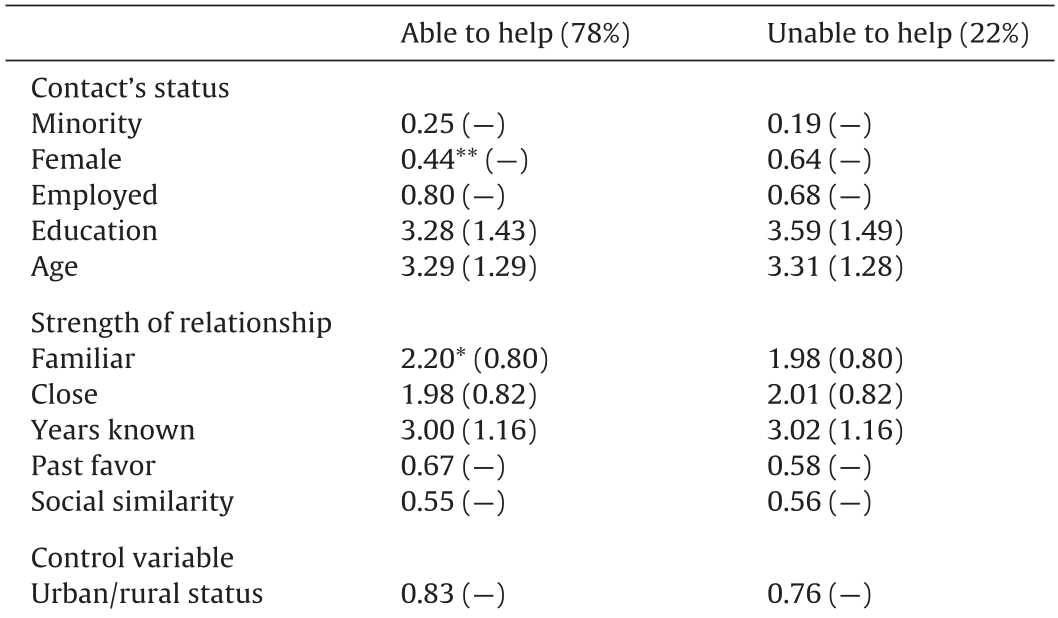
Key Findings: Who Can Actually Help?
1. The Gender and Employment Gap in "Ability"
The study found that men and employed individuals are significantly better positioned to provide job leads.
- Gender: Women are often concentrated in lower-ranking occupations with less hiring authority, which limits their access to valuable "insider information."
- Employment: If you aren't currently in a workplace, your "resource pool" for new job openings dries up quickly.
2. The Power of the "Good Worker" Signal
When it comes to willingness, demographics mattered less than reputation. If a contact believes a job seeker has a strong work ethic and is trustworthy, the likelihood of them providing help skyrockets by over 400%.
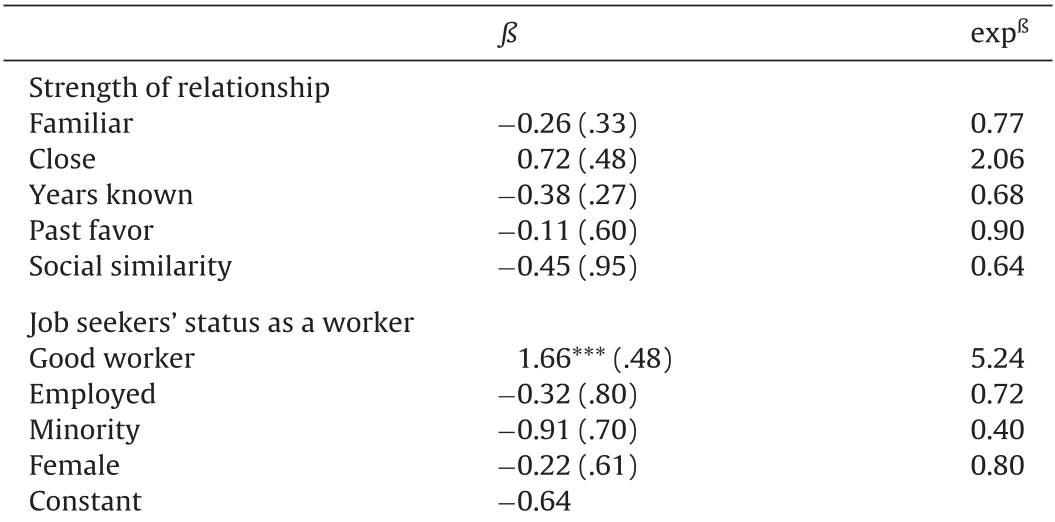
Deep Insight: The Risk of the Referral
Why are people so hesitant to help "bad workers"? It’s about Reputational Risk. Giving a recommendation is essentially "lending" your reputation to someone else. If the job seeker fails, the contact loses status at their own company. This is why networking reinforces inequality: those already marginalized (the long-term unemployed or those with "spotty" records) find it hardest to get anyone to take a risk on them.
Conclusion & Reflections
- Networking is not equitable: If you rely on a network of female or unemployed contacts, your search will be statistically less productive regardless of your own talent.
- Familiarity is key: Contrary to some theories, being familiar with a seeker's qualifications is a major driver of whether a contact actually knows how to help.
The Takeaway: For job seekers, merely "having a big network" isn't enough. You must ensure your contacts understand your specific skills (increasing their ability) and perceive you as a low-risk investment (increasing their willingness).