
Social-Network Defense: Thwarting Whitewashing with Routing Intelligence
A social-network defence against whitewashing
This paper introduces a social-network-based defense mechanism for Trust Assessment Mechanisms (TAM) in Multiagent Systems (MAS) and P2P networks. By integrating trust assessment directly into a social-network-based routing protocol, the method (RBR) effectively identifies and blocks malicious agents attempting "whitewashing" attacks.
TL;DR
Whitewashing—the act of discarding a tarnished digital identity to start fresh—remains one of the most persistent "cheap talk" problems in P2P and Multiagent Systems (MAS). This paper proposes a decentralized defense that integrates trust assessment directly into a social-network routing layer. By making interaction a privilege granted by "neighbor" agents, the system makes identity-resetting fruitless and reduces communication overhead by several orders of magnitude compared to SOTA benchmarks like PeerTrust.
The "Cheap Identity" Problem
In most open decentralized systems, creating a new ID costs nothing. Malicious agents exploit this: they cheat until their reputation is ruined, then "whitewash" by creating a new identity. Traditional Trust Assessment Mechanisms (TAMs) fail here because they treat a new agent as a "blank slate" rather than a potential threat. Furthermore, querying global feedback to verify these agents creates a massive message overhead that scales poorly as the network grows.
Methodology: Trust as a Routing Gatekeeper
The authors' central insight is that trust should not be global; it should be structural. Instead of allowing any agent to contact another, all interaction requests must flow through a path in a social network.
1. The Routing Protocol
When an agent wants to interact, the request travels through "contacts." Each router in the middle has a choice: forward, re-route, or block the request. If a request leads to a bad interaction, the feedback flows back only to the routers on that specific path.
2. The Multi-path Trust Formula
The core of the defense is the modification of the PeerTrust metric. If an agent is assessing an unknown target , it looks at the set of routers that have forwarded the request. The trust is calculated by comparing the feedback of agents previously forwarded by those routers against 's own satisfaction criteria:
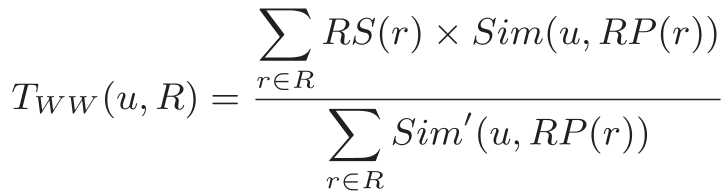
In this formula, measures how similar the router's past "referrals" are to what considers good behavior. If a router constantly "vouches" for whitewashers, its similarity score drops, and the requests it forwards are blocked.
Experimental Battleground
The researchers compared their approach (RBR) against the original PeerTrust in three scenarios:
SOTA Comparison: Effectiveness vs. Efficiency
The results revealed a fascinating trade-off:
- Simple Cheating: PeerTrust wins (96.8% vs 68.7% reduction) because it has access to more global information.
- Collusion: RBR significantly outperforms PeerTrust (78.2% vs 58.7%). Large-scale collusion feedback is usually "noisy" and scattered, but RBR concentrates on the routers actually facilitating the interactions.
- Whitewashing: This is the knockout blow. PeerTrust provided zero protection, while the Social-Network defense reduced bad interactions by 27.1%.
Complexity Explosion
The most striking result is the message overhead. PeerTrust requires messages to keep reputations updated. In empirical tests, this resulted in nearly 20 million messages per agent in some rounds. Contrarily, the Social-Network RBR stayed at roughly 7-8 messages, representing a jump in efficiency that makes the system actually deployable in real-world MANETs.

Critical Insight & Future Directions
The "Privacy of Feedback" is a double-edged sword. By limiting who sees feedback, you protect against massive collusion and simplify the network. The cost is slower learning during "simple" attacks.
Future Outlook: The authors suggest making the social network dynamic—where routers that facilitate successful interactions become "hubs." This would effectively evolve the network topology toward a high-trust, "Scale-Free" structure, further hardening the system against bad actors.
Final Takeaway
If you want to solve whitewashing, don't build a better database; build a better social structure. This paper proves that routing-based trust is not just a security feature—it's a massive scalability optimization.