
Behind the Megaphone: Decoding the Social Network of Extreme Tweeters
Social Network of Extreme Tweeters: A Case Study
The paper presents a case study on "Extreme Tweeters" (ETT), identifying a subset of "Anomalous Users" who exhibit high posting frequency but low topic diversity. By using Randomized SVD to measure "Interest Narrowness," the authors reveal how these users form clannish, tightly-knit social structures, particularly during major events like the 2018 US Midterm Elections.
TL;DR
In the vast ocean of Twitter, a small group of users—Extreme Tweeters (ETT)—drowns out the rest. This paper identifies a specific sub-category: Anomalous Users, who post incessantly but talk about almost nothing. By leveraging Singular Value Decomposition (SVD) and -core network analysis, the researchers uncover a "clannish" behavior where these users form hyper-dense clusters to synchronize messages, especially during heated political events.
The "Low Diversity" Paradox
Typically, the more a person talks, the more topics they cover. However, the authors observed a cluster of users who break this rule: high frequency, low diversity. Why would someone tweet hundreds of times a week about a single narrow topic? To solve this, the authors moved beyond simple word counts to a more robust mathematical definition of "Interest Narrowness."
Methodology: Measuring Interest with SVD
The core innovation is the Interest Narrowness () metric.
- Matrix Construction: For each user, a matrix is built where rows are tweets and columns are terms.
- SVD Approximation: Using Randomized SVD, the authors calculate how much of the "information energy" (Frobenius norm) is concentrated in the top singular values.
- The Formula: A higher value indicates the user is hyper-focused on a few specific themes, effectively filtering out the "noise" of diverse human conversation.
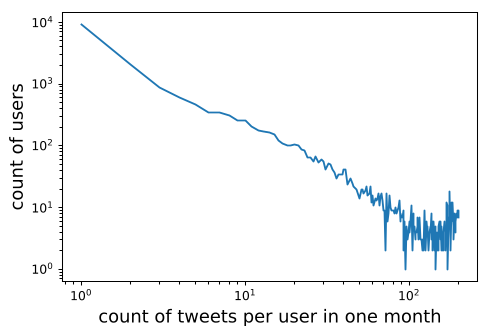 Fig 1: Classification of users based on tweet volume vs. content diversity (Note the red 'anomalous' cluster).
Connectivity: The Clannish Network
The study analyzed the social ties of these anomalous users across three tiers:
- Type-I: Interactions only among anomalous users.
- Type-II: Including interactions with other Extreme Tweeters.
- Type-III: The full ego-network including regular users.
By using -core decomposition, the researchers found that during the 2018 US Midterm Elections, these anomalous users didn't just tweet more—they banded together.
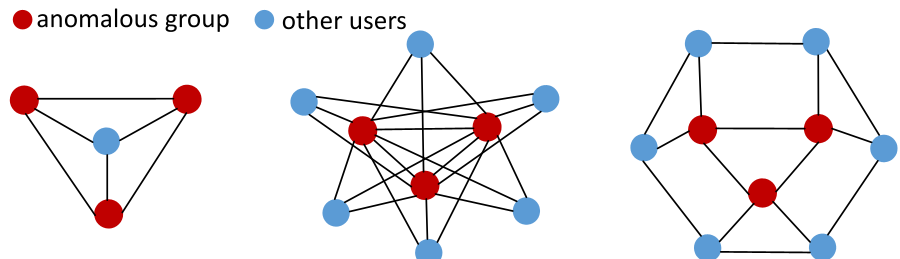 Fig 2: CCDF of coreness showing the surge in interaction density (red/purple lines) during the election week.
Key Findings: Diverse vs. Uniform Behavior
The authors identified two distinct types of anomalous groups:
- Group I (The Echo Chamber): High Common Neighbor Ratio (CNR). These users act in unison, mentioning the same small set of people using a very uniform set of hashtags.
- Group II (The Amplifiers): High Diversity Ratio (DR). They mention a vast range of outside users but maintain a different, specialized set of hashtags for internal group communication.
| Metric | Group I (Pre-Election) | Group II (Post-Election) |
|---|---|---|
| Coreness | High (56-72) | Lower (13) |
| Behavior | Collaborative/Internal | Diverse/Outreach |
Critical Insight: The Trust Network
The most striking takeaway is the "clannish" nature of these accounts. Within their own circles, they use specific "group hashtags" (like #UnitedVoteRed) with high frequency. When they interact with the public, they switch to a more "diluted" hashtag strategy. This suggests a sophisticated level of content control, acting as a "trust network" that maintains internal purity while attempting to influence the broader public discourse.
Conclusion & Future Work
The study proves that "Anomalous Users" are not just random loud voices; they are structurally distinct components of the social network. While the paper focuses on political tweets, the methodology provides a scalable way to identify bots or coordinated "human-cyborg" teams that manipulate digital debates. Future research will likely explore if these patterns hold across different languages and cultural contexts.