
wSVS: Engineering Strategic Firewalls to Contain Social Influence
On social network firewall selection
The paper introduces the weighted Segregating Vertex Set (wSVS) problem, a two-player competitive framework designed to contain the spread of influence in social networks. The core objective is to identify a minimum-weight "firewall" (vertex separator) that ensures the first player's reach is strictly less than half of the network's total weight.
TL;DR
In a competitive social network, how do you prevent a rival's influence from capturing the majority of the market with minimum cost? This paper introduces the weighted Segregating Vertex Set (wSVS) problem, a novel framework for selecting a "firewall" of nodes that isolates a competitor's reach to less than 50% of the network. The authors prove this is NP-complete and offer both an optimal MILP solution and an efficient LP-based heuristic.
Background & Positioning
Information diffusion in Online Social Networks (OSNs) is a battlefield. Whether it's product adoption, the spread of an epidemic, or a forest fire, the goal is often containment. While prior work like Influence Maximization focuses on growth, and Influence Blocking focuses on general reduction, wSVS targets a specific strategic threshold: Majority Control. It positions itself as a critical tool for any entity—brand, health official, or network admin—that needs to ensure a rival never crosses the 50% "dominance" line.
Problem & Motivation: The Battle for the Majority
The authors identify a gap in existing literature: most blocking models don't guarantee that the containment is sufficient to maintain a majority share. In a real-world scenario—say, competing car manufacturers—if Player A captures over 50% of the market, Player B loses the leader status.
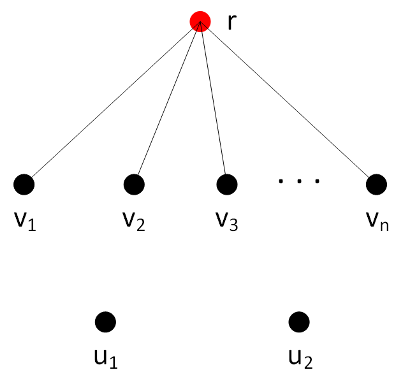
The wSVS problem treats this as a Vertex Separator challenge. We are given a set of people already won over by Player A (the seedset). We must then pick a separator set such that once is removed, the remaining nodes reachable by Player A have less total weight than the nodes beyond their reach. The challenge lies in the Inductive Bias that each node has a unique weight (utility/cost), making a simple cardinality-based cut insufficient.
Methodology: From MILP to Heuristics
The authors first define the problem mathematically using Mixed Integer Linear Programming (MILP).
1. Optimal Formulation
The objective is to minimize the weight of the separator: Subject to:
- No edges between components (reachable) and (unreachable).
- .
- The containment constraint: .
2. Heuristic Insight: LP Relaxation
Since solving MILPs is computationally expensive, the authors propose an LP Relaxation approach. They solve the linear program by allowing and to be fractional. The heuristic's "secret sauce" is its node selection strategy: it prioritizes nodes where the value is highest. This represents the "fraction" of a node that the LP considers most useful for a cut.
Experimental Evidence
The methodology was tested against three network topologies:
- Barabasi-Albert: Modeling scale-free social properties.
- Erdos-Renyi: Serving as a random baseline.
- Watts-Strogatz: Representing "small-world" high-clustering networks.
- Facebook Dataset: A real-world graph with ~4,000 nodes.
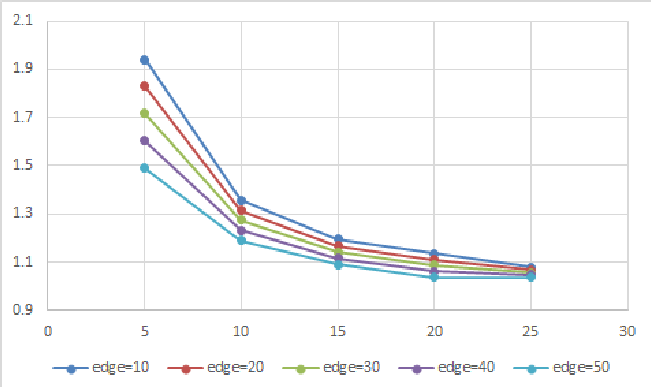
The results consistently showed that the heuristic (plotting the ratio of heuristic weight to optimal weight) hovered within a factor of 2 of the absolute optimal, while resolving significantly faster.
Critical Insight & Future Outlook
The wSVS problem is a major step forward for strategic defense in networks. Its NP-completeness proof (linked to the Set Partition Problem) highlights the complexity of balancing weights.
Takeaway: If you are defending a network from influence, you don't need to block everyone; you only need to strategically immunize the fractional "bridges" identified by an LP-relaxed cut.
Limitations: The model currently assumes a static undirected graph. In real social media, edges are often directed and influence is probabilistic. Integrating the wSVS constraint into a Continuous-Time Diffusion Model would be the logical next step for this research.